


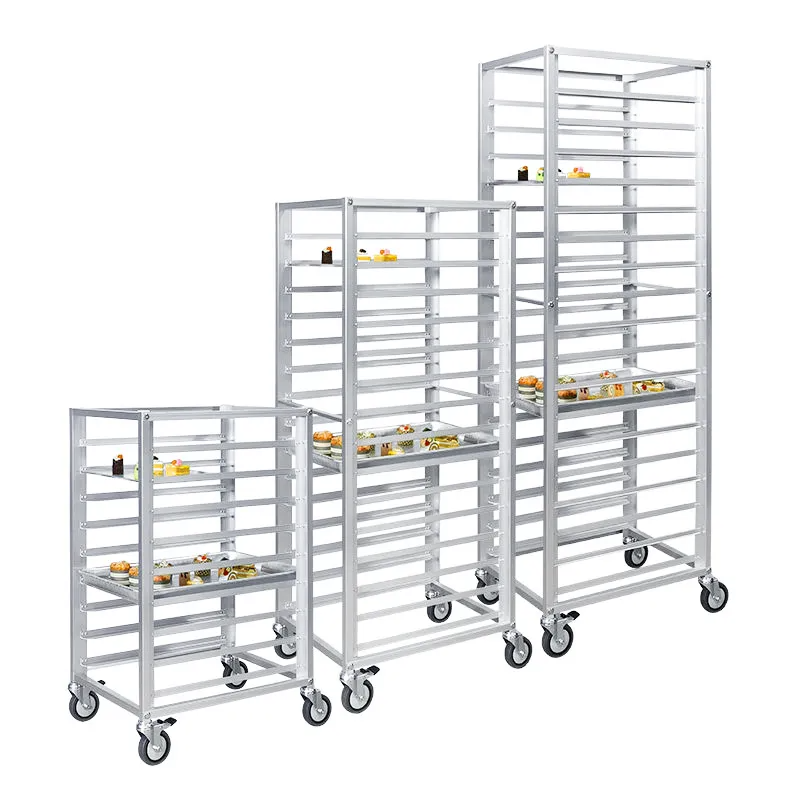
304 Stainless Steel Bakery Trolley: The Ultimate Guide for B2B Buyers
Product Introduction: What Is a 304 Stainless Steel Bakery Trolley?
A 304 stainless steel bakery trolley is a specialized wheeled rack designed for transporting bakery products, ingredients, and tools within commercial kitchens and food processing facilities. Typically constructed from food-grade 304 stainless steel, these trolleys are engineered to withstand the rigors of daily industrial use while maintaining strict hygiene standards. Unlike standard utility carts, bakery trolleys often feature multiple tiers, mesh or solid shelves, and robust casters to handle heavy loads of dough, baked goods, or trays. They solve critical problems: reducing manual handling injuries, optimizing workflow between proofing, baking, and packaging areas, and preventing contamination. For B2B buyers, selecting the right trolley means balancing load capacity, maneuverability, and corrosion resistance to match specific production lines.
Product Features: Engineering for Industrial Performance
When evaluating a 304 stainless steel bakery trolley, procurement teams should focus on design elements that directly impact longevity and efficiency.
- Reinforced Frame Structure: The load-bearing capacity of a trolley is determined by its frame. High-quality units use fully welded square tubing rather than bolted joints, which improves load stability during repeated transportation and industrial handling. Look for cross-bracing or gusseted corners to prevent racking under dynamic loads.
- Material Advantage – 304 Stainless Steel: 304 grade offers an optimal balance of corrosion resistance, formability, and cost. It resists attack from most bakery ingredients (sugar, salt, acids) and withstands frequent washdowns with mild detergents. For environments with chlorides or high humidity, 316 stainless steel is superior, but 304 remains the industry standard for general bakery use.
- Performance Characteristics: Key features include swivel casters with brakes for precise positioning, ergonomic push handles at optimal height, and smooth, crevice-free surfaces to prevent bacterial traps. Shelves may be solid, perforated, or wire mesh—each affecting airflow and cleanability.
Application Scenarios: Where 304 Stainless Steel Bakery Trolleys Excel
These trolleys are not confined to bakeries; their versatility spans multiple industries:
- Food Processing: Transporting raw ingredients, finished products, and waste. The 304 stainless steel construction complies with FDA and EU food-contact regulations.
- Bakery & Confectionery: Moving dough troughs, bread trays, and cake racks between proofers, ovens, and cooling areas. Mesh trolleys allow even air circulation for cooling.
- Industrial Manufacturing: Used as mobile workstations for assembly, parts storage, and tool transport where hygiene is secondary but durability is paramount.
- Cleaning & Sanitation: Holding dirty dishes, utensils, or cleaning supplies in commercial kitchens and hospitals. The corrosion resistance withstands steam and chemicals.
- Drying & Storage: As a drying rack for washed parts or as a mobile storage unit for inventory. Stackable designs save floor space.
- Transportation: Linking production stages, shipping docks, and cold storage. Heavy-duty casters handle thresholds and uneven floors.
Material Specification: Choosing Between 304, 316, 201 Stainless Steel and Aluminum
Understanding material trade-offs is essential for cost-effective procurement.
- 304 Stainless Steel: Contains 18% chromium and 8% nickel. Excellent corrosion resistance, good formability, and weldability. Ideal for most bakery environments. Cost-effective for high-volume production.
- 316 Stainless Steel: Adds 2-3% molybdenum, enhancing resistance to chlorides and acids. Recommended for coastal areas or facilities using aggressive sanitizers. Typically 20-30% more expensive than 304.
- 201 Stainless Steel: Lower nickel content, replaced with manganese. Offers moderate corrosion resistance at lower cost, but less durable in wet or chemical environments. Suitable for dry storage or light-duty applications.
- Aluminum: Lightweight and corrosion-resistant (naturally forms oxide layer), but softer and prone to denting. Not recommended for heavy loads or high-hygiene zones. Often used for economy trolleys.
For most B2B bakery applications, 304 stainless steel provides the best lifecycle value.
Specification Parameters: What Buyers Need to Confirm
When requesting quotes, specify these parameters to ensure the trolley matches your operation:
- Dimensions: Overall length, width, height (e.g., 1200mm x 600mm x 1700mm). Height should allow easy loading/unloading without bending.
- Thickness: Tube wall thickness (e.g., 1.2mm, 1.5mm, 2.0mm) and shelf thickness (e.g., 0.8mm, 1.0mm). Thicker gauges increase load capacity and durability.
- Capacity: Static and dynamic load ratings (e.g., 200kg, 500kg). Dynamic rating is lower due to rolling forces.
- Number of Tiers: Single, double, or multi-tier. More tiers increase capacity but reduce accessibility.
- Load Capacity per Shelf: Uniformly distributed load (UDL) rating. Ensure even loading to prevent deformation.
- Hole Diameter & Mesh Size: For perforated shelves, hole diameter (e.g., 5mm, 10mm) affects airflow and small-item retention. Mesh opening (e.g., 25mm x 25mm) is common for bakery trays.
- Tray Compatibility: Shelf spacing must accommodate standard bakery tray sizes (e.g., 600mm x 400mm, 18" x 26"). Confirm pitch between shelves.
- Surface Finish: Brushed, polished, or mirror finish. Brushed is standard for industrial use; polished offers easier cleaning but shows scratches.
- Caster Type: Swivel, rigid, or brake. Wheel material (polyurethane, nylon, rubber) affects floor protection and noise.
Customization Services: OEM/ODM Capabilities from a Reliable Manufacturer
Off-the-shelf trolleys rarely fit every production line. A capable manufacturer should offer:
- Custom Size: Adjust width, height, and tier spacing to match your equipment and aisle widths.
- Custom Design: Modify frame structure, add hooks, bins, or specialized trays. Provide drawings or samples for reverse engineering.
- Logo & Branding: Laser-etch or attach stainless steel plates with your company logo for asset tracking.
- Packing: Custom crating for export, including moisture barriers and shock-absorbing materials to prevent transit damage.
- Special Requirements: ESD-safe casters for electronics, high-temperature wheels for oven unloading, or RFID tags for inventory management.
For custom requirements, please contact our team to discuss your project. We provide full OEM/ODM support from our factory.
Procurement Guide: How to Select the Right Trolley and Supplier
B2B buyers should follow a structured approach to avoid costly mistakes.
- How to Choose Size: Measure your narrowest aisle and doorways. Ensure trolley width leaves at least 100mm clearance. Consider turning radius with swivel casters.
- How to Choose Material: For wet, acidic, or high-hygiene zones, choose 304 or 316. For dry storage, 201 may suffice. Always verify material certificates (mill test reports).
- How to Confirm Specifications: Request a detailed drawing with tolerances. Ask for load test reports and material certs. Insist on a pre-production sample for critical applications.
- How to Judge Supplier Capability: Audit the factory (or request a video tour). Check for in-house welding, polishing, and assembly lines. Ask about production capacity (e.g., 500 units/month), lead times, and quality control procedures (e.g., dimensional inspection, load testing, salt spray testing).
Image ALT text suggestion: "304 stainless steel bakery trolley with mesh shelves and swivel casters in a commercial bakery."
FAQ: Common Questions from B2B Buyers
Q1: What is the typical lead time for a custom 304 stainless steel bakery trolley?
A: For standard sizes, 15-20 days. For custom designs, 25-35 days after drawing approval. Larger orders (500+ units) may require 45-60 days. Always confirm with your supplier.
Q2: Can I mix 304 and 201 stainless steel to reduce cost?
A: Yes, but not recommended for structural components. Using 201 for non-critical parts (e.g., handles) can save 10-15%, but 304 should be used for all food-contact surfaces and load-bearing frames to ensure hygiene and longevity.
Q3: How do I verify the material is genuine 304?
A: Request a mill test certificate (MTC) and use a stainless steel test kit (molybdenum test) or XRF analyzer. Reputable suppliers will provide these without hesitation.
Q4: What caster options are best for bakery environments?
A: Polyurethane wheels on swivel casters with brakes are ideal. They are quiet, non-marking, and resist flour, sugar, and water. Avoid rubber wheels for high-temperature areas.
Q5: Can the trolley be used in a freezer?
A: Yes, if specified. For freezer use, choose 304 stainless steel and low-temperature grease for casters. Avoid 201 due to embrittlement risks.
Q6: What is the maximum load capacity for a 304 stainless steel bakery trolley?
A: Standard models handle 200-300kg dynamic load. Heavy-duty models with reinforced frames and 2.0mm tubes can reach 500kg. Always derate by 20% for uneven floors.
Q7: Do you provide samples for evaluation?
A: Yes, we offer pre-production samples for a fee (refundable on bulk orders). Lead time for samples is 7-10 days.
Q8: How should I maintain the trolley for optimal lifespan?
A: Clean daily with mild detergent and warm water. Rinse and dry. Inspect casters monthly for debris. Lubricate swivel bearings quarterly. Avoid abrasive cleaners that scratch the passive layer.
SEO Meta Information
SEO Title: 304 Stainless Steel Bakery Trolley | B2B Manufacturer & Supplier
Meta Description: Durable 304 stainless steel bakery trolleys for food processing. Food-grade, custom sizes, OEM. Get a quote from a reliable manufacturer today.
SEO Keywords: 304 stainless steel bakery trolley, food-grade trolley, bakery cart manufacturer, stainless steel trolley supplier, custom bakery trolley, industrial food cart, 304 vs 316 stainless steel, bakery trolley specifications, OEM stainless steel trolley, B2B bakery equipment

