


316 Stainless Steel Bakery Equipment: The B2B Buyer’s Guide to High-Performance Food-Grade Systems
Product Introduction: What Is 316 Stainless Steel Bakery Equipment?
When we talk about 316 stainless steel bakery equipment, we are referring to a specialized range of food-grade machinery, racks, trays, mixers, and conveyor systems manufactured from an austenitic chromium-nickel alloy containing molybdenum. Unlike general-purpose stainless steel, this grade is engineered to withstand the aggressive chemical environments found in commercial bakeries, including exposure to high-salinity doughs, acidic fruit fillings, and harsh cleaning agents like chlorine-based sanitizers. The primary problem this equipment solves is premature corrosion and contamination risk in high-humidity, high-temperature production zones. For plant managers and procurement officers, investing in 316-grade equipment means reducing downtime caused by structural degradation and ensuring compliance with stringent FDA and EU food-contact regulations. It is not merely a purchase of hardware; it is an acquisition of long-term operational reliability.
Product Features: Why 316 Grade Outperforms in Industrial Baking
The structural design of professional bakery equipment prioritizes load stability and sanitation. Key features include:
- Molybdenum-Enhanced Corrosion Resistance: The addition of 2-3% molybdenum prevents pitting and crevice corrosion, particularly in chloride-rich environments. This is critical for equipment exposed to salty doughs or coastal bakery locations.
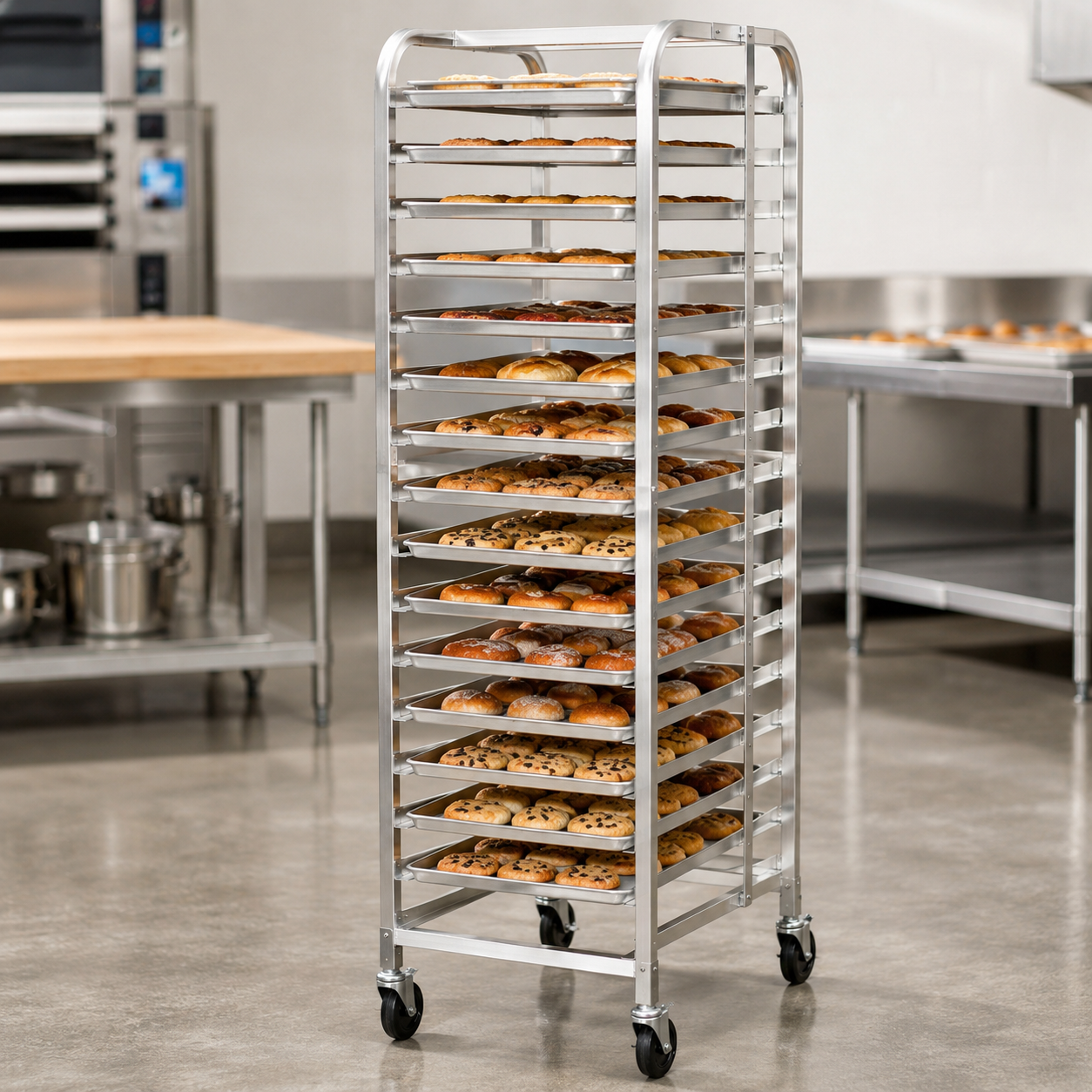
- Reinforced Frame Construction: Unlike consumer-grade racks, industrial 316 stainless steel bakery equipment utilizes fully welded, heavy-gauge tubular frames. This design improves load stability during repeated transportation and industrial handling, preventing sway and structural fatigue under static loads exceeding 500 kg.
- Hygienic Surface Finishes: We offer finishes from 2B (mill finish) to #4 (brushed) and #8 (mirror polish). These surfaces minimize bacterial adhesion and facilitate rapid cleaning, directly impacting your HACCP plan effectiveness.
- High-Temperature Tolerance: With a melting point range of 1375-1400°C, 316 stainless steel maintains structural integrity in oven environments up to 800°C for continuous operation, far exceeding the limits of aluminum or coated carbon steel.
These features are not marketing buzzwords; they are engineering choices that translate directly to lower total cost of ownership. For instance, a mixer bowl made from 316 stainless steel resists the abrasive action of dough hooks far longer than a 304 equivalent when processing high-salt rye or sourdough cultures.
Application Scenarios: Where 316 Stainless Steel Bakery Equipment Excels
This equipment is not universally required in every bakery. However, for specific high-demand applications, it is indispensable. Based on our experience supplying major industrial bakeries, here are the primary use cases:
Food Processing and Bakery Production
In high-volume bread and pastry lines, 316 stainless steel bakery equipment is used for mixing bowls, dough troughs, proofing cabinet frames, and conveyor belts. The material resists the corrosive effects of yeast metabolites and organic acids produced during fermentation. For laminated dough production, where dough temperatures must be tightly controlled, the low thermal conductivity of 316 stainless steel helps maintain consistent temperatures better than aluminum.
Industrial Manufacturing and Cleaning Systems
In automated cleaning (CIP) systems, equipment must withstand caustic soda and nitric acid solutions at elevated temperatures. Only 316-grade stainless steel can handle repeated exposure to these chemicals without stress corrosion cracking. We have seen 304 racks fail within 18 months in such environments, while 316 racks remain structurally sound after 5+ years.
Drying, Storage, and Transportation
For drying racks used in high-humidity proofers or blast freezers, 316 stainless steel prevents intergranular corrosion. In storage and transportation, stackable 316 racks with reinforced corner gussets ensure product safety during forklift handling and truck transit. A common procurement mistake is specifying 304 for freezer applications; the thermal cycling and condensation exposure make 316 a more reliable, albeit higher initial cost, choice.
Material Comparison: 304 vs. 316 vs. 201 vs. Aluminum
Understanding material differences is fundamental to smart procurement. Here is a technical breakdown:
- 304 Stainless Steel: General-purpose food grade. Good corrosion resistance but susceptible to pitting in chloride environments. Suitable for dry storage and low-acid contact.
- 316 Stainless Steel: Premium food grade with molybdenum. Superior resistance to chlorides, acids, and high-temperature cleaning. Ideal for meat processing, dairy, brewing, and high-salinity baking.
- 201 Stainless Steel: Lower nickel and higher manganese content. Reduced corrosion resistance. Often used in low-cost consumer racks. Not recommended for industrial bakery environments with frequent washing.
- Aluminum: Lightweight and thermally conductive. However, it reacts with acidic doughs, pits easily, and cannot withstand caustic cleaning. It also requires anodizing for food contact, which wears over time.
From a procurement perspective, the initial price difference between 304 and 316 is typically 20-30%. However, when you factor in replacement frequency, downtime, and contamination risk, the lifetime cost of 316 is often 40% lower over a 10-year period.
Specification Parameters: What to Specify in Your RFQ
When issuing a request for quotation, precise specifications prevent costly mismatches. Key parameters include:
- Dimensions: Standard rack sizes include 18x26 inches (half-sheet), 26x18 inches (full-sheet), and custom footprints. Specify overall height, width, and depth.
- Thickness: Tube wall thickness ranging from 1.2mm to 2.0mm. Heavier gauges (1.5mm+) are required for high-load applications.
- Capacity/Load: Static load capacity per shelf (e.g., 50 kg to 200 kg). Dynamic load capacity during transport.
- Number of Tiers: Typically 5 to 20 tiers. Specify spacing between shelves.
- Mesh/Perforation: Wire mesh aperture (e.g., 10mm x 10mm) or perforated plate hole diameter (e.g., 5mm). This affects airflow and cleaning.
- Surface Treatment: Electropolished, passivated, or pickled. Passivation is essential for 316 to maximize corrosion resistance after welding.
- Tray Compatibility: Confirm compatibility with standard 18x26 inch or 600x400mm baking trays.
Always request material test certificates (EN 10204 3.1) to verify the actual chemical composition of the steel.
Customization Services: OEM/ODM Capabilities
As a manufacturer with over 15 years of experience, we understand that standard products rarely fit every production line. Our factory offers comprehensive OEM and ODM services:
- Custom Size and Design: We can adjust dimensions, tier spacing, and load ratings based on your layout. Our engineering team uses CAD and 3D modeling to ensure fit.
- Logo and Branding: Laser-etch your company logo onto frame ends or side panels for brand identity.
- Special Packing: Export-grade packing with foam interleaves and reinforced cartons to prevent transit damage.
- Special Requirements: Anti-microbial coatings, static-dissipative wheels, and RFID tags for asset tracking.
For custom requirements, please contact our team to discuss your project. We provide rapid prototyping and sample validation before mass production.
Procurement Guide: How to Select the Right Equipment
Purchasing 316 stainless steel bakery equipment requires a strategic approach. Here are the critical questions to ask:
How to Choose the Right Size?
Measure your oven, proofer, and transport vehicle dimensions. Consider future expansion. A rack that fits perfectly today may become a bottleneck if you add a new oven next year. Standardize on one or two rack sizes to simplify logistics.
How to Choose the Right Material?
Use 316 for high-salt, high-acid, or high-humidity zones. Use 304 for dry storage and general transport. Never compromise on 316 for equipment that will be cleaned with chlorinated sanitizers.
How to Confirm Specifications?
Request a detailed drawing and material certificate. Verify weld quality (no burn-through, consistent penetration). Check that all edges are deburred and polished to prevent injury and bacterial traps.
How to Assess Supplier Capability?
Look for a factory with in-house tube milling, CNC bending, and automated welding. Ask for references from other industrial bakeries. A supplier who understands HACCP and FDA requirements is more valuable than one who simply offers the lowest price.
Frequently Asked Questions (FAQ)
Q1: Is 316 stainless steel magnetic?
316 stainless steel is generally non-magnetic in its annealed state. However, cold working (bending, welding) can introduce slight magnetism. This does not affect corrosion resistance or food safety.
Q2: Can I use 316 racks in a blast freezer?
Yes. 316 stainless steel maintains excellent toughness at cryogenic temperatures. It is actually preferred over 304 for freeze-thaw cycling because it resists stress corrosion cracking better.
Q3: What is the lead time for custom 316 stainless steel bakery equipment?
Standard lead time is 4-6 weeks for custom orders, depending on complexity and order volume. We offer expedited production for urgent projects.
Q4: Do you provide samples for testing?
Yes, we can provide a sample rack or tray for your validation. Sample costs are refundable upon a bulk order.
Q5: How do I clean and maintain 316 stainless steel equipment?
Use warm water, mild detergent, and a soft cloth. Avoid steel wool and chloride-based cleaners. For passivation, use a citric acid solution periodically. Always rinse and dry immediately after cleaning.
Q6: What is the minimum order quantity (MOQ)?
Our MOQ is typically 50 units for standard items and 10 units for custom designs. We support mixed container loading for distributors.
Q7: Can you provide FDA-compliant material certificates?
Absolutely. All our 316 stainless steel is sourced from certified mills and comes with full traceability, including FDA and LFGB compliance documentation.
Q8: How do you ensure packaging safety for international shipping?
We use heavy-duty corrugated cartons with foam corner protectors and steel strapping. For LCL shipments, we build custom wooden crates to prevent damage.
Image ALT Text Suggestions
For SEO optimization, use the following ALT text for product images:
- Image of 316 stainless steel bakery rack: "Industrial 316 stainless steel bakery rack with reinforced frame for high-load transport"
- Image of dough mixing bowl: "316 stainless steel mixing bowl for high-acid dough processing in commercial bakery"
- Image of cleaning system: "316 stainless steel CIP system components resistant to caustic cleaning agents"
SEO Meta Information
SEO Title: 316 Stainless Steel Bakery Equipment | B2B Industrial Supplier
Meta Description: Discover 316 stainless steel bakery equipment for high-corrosion environments. Specifications, material comparison, and OEM services for industrial buyers.
SEO Keywords: 316 stainless steel bakery equipment, industrial bakery racks, food-grade stainless steel, 316 vs 304 stainless steel, bakery equipment manufacturer, custom stainless steel racks, B2B bakery equipment supplier, high-corrosion food equipment

