





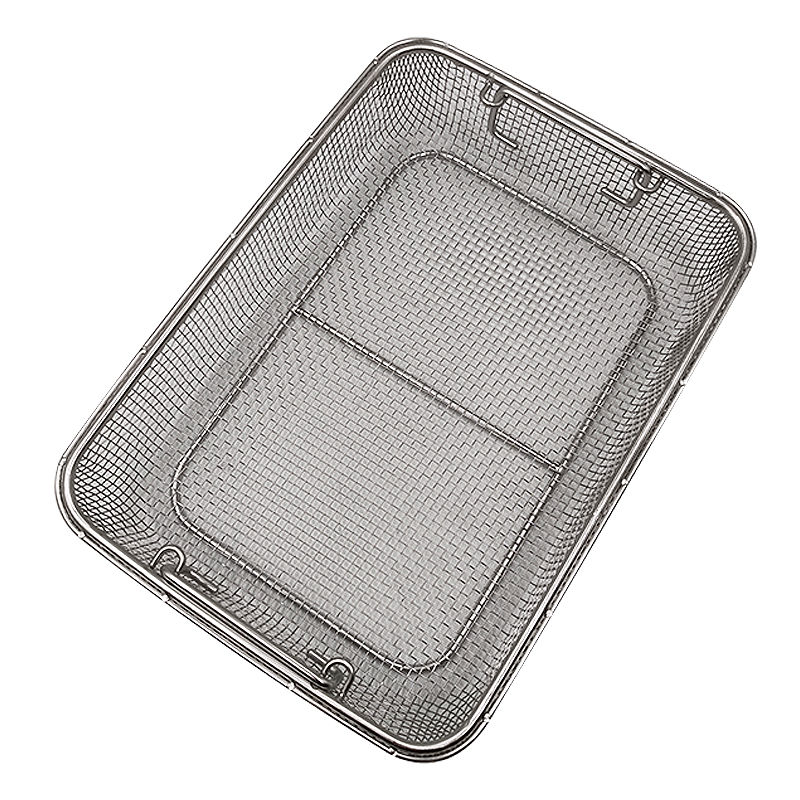
316 Stainless Steel Basket: Corrosion-Resistant & High-Temp Solutions
Why 316 Stainless Steel Baskets Are Essential for Demanding Industrial Environments
When your production line handles aggressive chemicals, high temperatures, or strict hygiene protocols, the equipment you choose must perform reliably under pressure. A 316 stainless steel basket is not just a container—it’s an engineered component that ensures process efficiency, product integrity, and safety compliance. Unlike standard 304 grades, 316 contains molybdenum, which significantly enhances its resistance to chlorides, acids, and saline environments. This makes it the material of choice for industries ranging from pharmaceutical manufacturing to offshore food processing.
For purchasing managers and engineers sourcing baskets for ultrasonic cleaning lines or autoclave sterilization, the decision is not about aesthetics—it’s about total cost of ownership. A 316 basket withstands thousands of cycles without pitting or crevice corrosion, reducing replacement frequency and preventing cross-contamination of parts. If you are evaluating suppliers for a long-term contract, demanding 316 ensures your investment is protected even when exposed to harsh detergents or steam.
Chemical Corrosion Resistance: The Decisive Factor in Harsh Processes
The primary advantage of a 316 stainless steel basket is its ability to resist a wide range of corrosive media. In pickling lines, electroplating baths, or chemical cleaning stations, baskets often come into direct contact with sulfuric acid, hydrochloric acid, or sodium hypochlorite. 316’s molybdenum content acts as a shield, preventing the breakdown of the passive oxide layer that protects the metal. This is why many industrial parts washers specify 316 when processing components that have been exposed to saltwater or deicing agents.
Furthermore, 316 offers excellent resistance to intergranular corrosion after welding, which is crucial because baskets are fabricated with multiple weld joints. A non-stabilized grade like 304 can suffer from weld decay in certain environments, but 316 maintains its structural soundness. For industries like marine engineering or chemical processing, this property alone justifies the higher material cost—because downtime due to basket failure is far more expensive than the initial purchase price.
High-Temperature Applications: Performance Under Thermal Stress
Another realm where a 316 stainless steel basket excels is high-temperature processing. Whether you are autoclaving medical instruments at 134°C or curing coatings in an oven at 200°C, 316 maintains its mechanical strength and resists oxidation scaling. The material’s coefficient of thermal expansion is designed to handle repetitive heating and cooling cycles without warping or cracking. This is particularly important in drying systems where baskets are loaded with wet parts and immediately subjected to heat.
We have seen customers in the aerospace sector use 316 baskets for solvent degreasing followed by oven drying, and the baskets retain their shape even after years of service. The wire mesh construction also allows for superior air circulation, ensuring uniform heating and faster drying times. Compared to plastic alternatives, 316 does not deform or emit volatile compounds at elevated temperatures, making it safe for use in cleanrooms and food production environments.
Medical and Laboratory Applications: Purity and Precision
In medical device manufacturing and laboratory research, contamination is not an option. A 316 stainless steel basket is the standard for sterilization containers, surgical instrument trays, and laboratory glassware washing racks. The non-reactive surface does not leach metal ions, even when exposed to biological samples or pharmaceutical intermediates. This inertness is critical for guaranteeing accurate test results and safeguarding patient health.
For cleanroom environments, baskets can be supplied with an electropolished finish to further reduce surface roughness and facilitate sterilization. The open mesh design ensures that sterilizing agents such as ethylene oxide or steam can fully penetrate, reaching every surface of the load. We also manufacture custom racks for robotic lab systems, where precise tolerances and tool-free handling are required. When you choose 316, you are aligning with the strictest regulatory standards, including FDA and EU MDR guidelines.
Material Grades Compared: Choose the Right Stainless Steel for Your Operation
While this article focuses on 316, it’s useful to compare it with other common grades to make an informed decision:
- SUS 304 (18/8): General-purpose grade for mild environments. Good corrosion resistance, economical choice, but can be susceptible to chloride stress corrosion cracking.
- SUS 316 (18/10/2): Contains 2-3% molybdenum, offering superior resistance to chlorides and acids. Ideal for marine, chemical, and medical applications.
- SUS 316L: Low-carbon version of 316, recommended for heavy welding to prevent sensitization. Excellent for large fabricated baskets.
The choice of grade directly impacts service life. For example, in a food processing plant that uses salt brine for curing, 304 may show surface rust within months, while 316 remains pristine for years. Therefore, evaluating your specific process chemicals is the first step in selecting the correct material grade.
Structure and Manufacturing: Precision Engineering for Longevity
The performance of a 316 stainless steel basket relies not only on the material but also on how it is manufactured. Our baskets start with high-quality wire that is precision drawn and then woven or welded into mesh panels. The welding process uses TIG (GTAW) to create clean, strong joints without spatter or discoloration. We reinforce all edges with a solid steel frame, which distributes loads evenly and prevents deformation under heavy parts.
Handles are designed ergonomically, either as fixed U-bolts or folding handles for stacking. For sealed processes, we offer custom lids with latches and gaskets. After fabrication, each basket undergoes a passivation treatment to remove any iron contamination and enhance corrosion resistance. Finally, every unit is inspected for weld quality, wire spacing, and dimensional accuracy before shipment. Our quality control procedures meet ISO9001 standards, ensuring consistency across large orders.
Application-Specific Designs: From Ultrasonic Cleaning to Food Processing
Depending on your industry, the basket design must fulfill specific functional requirements. For example, in ultrasonic cleaning, baskets must allow maximum sound wave penetration while holding small parts securely. A fine mesh with a sturdy frame works best. In food processing, baskets may need a polished finish to meet hygiene standards, and the mesh opening should prevent food from sticking. In medical sterilization, baskets often feature a mesh lid with a hinged design for easy loading. For drying processes, baskets benefit from a raised bottom to allow airflow from below.
We also serve the automotive industry where baskets are used in conveyor systems for parts washing, and in electronics manufacturing where anti-static materials and precise dimensions are crucial. Our engineers can modify wire diameter, mesh opening, and basket height to achieve the correct balance between strength, weight, and effective cleaning area. No two operations are identical, and that is why we approach every inquiry with a technical discussion rather than offering a one-size-fits-all solution.
Customization: Tailoring Your Basket to Your Exact Specifications
As an OEM manufacturer, we offer extensive customization options:
- Size: Length, width, and height can be tailored to fit your cleaning tanks or shelving systems.
- Mesh opening: From 0.5mm for fine parts to 50mm for bulky loads.
- Wire diameter: Choose a thicker wire for heavy loads, thinner for light-duty applications.
- Basket height: Can be shallow for flat parts or deep for voluminous products.
- Loading capacity: We reinforce the frame and base accordingly.
- Handle type: Standard, ergonomic, or spring-loaded handles.
- Material selection: Choose 304, 316, or 316L based on your environment.
- Packaging: Export packing to prevent damage during transit.
We also provide CAD drawings and samples for approval before mass production. This collaborative process ensures that the final product integrates seamlessly into your workflow, reducing the need for modifications later.
Purchasing Guide: Key Factors to Consider Before Ordering
When sourcing a 316 stainless steel basket, consider these factors to avoid costly mistakes:
1. How to select the right stainless steel basket? Assess the chemical environment, temperature range, and load weight. Determine whether you need a fine mesh for small parts or a coarse mesh for larger components.
2. How to choose mesh size? The opening should be smaller than the smallest part you process, but large enough to allow fluids to drain quickly. For cleaning applications, a common rule is to use a mesh opening of 1/2 the size of the smallest part feature.
3. How to choose the correct stainless steel grade? If chlorides are present, opt for 316. If you are working with acetic acid or high temperatures without chlorides, 304 might suffice. Always consult with your supplier’s engineering team.
4. What factors affect service life? Proper cleaning after each use, avoiding acid pickling without inhibitor, and ensuring the basket is not overloaded beyond its design capacity. Also, regular inspection for wire damage prevents progressive wear.
FAQ
Q: Can stainless steel mesh baskets be customized?
A: Yes, we offer full customization in size, mesh opening, wire diameter, and materials to meet your specific industrial requirements. We can manufacture to your drawings or develop a design based on your application.
Q: Which stainless steel grade is suitable for industrial cleaning?
A: For most industrial cleaning solutions, 316 is recommended because it withstands aggressive chemicals and high temperatures. However, 304 may be sufficient for mild detergents at ambient temperatures. We can help you select the right grade based on SDS of your chemicals.
Q: What industries use stainless steel wire baskets?
A: They are used in automotive parts manufacturing, pharmaceuticals, food and beverage, electronics plating, aerospace maintenance, and medical device sterilization. Their versatility makes them indispensable for processes involving washing, drying, heat treatment, and material handling.
Contact Us for Your Custom Stainless Steel Wire Mesh Basket Solution
Choosing the right basket supplier is as important as choosing the right material. With over 20 years of production experience, we deliver high-quality 316 baskets that meet your specifications and enhance your operational efficiency. Our team is ready to discuss your project, provide a quotation, and ensure fast delivery worldwide.