





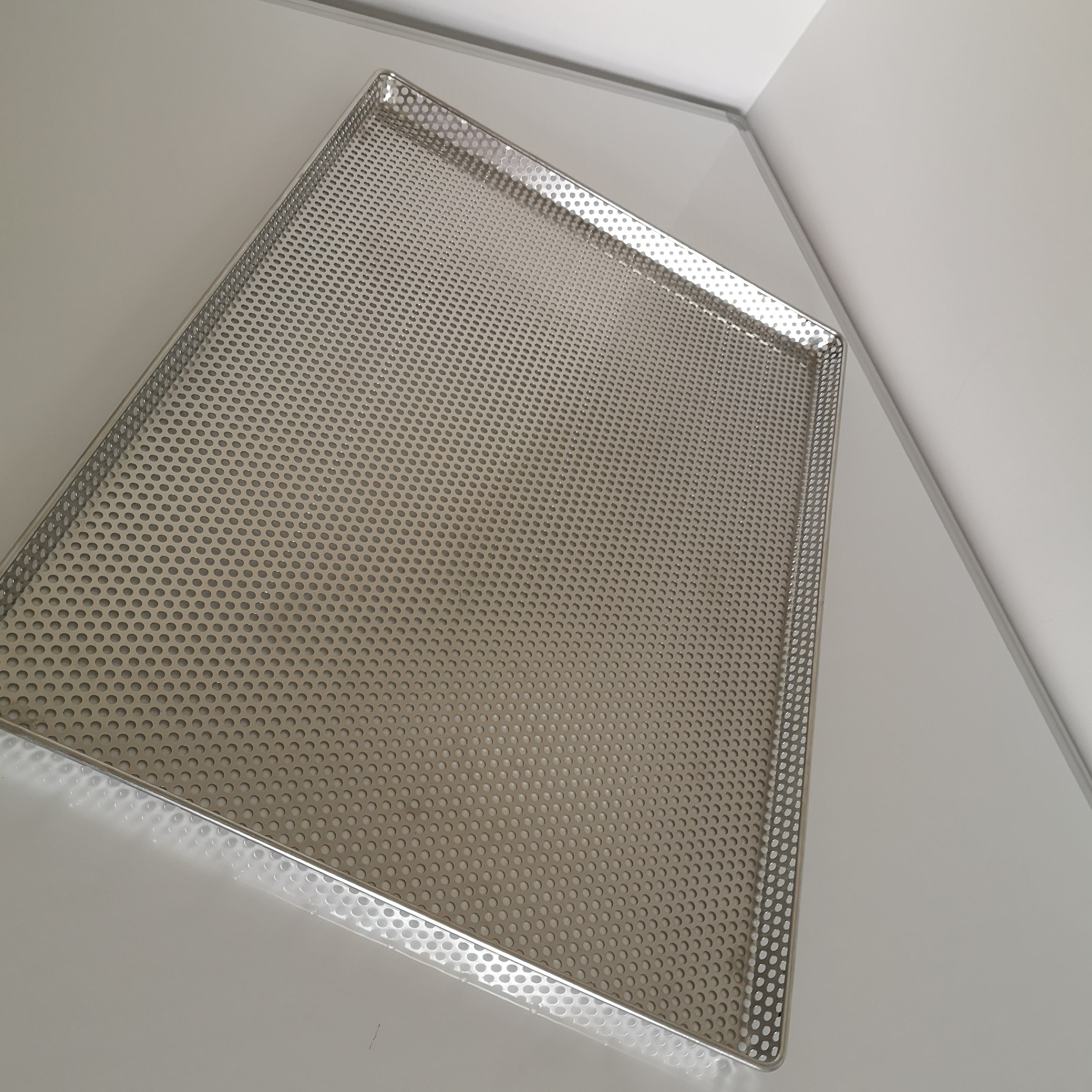
600 x 400 Oven Tray: The Essential Guide for Commercial Bakeries
What Is a 600 x 400 Oven Tray?
The 600 x 400 oven tray (also known as oven tray 600x400, metal oven tray 40x60, or bakery tray 600x400) is a standard size used across commercial bakeries worldwide. Measuring 600 mm by 400 mm, these trays are compatible with most rotary ovens, deck ovens, rack ovens, and baking trolleys. They are designed for high-volume production of bread, pastries, cookies, and other baked goods.
Typical Applications of the 600×400 mm Tray
This size is popular for baking a wide range of products, including bread rolls, baguettes, croissants, danishes, cakes, and sheet cookies. In commercial oven tray setups, the 600x400 dimension allows efficient use of oven space. For rotary ovens, these trays slide into rotating racks; for deck ovens, they stack multiple trays; for rack ovens, they fit onto trolleys. The versatility makes it a go-to for bakeries, pizzerias, and confectioneries.
Solid vs Perforated Oven Trays
When selecting a commercial oven tray, one key decision is solid or perforated. Solid trays are ideal for wet doughs, batters, or products that may drip, providing a sealed surface. Perforated trays (pierced with holes) allow heat circulation, reducing bake time and promoting even browning on bottoms – perfect for pastries and cookies. Perforation patterns can be customized: common hole diameters are 1, 1.5, 2, 2.5, 3, 4, 5, 6, 8, and 10 mm, with spacing and open area tailored to your product.
Flat vs Lipped Oven Trays: Why Edge Height Matters
Flat trays have no raised edges, making them easy to slide products on and off, often used for bread or pizza. Lipped trays have a raised rim (typically 10–40 mm high), which prevents spillage and allows stacking. The edge height affects baking: higher edges trap steam, ideal for moist products, while lower edges promote airflow for crisp results. For stainless steel tray 600x400, lipped options are common for safety during transport.
Impact of Thickness on Baking & Handling
The plate thickness of a metal oven tray 40x60 ranges from 0.5 mm to 2.0 mm. Thinner trays (0.5–0.8 mm) heat up quickly and are lightweight, suitable for light loads. Thicker trays (1.0–2.0 mm) distribute heat evenly, resist warping, and handle heavy doughs. For high-volume commercial use, 1.0 mm to 1.5 mm is recommended. Thicker trays also endure frequent stacking and washing. Compare options: 0.7 mm for pastries, 1.2 mm for bread, 2.0 mm for heavy products.
Material Selection: Stainless Steel vs Aluminum
Stainless steel tray 600x400 (grades 201, 304, 316) offers durability, corrosion resistance, and high temperature tolerance. Grade 304 is standard for most bakeries; 316 is for high-humidity or acidic environments. Aluminum options (1060, 3003, 5052) are lighter, heat faster, and are easier to handle but may dent. For commercial oven tray use, stainless steel is preferred for long-term durability, while aluminum suits applications needing quick temperature response.
How to Confirm Compatibility with Your Oven
Before purchasing bakery tray 600x400, measure your oven’s tray support (rack or shelf) dimensions. Check clearance for tray height, especially for lipped trays. For rotary ovens, ensure the tray slides easily onto rotating arms. For deck ovens, verify the tray fits the shelf depth. For rack ovens, confirm the trolley width. Never assume compatibility with generic brands; always match your specific oven model. Our trays are manufactured to standard 600x400 but we recommend providing your exact dimensions to avoid issues.
Product Highlights: Why Choose Our Trays
- Customizable hole patterns for optimal airflow
- Multiple thickness options (0.5–2.0 mm) to match load
- Choice of materials: 201, 304, 316 stainless steel or aluminum
- Flat or lipped edges with various heights
- Built to withstand repeated baking cycles without warping
- Easy to clean, food-grade safe
Specification Selection Table
Below is a quick reference for choosing your oven tray 600x400:
| Thickness (mm) | Recommended Use | Material |
|---|---|---|
| 0.5–0.8 | Light pastries, cookies | Aluminum or SS |
| 1.0–1.2 | General baking, bread | SS304 |
| 1.5–2.0 | Heavy dough, high volume | SS316 |
Compatibility Checklist
- Measure oven rack width and depth (min 600x400 mm)
- Check clearance above and below tray for airflow
- Lipped trays: ensure height fits within oven cavity
- Verify trolley/tray slide mechanism fits tray edge
- Test one sample before bulk order
Frequently Asked Questions
The most common size is 600 x 400 mm (also 60x40 cm). It fits most rotary, deck, and rack ovens.
Solid for wet doughs/batters; perforated for dry items like pastries and cookies to promote even baking.
1.2 mm to 1.5 mm stainless steel is ideal for durability and heat distribution.
Yes, aluminum is lightweight but ensure thickness (≥1.0 mm) to avoid warping under heat.
Measure the internal rack dimensions and clearance; consult your oven manual or contact us for guidance.
Ready to Order? Get a Quote Today
Whether you need stainless steel tray 600x400, metal oven tray 40x60, or custom perforations, we supply high-quality trays for bakeries worldwide. Contact us with your specifications (material, thickness, edge type, hole pattern) for a fast quote. We do not list brand compatibility – just send your oven details for a perfect fit.What is the standard size of a commercial oven tray?Should I choose a solid or perforated tray?What thickness is best for high-volume bread production?Can I use aluminum trays in a rotary oven?How do I confirm my oven is compatible with 600x400 trays?