


Bakery Production Line Trolley: A Comprehensive Guide for B2B Buyers
Product Introduction: What Is a Bakery Production Line Trolley?
A bakery production line trolley is a specialized wheeled rack designed to carry baking trays, pans, and products through various stages of industrial baking—from proofing and baking to cooling and packaging. Unlike generic carts, these trolleys are engineered to integrate seamlessly with automated systems, ensuring smooth workflow and reducing manual handling. They solve critical problems: minimizing product damage, optimizing space utilization, and maintaining hygiene standards in high-volume operations.
Product Features: Engineering for Industrial Demands
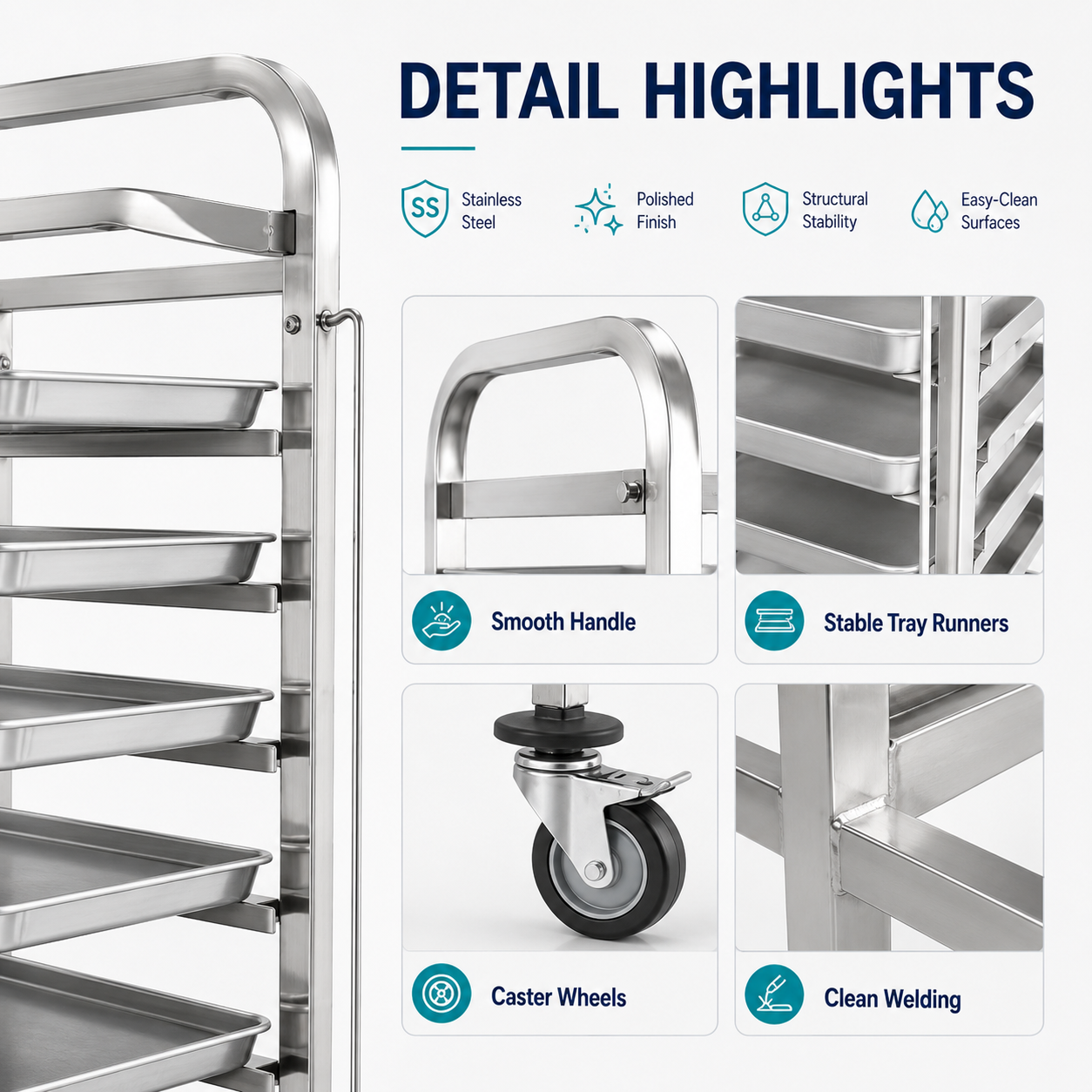
Our trolleys feature a reinforced frame structure that enhances load stability during repeated transportation, even under heavy loads. The use of 304 stainless steel ensures corrosion resistance, crucial for humid baking environments. Key design elements include:
- Modular construction: Allows for easy replacement of damaged parts, reducing downtime.
- High-capacity bearings: Swivel casters with brakes enable smooth movement across uneven floors.
- Ventilated side panels: Promote airflow for cooling or drying processes.
- Stackable design: Maximizes storage efficiency when not in use.
These features directly address the rigors of 24/7 production lines, where durability and reliability are non-negotiable.
Application Scenarios: Beyond the Bakery
While primarily used in bakeries, these trolleys are versatile across multiple industries:
- Food Processing: Transporting ingredients, finished goods, or waste in meat, dairy, and ready-meal plants.
- Industrial Manufacturing: Moving components through assembly lines or ovens for curing.
- Cleaning & Drying: Holding parts during wash-down or drying cycles in pharmaceutical and electronics manufacturing.
- Storage & Transportation: Acts as mobile shelving in warehouses, ensuring organized logistics.
In each scenario, the trolley's design must match specific hygiene, temperature, and load requirements.
Material Selection: Choosing the Right Stainless Steel
The material of construction significantly impacts longevity and cost. Here's a breakdown:
- 304 Stainless Steel: The industry standard for food contact. Offers excellent corrosion resistance and durability at a moderate cost.
- 316 Stainless Steel: Superior resistance to chlorides and acids, ideal for harsh cleaning chemicals or marine environments. Higher cost but necessary for extreme conditions.
- 201 Stainless Steel: A cost-effective alternative with lower nickel content. Suitable for dry environments but less resistant to corrosion.
- Aluminum: Lightweight and rust-resistant, but prone to denting and not as hygienic for direct food contact.
For most bakery applications, 304 stainless steel provides the best balance of performance and affordability.
Specifications: Key Parameters for Procurement
When specifying a trolley, buyers should consider:
- Dimensions: Standard sizes range from 600x400mm to 800x600mm to accommodate common tray sizes (e.g., 18"x26"). Custom sizes available.
- Thickness: Frame tubes typically 1.2-2.0mm; wire mesh 3-5mm diameter.
- Capacity: Load ratings from 100kg to 500kg, depending on design.
- Number of Shelves/Levels: 10 to 30 tiers, with adjustable spacing.
- Load Capacity per Shelf: Usually 10-30kg per level.
- Mesh Size & Aperture: Critical for airflow; standard openings 10x10mm to 50x50mm.
- Tray Compatibility: Ensure trolley accepts your existing trays (e.g., bun pans, baguette trays).
- Surface Treatment: Polished or electropolished for easy cleaning and sanitation.
These specs must align with your production line's physical layout and operational tempo.
Customization Services: Tailoring to Your Line
As a manufacturer with extensive OEM/ODM experience, we offer:
- Custom Sizes: Adapt trolleys to fit your oven, proofer, or conveyor dimensions.
- Custom Design: Modify shelf spacing, caster types, or add handles for ergonomic use.
- Logo & Branding: Laser-etch your company logo for asset tracking.
- Special Packing: Knock-down packing to reduce shipping costs.
- Special Requirements: E.g., static-dissipative wheels for electronics, or high-temperature coatings.
Our engineering team collaborates closely with clients to ensure seamless integration. For custom requirements, please contact our team to discuss your specifications.
Procurement Guide: Making Informed Decisions
When sourcing trolleys, consider these factors to avoid costly mistakes:
- How to Choose Size? Measure your existing trays and the space available in ovens, proofers, and storage areas. Allow clearance for movement.
- How to Choose Material? Assess your environment: 304 for general bakery, 316 for high-acid or salty products, 201 for dry storage only.
- How to Confirm Specifications? Request detailed drawings and samples. Verify load ratings with test reports.
- How to Judge Supplier Capability? Evaluate their manufacturing equipment, quality control processes (e.g., ISO certification), and experience with similar clients. Ask for references and factory audit reports.
Remember, a low-cost trolley may lead to higher long-term costs due to frequent replacements or product damage.
Frequently Asked Questions (FAQ)
Q1: What is the typical lead time for custom trolleys?
A: For standard designs, 15-20 days; custom orders may take 25-35 days depending on complexity and order volume.
Q2: Can these trolleys withstand high temperatures in ovens?
A: Yes, our stainless steel trolleys can endure temperatures up to 300°C (572°F) continuously, suitable for baking ovens. However, casters may have lower temperature limits; specify if needed.
Q3: Are replacement parts available?
A: Absolutely. We stock common components like casters, bolts, and mesh panels for quick shipment.
Q4: Do you provide samples for evaluation?
A: Yes, sample orders are welcome. We can produce a prototype based your specifications, though sample costs and freight are typically borne by the buyer.
Q5: What is your MOQ?
A: Our minimum order quantity is 50 units for standard models, but we can accommodate smaller trial orders for custom projects.
Q6: How do you ensure quality?
A: We implement rigorous inspections at every stage: raw material verification, in-process checks, and final pre-shipment inspection. Third-party inspections are also accepted.
Q7: What payment terms do you offer?
A: Typically 30% deposit, 70% balance against B/L copy. For long-term partners, we can discuss flexible terms.
Q8: Can you handle large volume orders?
A: Yes, our factory has a monthly capacity of 10,000 units, ensuring timely delivery for bulk orders.
Image ALT text suggestion: "Stainless steel bakery production line trolley with multiple shelves loaded with baking trays in a commercial bakery."
SEO Metadata
SEO Title: Bakery Production Line Trolley | Industrial Baking Transport Solutions
Meta Description: Discover durable bakery production line trolleys for efficient transport. 304 stainless steel, custom sizes, OEM. Ideal for food processing, bakeries. Request a quote today.
SEO Keywords: bakery trolley, production line trolley, stainless steel trolley, baking tray trolley, industrial bakery cart, food processing trolley, custom trolley manufacturer, bakery equipment supplier.

