


Bakery Trolley Capacity: A Procurement Guide for Industrial Buyers
Product Introduction
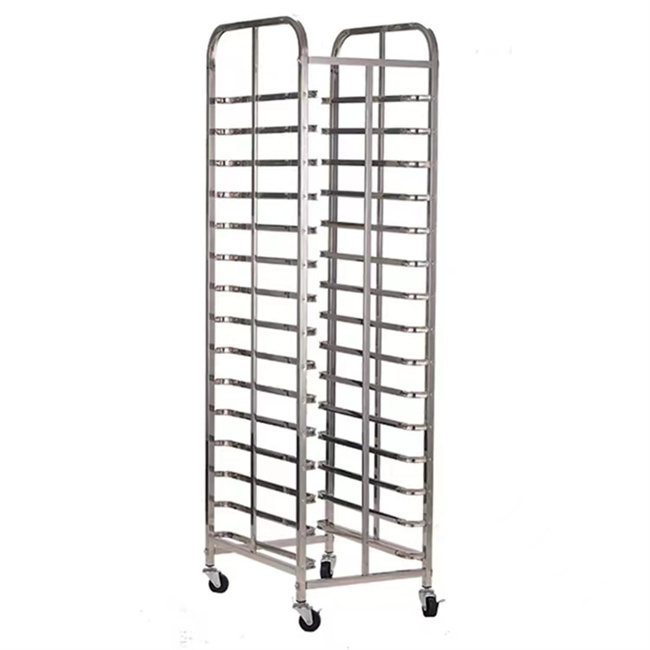
When specifying a bakery trolley capacity, industrial buyers must consider far more than just the number of shelves. A bakery trolley, also known as a bakery rack or pan truck, is a wheeled frame designed to hold baking pans, trays, or dough troughs during proofing, baking, cooling, and transport. Its primary purpose is to streamline high-volume production by enabling the simultaneous movement of multiple batches. In a commercial bakery, a single trolley can replace dozens of manual trips, directly reducing labor costs and product damage. The capacity of a trolley—measured in total weight load, number of tiers, and compatibility with standard pan sizes—determines how well it integrates into your existing production line. For B2B buyers, understanding these specifications is critical to avoiding bottlenecks and ensuring a safe, efficient operation.
Product Features
Industrial bakery trolleys are engineered for durability and hygiene. The frame is typically constructed from 304 stainless steel or 201 stainless steel, with options for 316 stainless steel in highly corrosive environments. The choice of material affects not only lifespan but also cost and weight. Reinforced cross-bracing and welded joints improve load stability during repeated transportation over uneven floors. The tray slides are often made of stainless steel or aluminum, with precise spacing to prevent pan tipping. Casters are a critical component: heavy-duty polyurethane or nylon wheels with sealed bearings ensure smooth rolling and resistance to flour dust and high temperatures. Some models feature a brake system to secure the trolley during loading or unloading. The number of tiers (often 6 to 30) and the spacing between them dictate how many pans can be carried. For example, a 20-tier trolley with 75mm spacing can hold 20 standard 18" x 26" sheet pans, but the total weight capacity must not be exceeded. Manufacturers like us design trolleys with a safety factor of 2:1, meaning a trolley rated for 500 kg can withstand brief overloads but should not be routinely pushed beyond its limit.
Application Scenarios
Bakery trolley capacity requirements vary significantly across industries. In food processing, trolleys transport raw ingredients, finished goods, and even waste. They must withstand frequent washdowns, so 304 stainless steel with a polished surface is common. In bakery operations, trolleys are used for proofing (where humidity and heat are present), baking (high temperatures up to 250°C), and cooling. The capacity here is often limited by oven dimensions: a trolley must fit into the oven chamber, so external dimensions and tier count are matched to the oven's interior. In industrial manufacturing, trolleys carry components or tools; here, capacity is defined by weight and durability rather than food safety. Cleaning applications require trolleys that can be disassembled or have open designs to prevent water pooling. Drying racks may need perforated trays or mesh shelves for airflow. Storage and transportation between facilities demand trolleys with high load capacity and secure stacking features. For example, a large-scale bread producer might use 30-tier trolleys with a 600 kg capacity to move dough troughs from mixer to proofer, while a pastry shop might prefer a 10-tier trolley with a 200 kg capacity for flexibility.
Material Selection
The material of your bakery trolley directly influences its capacity, hygiene, and cost. 304 stainless steel is the industry standard for food contact: it resists corrosion from acids, alkalis, and cleaning agents, and can handle temperatures from -40°C to 800°C. It is ideal for bakeries and food processing. 316 stainless steel adds molybdenum for superior resistance to chlorides and salts, making it suitable for marine environments or facilities that use aggressive sanitizers. It is more expensive but extends service life in harsh conditions. 201 stainless steel is a lower-cost alternative with lower nickel content; it offers moderate corrosion resistance and is often used for dry storage or light-duty applications. However, in humid or washdown areas, 201 may rust over time. Aluminum trolleys are lightweight and resistant to some chemicals, but they are not as strong as stainless steel and can dent under heavy loads. They are often chosen for drying or where mobility is prioritized over maximum capacity. As a manufacturer, we recommend selecting the material based on the most aggressive environment the trolley will face, not just the initial cost.
Specifications and Parameters
When procuring bakery trolleys, buyers should focus on these key specifications:
- Dimensions: Overall length, width, and height must fit through doorways, into ovens, and within storage areas. Common pan sizes include 18" x 26", 16" x 24", and 600 x 400 mm.
- Thickness: Tube wall thickness (e.g., 1.2 mm, 1.5 mm, 2.0 mm) affects load capacity and durability. Thicker tubes resist bending under heavy loads.
- Capacity: Total weight load, typically ranging from 150 kg to 1000 kg. Always consider the weight of the trolley itself plus the product.
- Number of Tiers: From 6 to 30 or more. Tier spacing (e.g., 75 mm, 100 mm, 150 mm) must accommodate the height of your pans and products.
- Load per Tier: Evenly distributed weight per shelf should not exceed the rated capacity divided by the number of tiers.
- Hole Diameter and Mesh: For perforated trays or mesh shelves, hole size affects airflow and drainage. Common mesh openings are 5 mm to 20 mm.
- Tray Compatibility: Ensure the trolley's slides or supports match your existing pan flanges or edges.
- Surface Treatment: Polished, brushed, or electropolished surfaces improve cleanliness and corrosion resistance.
For example, a 20-tier trolley with 100 mm spacing and a 500 kg capacity is typical for bread bakeries. A 15-tier trolley with 150 mm spacing and 300 kg capacity suits pastry operations with taller products.
Customization Services
As a manufacturer with full OEM/ODM capabilities, we understand that standard trolleys rarely fit every production line. We offer custom sizes to match your oven or proofing chamber, custom designs for special pan configurations, and logo printing for brand identification. Our engineering team can modify tier spacing, add extra reinforcement, or integrate features like removable shelves or braking casters. We also provide custom packing to minimize shipping damage and optimize container loading. For special requirements such as high-temperature alloys or anti-static wheels, we work with you to develop a solution. Our production capability includes automated tube cutting, robotic welding, and surface treatment lines, ensuring consistent quality and short lead times. For custom requirements, please contact our team to discuss your project.
Procurement Guide
How to choose the right bakery trolley capacity for your operation? Start by answering these questions:
- What is the maximum weight you need to transport? Add the weight of the trolley, pans, and product. Choose a capacity at least 20% higher than your typical load.
- How many pans must be moved at once? This determines the number of tiers. Consider future expansion.
- What are the dimensions of your oven, proofer, and storage areas? The trolley must fit through all access points.
- What is the operating environment? High humidity, temperature extremes, or corrosive chemicals dictate material choice (304 vs. 316).
- How will you confirm specifications? Request a detailed drawing with tolerances and load ratings. Ask for a sample or third-party test report.
- How to judge supplier capability? Check for ISO 9001 certification, factory audit reports, and references from similar industries. A supplier with in-house welding and polishing can better control quality.
Common pitfalls include underestimating load capacity, ignoring caster quality (cheap casters fail first), and selecting 201 stainless steel for wet environments. Always request a warranty and spare parts availability.
FAQ
Q: What is the maximum load capacity for a bakery trolley?
A: Standard models range from 150 kg to 1000 kg. Heavy-duty trolleys with reinforced frames can handle up to 1500 kg, but always verify with the manufacturer.
Q: Can I use a bakery trolley in a freezer?
A: Yes, but you need stainless steel (304 or 316) and low-temperature casters (e.g., nylon or polyurethane rated for -40°C). Lubricants must also be freezer-safe.
Q: How do I choose between 304 and 316 stainless steel?
A: Choose 304 for general bakery and food processing. Choose 316 if your facility uses chlorinated cleaners, is near saltwater, or requires maximum corrosion resistance.
Q: What is the typical lead time for custom trolleys?
A: For OEM orders, lead time is usually 30-45 days after drawing approval, depending on quantity and complexity.
Q: Do you provide samples?
A: Yes, we can provide a sample for evaluation, though sample and shipping costs apply. For large orders, we can offer a pre-production sample.
Q: How do I maintain a bakery trolley?
A: Regularly inspect casters for debris, tighten bolts, and clean with mild detergent. Avoid harsh chemicals that can damage stainless steel passivation.
Q: What is the warranty on your trolleys?
A: We offer a 1-year warranty against manufacturing defects. Extended warranties are available for bulk orders.
Q: Can I mix different tier spacings on one trolley?
A: Yes, we can customize tier spacing to accommodate different pan heights. This is a common OEM request.
Image ALT text suggestion: "Stainless steel bakery trolley with 20 tiers and 500 kg capacity in a commercial bakery."
SEO Title: Bakery Trolley Capacity Guide for Industrial Buyers
Meta Description: Learn how bakery trolley capacity, tiers, and environment affect your procurement. Expert guide for B2B buyers from a leading manufacturer.
SEO Keywords: bakery trolley capacity, bakery rack capacity, industrial bakery trolley, stainless steel bakery trolley, bakery trolley manufacturer, custom bakery trolley, bakery trolley specifications, bakery trolley procurement, bakery trolley load capacity, bakery trolley tiers.

