


Bakery Trolley vs Bakery Rack: A B2B Procurement Guide for Industrial Bakeries
Understanding Bakery Trolleys and Bakery Racks
In the commercial baking sector, the terms bakery trolley and bakery rack are often used interchangeably, but they refer to distinct pieces of equipment with different designs and applications. A bakery trolley, also known as a bakery cart or roll-in rack, is a wheeled frame designed to hold multiple baking trays or pans, allowing for efficient transport of products throughout the production facility. A bakery rack, on the other hand, typically refers to a stationary or mobile shelving unit used for cooling, storing, or displaying baked goods. While both serve essential functions, understanding their differences is critical for optimizing your bakery's workflow and making a cost-effective purchase.
When procuring equipment for a commercial bakery, the decision between a trolley and a rack should be based on your specific production needs, space constraints, and material handling requirements. This article provides a detailed comparison to guide your purchasing decision, covering design, materials, applications, and customization options.
Product Overview: What Each Equipment Solves
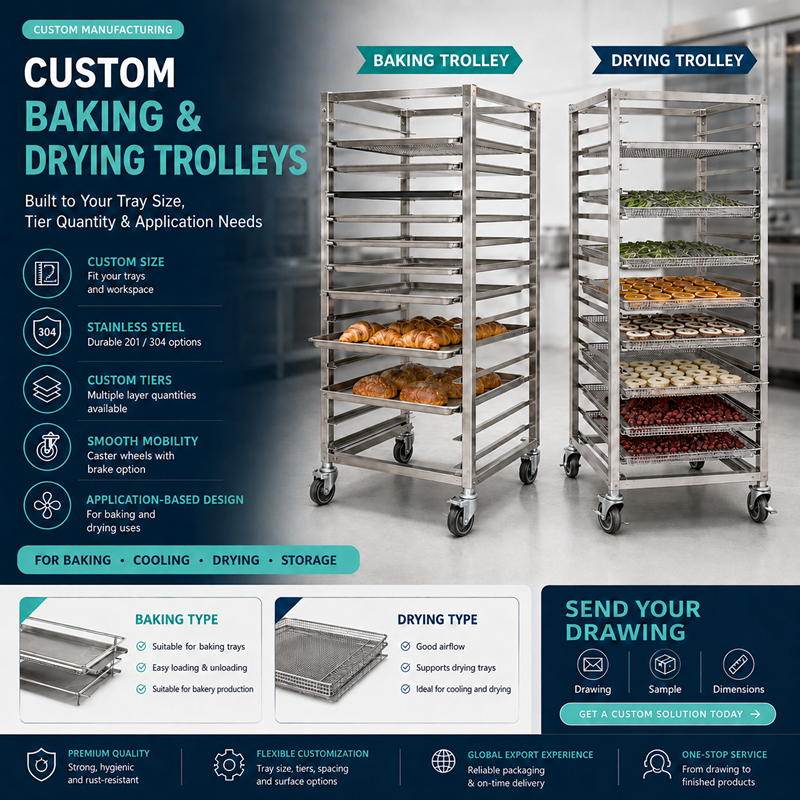
A bakery trolley is engineered for mobility and integration with production lines. It typically features a sturdy frame with shelves or slides to accommodate standard baking trays (e.g., 18" x 26" or 600mm x 400mm). Trolleys are essential for moving products from proofers to ovens, and then to cooling areas, minimizing manual handling and reducing the risk of product damage. They are often used in high-volume operations where speed and efficiency are paramount.
A bakery rack is generally a stationary or semi-mobile unit with multiple tiers, used for cooling, storing, or displaying finished products. Racks are common in retail bakeries, pastry shops, and storage areas. They may be designed with different shelf configurations, such as flat shelves, wire mesh shelves, or angled shelves for display. While some racks are mobile, their primary function is organization and storage rather than transportation.
In a B2B context, the choice between a trolley and a rack depends on whether your priority is transportation efficiency or storage and display. Many industrial bakeries use both: trolleys for production flow and racks for cooling and storage.
Key Design and Material Features
Industrial bakery equipment must withstand harsh conditions, including high temperatures, humidity, and frequent cleaning. The materials and construction directly affect durability, hygiene, and lifespan.
- Frame Construction: Bakery trolleys typically feature a reinforced tubular frame made from stainless steel or aluminum, with welded joints for strength. Racks may use a similar frame but with fewer mobility features. The design must support heavy loads (up to 500 kg or more) without deformation.
- Material Options: Common materials include 304 stainless steel, 316 stainless steel, 201 stainless steel, and aluminum. 304 stainless steel offers excellent corrosion resistance and is suitable for most bakery environments. 316 stainless steel provides superior resistance to chlorides and acids, ideal for washdown areas or coastal facilities. 201 stainless steel is a cost-effective alternative for dry environments but less resistant to corrosion. Aluminum is lightweight and resistant to rust but may dent under heavy loads.
- Surface Finish: Stainless steel surfaces are often polished or brushed to facilitate cleaning and prevent bacterial growth. Some manufacturers offer electropolishing for enhanced hygiene.
- Tray Compatibility: Trolleys and racks must accommodate standard tray sizes. Common specifications include 18" x 26" (US) and 600mm x 400mm (EU). Custom sizes are available for specialized operations.
When evaluating suppliers, inquire about material certificates (e.g., Mill Test Certificates) and welding quality. A reputable manufacturer will provide detailed specifications and test reports.
Applications Across Industries
Bakery trolleys and racks are not limited to bakeries; they are used across various industries for different purposes.
- Food Processing: Trolleys are used to transport ingredients, semi-finished products, and finished goods between processing stations. Racks are used for cooling and storing packaged products.
- Bakery: Trolleys move dough through proofing, baking, and cooling processes. Racks are used for cooling bread, pastries, and cakes, as well as for display in retail settings.
- Industrial Manufacturing: Similar trolleys and racks are used to transport and store components, tools, and parts. Stainless steel construction is essential for cleanrooms and corrosive environments.
- Cleaning and Drying: Trolleys with wire mesh shelves are used for drying parts after cleaning. Racks are used for air drying and storage.
- Storage and Transportation: Mobile racks (often called roll-in racks) are used in warehouses and logistics for efficient storage and movement of goods.
Understanding your specific application is crucial for selecting the right equipment. For example, a bakery producing artisan bread may require trolleys that fit into rack ovens, while a pastry shop may need display racks with glass shelves.
Material Selection Guide
Choosing the right material is a balance between cost, durability, and environmental conditions. Here's a detailed comparison:
- 304 Stainless Steel: The industry standard for food-grade equipment. It offers good corrosion resistance, easy cleaning, and high strength. Suitable for most bakery applications, including ovens and proofers. Temperature range: -196°C to 800°C.
- 316 Stainless Steel: Contains molybdenum, providing enhanced resistance to chlorides and acids. Ideal for coastal areas, meat processing, and chemical exposure. Higher cost but longer lifespan in harsh environments.
- 201 Stainless Steel: A lower-cost alternative with lower nickel content. It has reduced corrosion resistance, making it suitable for dry, non-corrosive environments. Not recommended for frequent washdowns or high humidity.
- Aluminum: Lightweight and rust-resistant, but softer than stainless steel. Often used for racks that are not subjected to heavy loads. Not suitable for high-temperature applications above 200°C.
For B2B buyers, consider the total cost of ownership. While 316 stainless steel has a higher upfront cost, it may reduce maintenance and replacement costs in the long run.
Specifications and Customization
When specifying bakery trolleys and racks, consider the following parameters:
- Dimensions: Overall length, width, and height. Ensure compatibility with ovens, proofers, and doorways.
- Thickness: Material thickness affects load capacity. Typical stainless steel tubes range from 1.0mm to 2.0mm.
- Capacity: Number of shelves and load capacity per shelf (e.g., 50 kg per shelf).
- Number of Tiers: Common configurations include 10, 15, 20, or custom.
- Load Capacity: Total weight the unit can support, including dynamic loads during movement.
- Mesh Size: For wire mesh shelves, specify opening size (e.g., 10mm x 10mm) to prevent small items from falling through.
- Tray Compatibility: Ensure shelves or slides match your tray size. Adjustable slides offer flexibility.
- Surface Treatment: Polished, brushed, or coated for specific hygiene requirements.
Customization is often necessary for industrial bakeries. A reliable manufacturer should offer OEM/ODM services, including custom sizes, designs, logos, and packaging. For special requirements such as explosion-proof casters or high-temperature wheels, consult with the factory's engineering team.
Procurement Guide: How to Choose
Purchasing bakery equipment is a significant investment. Follow these steps to ensure you select the right supplier and product:
- Define Your Requirements: Determine the number of trolleys/racks needed, load capacities, and environmental conditions. Consider future expansion.
- Evaluate Material Options: Based on your cleaning procedures and environment, choose between 304, 316, 201 stainless steel, or aluminum. Request material certificates.
- Verify Specifications: Ask for detailed drawings and specifications. Check dimensions, thickness, and load ratings. Ensure compatibility with existing equipment.
- Assess Supplier Capability: A reputable manufacturer should have ISO certifications, in-house testing facilities, and experience with B2B clients. Request references and factory audit reports.
- Request Samples or Prototypes: For custom designs, order a sample to evaluate quality and workmanship.
- Consider Logistics: Confirm packaging, shipping, and lead times. For international orders, clarify Incoterms and customs documentation.
For custom requirements, please contact our team. We provide tailored solutions to meet your specific production needs.
Frequently Asked Questions (FAQ)
Q1: What is the difference between a bakery trolley and a bakery rack?
A bakery trolley is designed for mobility and transport, often used to move trays through production. A bakery rack is primarily for storage, cooling, or display, and may be stationary or mobile. The key difference is in their primary function: trolleys for transport, racks for organization.
Q2: Which material is best for a high-humidity bakery environment?
For high-humidity environments, 304 or 316 stainless steel is recommended due to their excellent corrosion resistance. 316 stainless steel offers superior protection against chlorides and acids, making it ideal for washdown areas.
Q3: Can I customize the size and number of shelves?
Yes, most manufacturers offer OEM/ODM services. You can specify dimensions, shelf count, load capacity, and even branding. Provide detailed requirements to ensure a perfect fit.
Q4: How do I determine the load capacity needed?
Calculate the maximum weight of products per shelf and multiply by the number of shelves. Consider dynamic loads during movement. A safety factor of 1.5 to 2 is recommended. Consult the manufacturer for load testing data.
Q5: What is the typical lead time for custom orders?
Lead times vary based on complexity and order volume. Typically, custom orders take 4-8 weeks after design approval. Confirm with your supplier and plan accordingly.
Q6: Are casters included? What types are available?
Most trolleys include casters, but specifications vary. Common types include swivel casters with brakes, high-temperature casters for oven use, and non-marking wheels for clean floors. Discuss your needs with the supplier.
Q7: How do I clean and maintain stainless steel trolleys?
Clean with mild detergent and water, then rinse and dry. Avoid abrasive cleaners that can scratch the surface. For stubborn stains, use a stainless steel cleaner. Regular maintenance extends lifespan.
Q8: Can these trolleys be used in rack ovens?
Yes, many trolleys are designed to roll directly into rack ovens. Ensure the trolley dimensions and caster types are compatible with your oven model. Specify oven integration when ordering.
Image ALT Text Suggestions
For SEO and accessibility, use descriptive ALT text for images:
- "Stainless steel bakery trolley with 20 trays for industrial baking"
- "Mobile bakery rack with wire mesh shelves for cooling pastries"
- "304 stainless steel bakery trolley with reinforced frame and casters"
SEO Metadata
SEO Title: Bakery Trolley vs Bakery Rack: B2B Comparison Guide
Meta Description: Compare bakery trolley vs bakery rack for industrial bakeries. Learn about materials, applications, and procurement tips. Contact us for custom solutions.
SEO Keywords: bakery trolley, bakery rack, stainless steel bakery trolley, industrial bakery equipment, bakery trolley manufacturer, custom bakery rack, bakery trolley vs rack, bakery equipment procurement, 304 stainless steel trolley, bakery trolley supplier

