


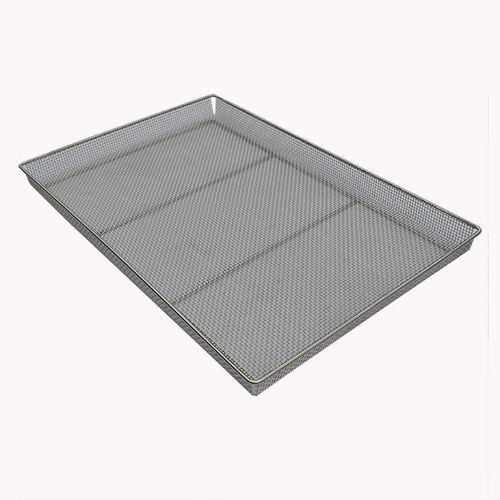
Baking Cooling Rack for Industrial Buyers: A Sourcing Guide to Stainless Steel Mesh Trays
Product Introduction
In industrial baking and food processing environments, a baking cooling rack is not a peripheral accessory—it is a critical component in the production flow. These racks are engineered to support hot baked goods immediately after oven discharge, allowing rapid and uniform cooling while maintaining product integrity and hygiene. For importers, distributors, and food processing companies, specifying the right cooling rack directly impacts throughput, product quality, and long-term operational cost.
This industrial tray is designed for continuous production environments where hygiene, load stability, and long-term operation reliability are critical. Unlike consumer-grade cooling racks, industrial units must withstand repeated thermal cycling, high-frequency handling, and rigorous sanitation protocols. Whether you are equipping a commercial bakery line or sourcing for a food processing plant, the rack must integrate seamlessly with existing conveyor systems, racking structures, and washing equipment.
The procurement challenge is real: many buyers receive generic quotes that fail to address load capacity, material suitability for specific cleaning chemicals, or dimensional tolerances required for automated handling. This guide addresses those gaps, helping sourcing teams make informed decisions when evaluating industrial mesh tray suppliers and commercial drying rack manufacturers.
Product Features and Engineering Advantages
The engineering of a baking cooling rack for industrial use focuses on three core requirements: structural rigidity, airflow efficiency, and cleanability. The reinforced frame design improves load stability during repeated transportation and high-frequency industrial handling, preventing deformation that would otherwise compromise product placement and equipment compatibility.
Manufacturing processes vary significantly between suppliers. High-quality racks are produced using automated welding or spot welding for consistent joint strength, followed by post-weld passivation or polishing to restore corrosion resistance in the heat-affected zones. Edge treatment—whether deburred, hemmed, or encapsulated—is a key indicator of manufacturing discipline, as sharp edges pose both safety risks and contamination traps in food environments.
Key engineering advantages include:
- High corrosion resistance through appropriate material selection and surface treatment, essential for wash-down environments.
- Easy cleaning surface with open mesh design that prevents debris accumulation and allows thorough drainage.
- Stable load capacity achieved through reinforced frame construction and optimized wire spacing.
- Custom manufacturing options for non-standard equipment interfaces and specific production layouts.
- Thermal stability allowing racks to move directly from oven discharge to cooling zones without warping.
Industrial environments demand more than durability claims. The rack must resist deformation under repeated loading, maintain dimensional accuracy across batches for automated handling, and withstand exposure to cleaning agents without surface degradation. These factors should be verified through supplier documentation, sample testing, and reference checks rather than accepted at face value.
Application Scenarios
Understanding where and why baking cooling racks are deployed helps buyers specify correctly. The requirements vary substantially across sectors.
In food processing, racks are used for cooling, draining, and transporting products between process stages. Hygiene and corrosion resistance are paramount, and racks often must be compatible with CIP (clean-in-place) or manual wash-down systems. In bakery operations, the cooling rack is central to post-bake handling—breads, pastries, and confectionery items require uniform airflow to prevent sogginess and condensation. Rack dimensions must match oven and proofer footprints to maintain workflow continuity.
In industrial manufacturing, mesh trays serve drying and cooling roles for components after coating, painting, or heat treatment. Load capacity and chemical resistance often take priority over food-grade surface finish. Drying processes across industries rely on open mesh design to maximize air circulation, reducing drying times and energy consumption.
In cleaning processes, racks support parts through ultrasonic or spray cleaning systems, requiring material compatibility with detergents and temperature fluctuations. For storage and transportation, stackable designs improve space utilization in warehouses and delivery vehicles. In pharmaceutical and laboratory settings, stainless steel drying trays are used for glassware, instruments, and sample containers, where contamination control and cleanability are non-negotiable.
For commercial production—from central kitchens to contract manufacturers—the rack must balance flexibility across product lines with the robustness demanded by multi-shift operation. Each application imposes distinct requirements on material, dimensions, and surface finish; a single generic specification rarely serves all scenarios well.
Material Options and Manufacturing Details
Material selection is one of the most consequential decisions in specifying a baking cooling rack. The most common grades are 304 and 316 stainless steel, with 201 stainless steel and aluminum used in cost-sensitive or light-duty applications.
304 stainless steel provides reliable corrosion resistance for food contact applications and daily industrial cleaning environments. It is the default choice for most bakery and food processing racks, offering a balance of cost and performance. 316 stainless steel adds molybdenum for enhanced resistance to chlorides and aggressive cleaning chemicals, making it suitable for marine environments, pharmaceutical production, and facilities using high-salt or acidic sanitation agents. The cost premium is significant, so 316 is typically specified only where the operating environment demands it.
201 stainless steel offers lower cost but reduced corrosion resistance, making it appropriate for dry storage or light-duty applications where moisture and chemicals are limited. Buyers should be cautious about suppliers substituting 201 for 304 without disclosure—a common issue in price-driven sourcing. Aluminum racks are lightweight and offer good thermal conductivity, but they are susceptible to corrosion in wet environments and are less suitable for food contact unless coated or anodized.
Manufacturing details matter as much as material grade. Wire diameter, mesh opening, and frame thickness all influence load capacity and airflow. Surface treatments—such as electropolishing or passivation—enhance corrosion resistance and cleanability. Production tolerances should be confirmed in writing, particularly for automated handling systems where millimeter-level deviations can cause jams or misalignment.
Specifications and Technical Parameters
Industrial buyers should approach specifications systematically, confirming each parameter against actual operating conditions rather than relying on catalog averages. Key parameters include:
- Size: Available sizes can be customized according to equipment dimensions and production requirements. Standard footprints exist, but most industrial buyers require custom dimensions to match oven, proofer, or conveyor interfaces.
- Thickness: Frame and wire thickness determine load capacity. Typical wire diameters range from 2 mm to 6 mm, with frame thicknesses from 1.0 mm to 2.0 mm depending on load requirements.
- Capacity and weight loading: Load ratings should be specified per rack and per layer, accounting for dynamic loads during transportation, not just static loading.
- Layers: Single-layer, multi-layer, and stackable designs are available; layer count affects airflow and handling efficiency.
- Mesh opening and wire diameter: These parameters balance airflow against product support. Smaller openings suit small items; larger openings improve circulation.
- Tray compatibility: Racks must interface with existing racking systems, trolleys, and conveyor mechanisms. Compatibility should be verified with drawings, not assumptions.
- Surface treatment: Polished, passivated, or electropolished finishes affect cleanability and corrosion resistance.
- Production tolerance: Dimensional tolerances should be agreed in writing, particularly for automated systems.
Where specific parameters are not fixed, buyers should request the supplier's standard ranges and confirm customization capabilities before committing to a purchase order.
Custom OEM Manufacturing Service
For buyers sourcing under private label or requiring equipment-specific designs, OEM manufacturing capability is a decisive supplier selection criterion. A capable OEM stainless steel tray manufacturer should offer custom size and design services based on buyer drawings or samples, material selection guidance, and prototype development before bulk production.
Logo marking—through laser etching or stamping—supports brand differentiation for distributors and importers. Special packaging, including custom cartons, pallet configurations, and labeling, is essential for efficient warehousing and resale. Prototype development allows buyers to validate fit, finish, and performance before committing to volume, reducing risk in long-term supply relationships.
Bulk production capability should be assessed through factory audits, production capacity documentation, and references from existing export customers. For custom requirements, please contact our team to discuss drawings, target volumes, and delivery schedules. Early engagement on design and material selection typically reduces lead times and avoids costly revisions during production.
Purchasing Guide for Industrial Buyers
Effective procurement of baking cooling racks requires a structured approach. Before requesting quotations, buyers should confirm the working environment—temperature range, cleaning chemicals, and humidity—as these determine material grade and surface treatment. Material requirements should be specified explicitly, with certificates of material composition requested to avoid substitution.
Equipment compatibility must be verified against actual dimensions and interface points, ideally with drawings or samples. Supplier production capacity, quality control systems, and export experience should be evaluated through audits, certifications, and customer references. Packaging and delivery reliability are equally important, particularly for importers managing inventory cycles and distributor expectations.
Key purchasing considerations include:
- Confirm working environment including temperature, moisture, and cleaning agents.
- Check material requirements and request mill certificates or test reports.
- Verify equipment compatibility with drawings and, where possible, physical samples.
- Evaluate supplier production capacity and quality control processes.
- Agree on packaging and delivery terms to avoid downstream handling issues.
- Clarify warranty and after-sales support for long-term supply relationships.
For bulk orders, buyers should request pre-production samples, agree on inspection criteria, and consider third-party inspection for first shipments. Documenting specifications and tolerances in the purchase contract protects both parties and reduces the risk of disputes.
Frequently Asked Questions
What stainless steel grade is recommended for food processing applications?
304 stainless steel is the standard recommendation for most food processing and bakery applications due to its balance of corrosion resistance and cost. For environments with aggressive cleaning chemicals or high chloride exposure, 316 stainless steel is preferred. Buyers should confirm the grade with material certificates and avoid suppliers who cannot document composition.
Can the tray size be customized?
Yes. Most industrial suppliers offer custom dimensions based on equipment footprints, conveyor interfaces, and production requirements. Buyers should provide detailed drawings or physical samples, and confirm tolerances in writing before production. Custom sizing typically requires a minimum order quantity and additional lead time.
Do you provide OEM manufacturing service?
OEM services including custom design, logo marking, and private label packaging are available from qualified manufacturers. Buyers should discuss prototype development and sampling before bulk production. OEM arrangements should be documented with specifications, quality standards, and packaging requirements to ensure consistency across shipments.
What information should buyers provide before quotation?
Buyers should provide dimensions, material grade, load requirements, surface finish, quantity, and any equipment compatibility details. Drawings or samples are highly recommended. Additionally, information on operating environment, cleaning methods, and delivery timelines helps suppliers propose accurate specifications and pricing.
How do you control product quality?
Quality control should include incoming material inspection, in-process checks during welding and finishing, and final dimensional and surface inspections. Buyers should request inspection reports and consider third-party verification for first orders. A documented quality management system and traceability records are indicators of a reliable supplier.
What is the typical lead time for bulk orders?
Lead times vary by customization level and order volume, typically ranging from 15 to 45 days after sample approval. Buyers should confirm production schedules in writing and account for shipping time. For repeat orders, maintaining agreed specifications and packaging reduces lead time variability.
How should racks be packaged for export?
Export packaging should protect against deformation and surface damage during transit. Common approaches include individual wrapping, edge protection, and reinforced cartons or pallets. Buyers should specify packaging requirements in the purchase order and request photos of packed goods before shipment for verification.

