


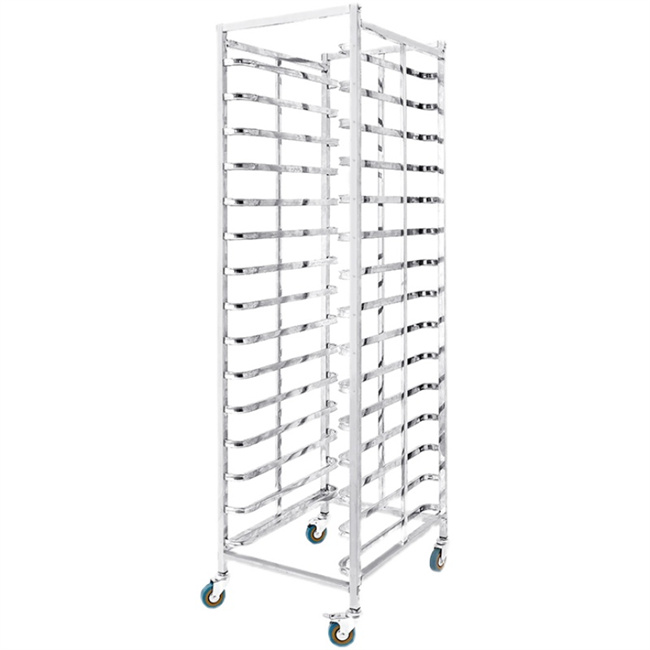
Bulk Order Stainless Steel Trolley: A Procurement Guide for Industrial Buyers
Product Introduction: The Backbone of Industrial Material Handling
When you place a bulk order stainless steel trolley, you're not just buying carts—you're investing in the operational backbone of your facility. These trolleys are engineered to transport raw materials, work-in-progress, and finished goods across food processing plants, bakeries, manufacturing floors, and logistics hubs. Unlike consumer-grade carts, industrial stainless steel trolleys are designed to withstand continuous heavy loads, harsh cleaning chemicals, and extreme temperatures. They solve critical problems: reducing manual handling injuries, improving workflow efficiency, and maintaining hygiene standards. For B2B buyers, the key is understanding that a bulk order is a long-term commitment; the trolleys must integrate seamlessly with your existing racking, ovens, and conveyor systems.
Product Features: Engineered for Demanding Environments
Industrial stainless steel trolleys differ from generic utility carts in several design aspects. The frame is typically constructed from square or round stainless steel tubing with a wall thickness of 1.2mm to 2.0mm, providing rigidity without excessive weight. Corner joints are reinforced with gussets or welded brackets to prevent twisting under uneven loads. The shelves or trays are often made from perforated stainless steel sheets (hole diameter 5-10mm) or wire mesh (aperture 20x20mm to 50x50mm), which allows air circulation for drying or cooling and facilitates drainage in wet environments. Casters are a critical component: for bulk orders, specify heavy-duty swivel casters with brake, typically 100mm to 200mm in diameter, with load capacities ranging from 150kg to 500kg per caster. The frame design must accommodate repeated industrial handling—for instance, a reinforced undercarriage with a cross-brace improves load stability during repeated transportation over rough floors. Additionally, ergonomic push handles at optimal height reduce operator fatigue, a factor often overlooked in bulk procurement.
Application Scenarios: Where Stainless Steel Trolleys Deliver Value
Different industries impose unique requirements on trolley design. In food processing, trolleys must comply with FDA and EU hygiene regulations, meaning smooth, crevice-free surfaces and 316 stainless steel for high-corrosion areas like brine rooms. For bakeries, trolleys often serve as oven racks—they need to withstand temperatures up to 300°C without warping, and the shelf spacing must match standard baking pans (e.g., 600x400mm). In industrial manufacturing, trolleys transport heavy components; here, load capacity and impact resistance are paramount, often requiring 201 stainless steel for cost-sensitive, dry environments. Cleaning and drying applications demand open wire mesh for rapid drainage and air flow, while storage and transportation in warehouses benefit from multi-tier designs to maximize space utilization. A pharmaceutical cleanroom might require electropolished surfaces to prevent particle accumulation. Understanding these nuances is essential when specifying a bulk order—a one-size-fits-all approach leads to premature failures and safety risks.
Material Selection: 304 vs. 316 vs. 201 Stainless Steel
The choice of material directly impacts lifespan, maintenance cost, and compliance. 304 stainless steel is the industry workhorse, offering excellent corrosion resistance in most food and industrial environments. It contains 18% chromium and 8% nickel, making it suitable for wet and humid conditions. 316 stainless steel adds 2-3% molybdenum, significantly improving resistance to chlorides and acids—ideal for seafood processing, chemical plants, or coastal facilities. 201 stainless steel substitutes manganese for some nickel, reducing cost but also corrosion resistance; it's acceptable for dry storage or light-duty applications where moisture is minimal. Aluminum trolleys are lightweight and rust-free but cannot withstand aggressive cleaning chemicals or high temperatures, and they are prone to denting. For bulk orders, we recommend specifying the material grade based on the most corrosive exposure the trolley will face. A common mistake is over-specifying 316 for dry warehouses (unnecessary cost) or under-specifying 201 for wet areas (rapid rust). Our engineers can help you match material to application during the quoting phase.
Specifications and Customization: What to Include in Your Bulk Order
To avoid costly errors, your purchase order should detail the following parameters:
- Dimensions: Overall length, width, and height (e.g., 1200mm x 800mm x 950mm). Consider doorway and aisle widths.
- Shelf thickness and quantity: Typically 1.0mm to 1.5mm sheet thickness; 2 to 5 shelves.
- Load capacity: Uniformly distributed load per shelf or total (e.g., 250kg per shelf).
- Mesh/perforation: Hole diameter or mesh aperture; open area percentage.
- Caster type: Swivel, rigid, with brake; wheel material (polyurethane, nylon, rubber) for floor compatibility.
- Surface finish: Brushed, polished, or electropolished; Ra value for hygienic applications.
- Tray compatibility: For bakery trolleys, specify pan size and runner spacing.
Customization is where a manufacturer's capability shines. OEM/ODM services can include custom sizes, logo etching or laser marking, custom packaging (e.g., palletized or crated for sea freight), and special features like drainage taps, handles, or locking mechanisms. For bulk orders, we recommend requesting a pre-production sample to validate design and workmanship before full-scale manufacturing. Our factory maintains a dedicated line for custom stainless steel trolleys, with in-house welding, bending, and polishing to ensure consistency across large batches.
Procurement Guide: How to Source Bulk Stainless Steel Trolleys Effectively
Selecting the right supplier is as important as specifying the product. Here are key considerations:
- Size selection: Map your material flow—measure the largest item to be transported and the tightest corner it must navigate. Add 10% clearance.
- Material confirmation: Request mill test certificates for the stainless steel grade to verify composition.
- Specification verification: Ask for a detailed drawing (2D/3D) and a bill of materials before production. Confirm caster load ratings and brand if specified.
- Supplier capability assessment: Evaluate production capacity (monthly output), quality control processes (weld inspection, load testing), and experience with similar bulk orders. A factory audit or video walkthrough can reveal welding quality and surface finish consistency.
- Total cost of ownership: Cheaper 201 trolleys may need replacement in 2 years, while 304 lasts 10+ years. Factor in maintenance and downtime.
For custom requirements, please contact our team. We provide engineering support, rapid prototyping, and competitive pricing for bulk orders, ensuring your trolleys are delivered on time and to spec.
Image ALT Text Suggestions
For product pages, use descriptive ALT text: "Bulk order stainless steel trolley with four shelves and heavy-duty casters in a food processing plant" or "Custom 316 stainless steel bakery trolley with multiple trays for oven loading". This improves SEO and accessibility.
FAQ: Common Questions from B2B Buyers
Q: What is the typical lead time for a bulk order of 500 stainless steel trolleys?
A: Lead time depends on customization and material availability. Standard models: 4-6 weeks. Custom designs with new tooling: 8-12 weeks. We provide a detailed production schedule upon order confirmation.
Q: Can you provide samples before mass production?
A: Yes, we offer pre-production samples for approval. Sample cost is usually refundable against the bulk order. Lead time for samples is 7-10 days.
Q: How do you ensure consistent quality across a large batch?
A: We implement batch-level quality control: raw material inspection, in-process checks at welding and assembly, and final load testing (150% of rated capacity). Each trolley is inspected for dimensional accuracy and surface finish.
Q: What is the minimum order quantity (MOQ)?
A: For standard designs, MOQ is 50 units. For custom designs, MOQ may be 100 units depending on complexity. We can discuss flexible arrangements for trial orders.
Q: Do you offer custom packaging for export?
A: Yes, we provide export-worthy packaging: individual wrapping with foam corners, then palletized or crated. We can also print your logo on packaging.
Q: How do you handle after-sales support for bulk orders?
A: We provide a 2-year warranty on casters and structural integrity. Spare parts (casters, handles) are available at cost. Our technical team offers remote support for assembly and maintenance.
Q: Can you match our existing trolley design for compatibility?
A: Absolutely. Send us a sample or drawings, and we will reverse-engineer to ensure your new trolleys integrate with current racks, ovens, or conveyor systems.
Q: What payment terms do you offer for bulk orders?
A: Typically 30% deposit, 70% balance against B/L copy. For long-term partners, we can discuss L/C at sight or other terms.
SEO Meta Information
SEO Title: Bulk Order Stainless Steel Trolley | Industrial Procurement Guide
Meta Description: Source bulk stainless steel trolleys for food processing, manufacturing & logistics. Custom OEM, 304/316 options, load-tested. Get a quote today.
SEO Keywords: bulk order stainless steel trolley, industrial stainless steel trolley, stainless steel trolley manufacturer, custom stainless steel trolley, 304 stainless steel trolley, 316 stainless steel trolley, food grade trolley, bakery trolley bulk, stainless steel cart supplier, heavy duty trolley OEM.

