


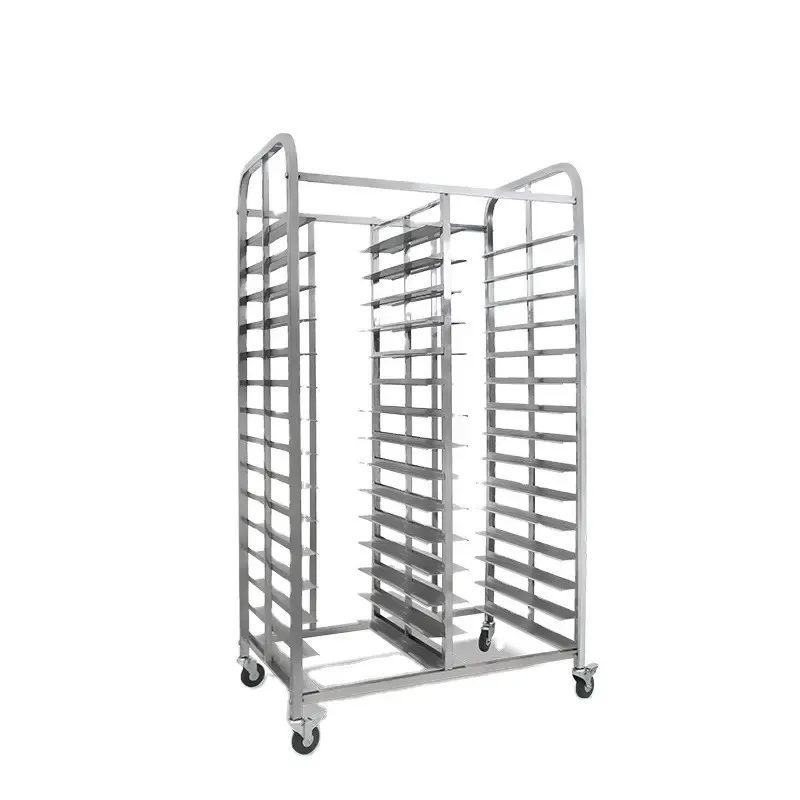
Commercial Baking Rack Trolley: A Strategic Sourcing Guide for Bakeries, Central Kitchens, and Food Processing Plants
Product Introduction: More Than Just a Rack on Wheels
In any high-volume baking or food processing environment, a commercial baking rack trolley is not merely a mobile storage unit; it is a critical component of the production workflow. These wheeled frames are designed to hold multiple baking trays or screens, allowing for efficient transport, proofing, baking, cooling, and storage of products such as bread, pastries, and prepared meals. The core problem they solve is the seamless movement of goods between different stages of production without unnecessary handling, which reduces labor costs, minimizes product damage, and ensures consistent quality. For buyers, understanding the engineering behind these trolleys is essential to selecting models that withstand the rigors of daily industrial use.
Product Features: Engineered for Demanding Environments
A well-built rack trolley is characterized by its structural integrity and material quality. Key features include:
- Reinforced frame construction: Typically made from stainless steel or aluminum, with welded joints and cross-bracing to prevent flexing under heavy loads. This is crucial for stability during repeated transportation over uneven floors.
- High-load casters: Swivel casters with brakes, often made of polyurethane or nylon, provide smooth maneuverability and reliable stopping, reducing the risk of accidents in busy kitchens.
- Corrosion resistance: Stainless steel grades such as 304 and 316 offer superior resistance to moisture, steam, and cleaning chemicals, extending the trolley's lifespan in humid bakery environments.
- Modular design: Many models feature adjustable tray slides to accommodate different tray sizes, enhancing versatility across product lines.
These features are not just about durability—they directly impact operational efficiency. For instance, the reinforced frame structure improves load stability during repeated transportation and industrial handling, which reduces downtime and maintenance costs.
Application Scenarios: From Bakeries to Industrial Manufacturing
Commercial baking rack trolleys are indispensable in various sectors:
- Bakeries: Used for proofing dough, moving trays into and out of ovens, and cooling baked goods. The trolleys must withstand high temperatures and frequent washes.
- Central kitchens and catering: Facilitate the efficient transport of prepared foods from cooking areas to blast chillers or packing lines. Stainless steel construction ensures hygiene compliance.
- Food processing plants: Serve as mobile storage for ingredients or finished products, often integrated with automated conveyor systems. The trolleys must be compatible with plant layouts and cleaning protocols.
- Industrial manufacturing: Beyond food, these trolleys are used for drying, curing, or storing components in automotive and electronics industries, where ESD-safe or heat-resistant versions are required.
- Cleaning and drying: In facilities that require frequent sanitation, trolleys with open designs and smooth surfaces allow for thorough cleaning and rapid drying, preventing bacterial growth.
Each application demands specific design considerations. For example, a bakery might prioritize heat resistance, while a food processing plant may need trolleys that are fully welded for hygiene.
Material Selection: 304 vs. 316 vs. 201 Stainless Steel and Aluminum
The choice of material significantly affects performance, longevity, and cost. Here's a breakdown:
- 304 stainless steel: The industry standard for food-grade applications. Offers excellent corrosion resistance, good formability, and withstands typical cleaning chemicals. Ideal for most bakery and kitchen environments.
- 316 stainless steel: Contains molybdenum, providing superior resistance to chlorides and acids. Recommended for coastal areas, meat processing, and facilities using aggressive sanitizers. Higher cost but longer service life in harsh conditions.
- 201 stainless steel: A lower-cost alternative with moderate corrosion resistance. Suitable for dry storage or light-duty applications but may rust in humid environments. Not recommended for direct food contact or frequent washing.
- Aluminum: Lightweight and corrosion-resistant (naturally forms an oxide layer), but less strong than stainless steel. Often used for trolleys that need to be frequently lifted or moved. However, it can dent under heavy impacts and may not withstand high-temperature oven loading.
When specifying, consider the operating environment, cleaning regimen, and load requirements. For a central kitchen with daily washdowns, 304 or 316 is a wise investment.
Specifications: Key Parameters for Procurement
B2B buyers should evaluate the following specifications to ensure compatibility with existing trays and processes:
- Dimensions: Overall length, width, and height (e.g., 26" x 18" x 70"). Must match tray sizes and door clearances.
- Thickness: Tube wall thickness (e.g., 1.2mm to 2.0mm) affects load capacity and durability. Thicker is generally better for heavy-duty use.
- Capacity: Number of trays or weight load (e.g., 10 trays, 250 kg).
- Number of layers: Typically 6 to 20, with adjustable spacing.
- Load capacity: Static and dynamic load ratings. Dynamic load is critical for safe movement.
- Hole size and mesh: For perforated trays, hole diameter and pattern affect airflow and drainage. For wire mesh, mesh count and wire diameter determine strength and cleanliness.
- Tray compatibility: Standard tray sizes include 18" x 26", 16" x 24", etc. Ensure slide spacing accommodates your trays.
- Surface treatment: Polished, brushed, or coated. Polished surfaces are easier to clean but may show scratches; brushed finishes hide wear better.
Always request a detailed specification sheet and, if possible, a sample for testing.
Customization Services: Tailoring to Your Production Needs
As a manufacturer with extensive OEM/ODM experience, we understand that standard trolleys may not fit every operation. Our customization capabilities include:
- Custom sizes: Modify dimensions to fit specific oven or proofer openings.
- Custom designs: Adjust tray slides, add handles, or integrate RFID tags for tracking.
- Logo and branding: Laser-etch or attach branded plates for fleet identification.
- Packaging: Custom crating for safe ocean transport, with or without pallets.
- Special requirements: ESD-safe coatings, heat-resistant wheels, or reinforced frames for heavy loads.
For custom requirements, please contact our team to discuss your project. We provide engineering support and rapid prototyping.
Procurement Guide: How to Choose the Right Trolley and Supplier
When purchasing commercial baking rack trolleys, consider these factors:
- Size selection: Measure your trays, oven, and storage areas. Consider future product lines. A trolley that is too wide may not fit through doors; too narrow may reduce efficiency.
- Material choice: Match to your cleaning chemicals and environment. For high-humidity areas, 304 is minimum; for acidic foods, 316.
- Specification confirmation: Request CAD drawings and load test reports. Verify caster quality (e.g., brands like Blickle or Colson).
- Supplier assessment: Evaluate manufacturing capabilities: Do they have in-house welding, polishing, and testing? Check certifications (ISO 9001, NSF). Request references from similar industries.
A reliable supplier will offer technical support and after-sales service. Avoid those who cannot provide detailed specifications or samples.
Frequently Asked Questions (FAQ)
Q1: What is the typical lead time for a custom commercial baking rack trolley?
A1: Lead time varies based on complexity and order quantity. For standard models, 15-20 days; for custom designs, 25-35 days after drawing approval. We prioritize efficient production without compromising quality.
Q2: Can these trolleys be used in freezers or blast chillers?
A2: Yes, but you must specify low-temperature casters and materials that withstand thermal shock. Stainless steel 304 is suitable for -40°C to 200°C with proper design.
Q3: How do I ensure the trolley is compatible with my existing trays?
A3: Provide us with your tray dimensions (length, width, thickness) and we will adjust the slide spacing and frame size accordingly. We can also produce custom trays if needed.
Q4: What is the difference between welded and riveted construction?
A4: Welded frames are stronger and more durable, with no crevices for bacterial growth—ideal for food safety. Riveted frames are cheaper but may loosen over time and are harder to clean.
Q5: Do you offer samples for evaluation?
A5: Yes, we provide samples for a fee, which is refundable upon bulk order. This allows you to test the trolley in your actual production environment.
Q6: What surface finish is best for hygiene?
A6: A polished or brushed finish with a roughness average (Ra) of ≤0.8 µm is recommended for food contact areas. It prevents residue buildup and facilitates cleaning.
Q7: How often should casters be maintained or replaced?
A7: Inspect casters monthly for wear and debris. Under normal use, quality casters last 2-3 years. Replace immediately if wheels are flat-spotted or bearings are noisy.
Q8: Can I mix and match different trolley sizes in one order?
A8: Absolutely. We accommodate mixed orders to suit your diverse needs, with no minimum order quantity per size for custom projects.
For further assistance or to request a quote, please reach out to our sales team. We are committed to providing high-quality, durable solutions for your commercial baking needs.
Image ALT text suggestion: "Commercial baking rack trolley with 10 layers of stainless steel trays in a bakery setting."
SEO Title: Commercial Baking Rack Trolley | B2B Sourcing Guide
Meta Description: Expert guide for B2B buyers on commercial baking rack trolleys. Learn about materials, specs, and customization for bakeries and food plants. Request a quote today.
SEO Keywords: commercial baking rack trolley, bakery rack trolley, stainless steel trolley, food processing trolley, custom baking rack, industrial baking trolley, rack trolley manufacturer, baking tray trolley, central kitchen trolley, OEM baking trolley

