


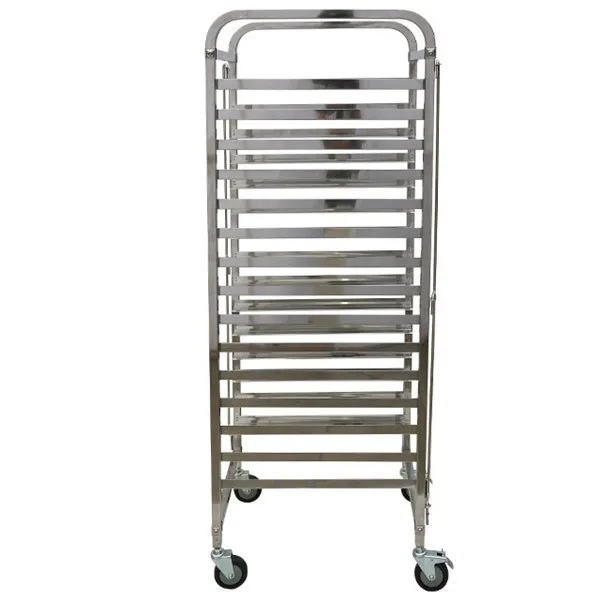
Commercial Kitchen Trolley Stainless Steel: A B2B Procurement Guide for Industrial Buyers
Product Overview: What Is a Commercial Kitchen Trolley Stainless Steel?
A commercial kitchen trolley stainless steel is a mobile platform designed for transporting goods, ingredients, or waste in demanding environments. Unlike consumer-grade carts, these trolleys are engineered for continuous use in food processing plants, commercial bakeries, industrial kitchens, and pharmaceutical cleanrooms. They solve key problems: reducing manual handling injuries, maintaining hygiene standards, and improving workflow between preparation, cooking, and storage zones. For B2B buyers, the trolley is not a one-size-fits-all item—it's a configurable tool that must match load profiles, cleaning protocols, and space constraints.
Product Features: Engineering for Industrial Durability
Industrial trolleys differ from retail models in several critical ways. First, the reinforced frame structure—often using 1.2mm to 2.0mm wall thickness—improves load stability during repeated transportation and industrial handling. Second, welded joints replace bolts to eliminate crevices where bacteria can harbor. Third, heavy-duty casters with sealed bearings resist water, grease, and chemicals. Key performance characteristics include:
- Load capacity: Typically 150kg to 500kg, depending on design.
- Corrosion resistance: Stainless steel grades 304 and 316 offer varying levels of protection.
- Cleanability: Smooth surfaces and rounded corners meet HACCP and FDA requirements.
- Mobility: Swivel casters with brakes enable precise positioning in tight spaces.
Application Scenarios Across Industries
Different sectors require tailored trolley configurations. In food processing, trolleys transport raw materials to assembly lines and finished products to packaging. Bakery operations use multi-tier trolleys for proofing and cooling racks. Industrial manufacturing relies on heavy-duty trolleys for parts movement between workstations. Cleaning crews use trolleys with integrated buckets and wringers. Drying applications employ ventilated shelves for airflow. Storage and transportation benefit from stackable or nesting designs. For example, a meat processing plant might use a 304 stainless steel trolley with solid shelves for raw product, while a pharmaceutical cleanroom requires a 316 stainless steel trolley with perforated shelves for autoclaving.
Material Selection: 304 vs. 316 vs. 201 Stainless Steel and Aluminum
Material choice directly impacts lifespan, hygiene, and cost. 304 stainless steel is the industry standard for most food and beverage applications—it offers excellent corrosion resistance and formability. 316 stainless steel adds molybdenum for superior resistance to chlorides and acids, making it ideal for coastal facilities or chemical processing. 201 stainless steel is a lower-cost alternative with reduced nickel content; it is acceptable for dry storage but not for wet or acidic environments. Aluminum trolleys are lightweight and corrosion-resistant but softer and less durable under heavy loads. For B2B buyers, the rule is simple: match the material to the most aggressive cleaning agent and food type used in your facility.
Specifications: What to Look for in a Quote
When requesting quotes from a manufacturer or supplier, specify these parameters:
- Dimensions: Length, width, and height (e.g., 1200mm x 600mm x 900mm).
- Thickness: Sheet metal thickness (1.0mm, 1.2mm, 1.5mm, 2.0mm).
- Capacity: Uniform load rating in kilograms.
- Number of shelves: 2, 3, 4, or custom.
- Load per shelf: Ensure even distribution.
- Perforation: Hole diameter (e.g., 5mm, 10mm) and pitch.
- Mesh size: For wire mesh trolleys.
- Tray compatibility: Standard GN pan sizes or custom trays.
- Surface finish: Brushed, polished, or electropolished.
Providing these details to your supplier reduces back-and-forth and ensures the final product meets operational needs.
Customization: OEM/ODM Capabilities for Your Brand
A capable manufacturer offers full OEM/ODM services. This includes custom sizes to fit existing racking or pass-through windows, custom designs such as folding shelves or hitches for towing, logo application via laser etching or plate mounting, and special packaging for export. Some buyers require trolleys that integrate with conveyor systems or lift gates. When evaluating a factory, ask about their engineering support, prototyping lead times, and minimum order quantities. For custom requirements, please contact our team to discuss your specifications.
Procurement Guide: How to Choose the Right Trolley and Supplier
Selecting the right trolley involves four key decisions:
- How to choose size: Measure doorways, aisles, and storage areas. Allow at least 100mm clearance on each side for maneuverability.
- How to choose material: Use 304 for general foodservice, 316 for high-chloride or pharmaceutical, 201 for dry storage only.
- How to confirm specifications: Request a detailed drawing with tolerances and a material certificate.
- How to judge supplier capability: Look for ISO 9001 certification, in-house welding and polishing, and references from similar industries. A factory that produces trolleys as a core product line will have better quality control than a trading company.
Additionally, consider total cost of ownership: a cheaper 201 trolley may need replacement in 12 months, while a 304 trolley lasts 5–10 years. For high-volume buyers, negotiate a spare parts kit (casters, bolts) and a maintenance schedule.
Frequently Asked Questions (FAQ)
Q1: What is the typical lead time for a custom commercial kitchen trolley?
A1: For standard sizes, 15–25 days after deposit. For fully custom designs, 30–45 days including prototyping and approval.
Q2: Can I mix 304 and 316 stainless steel on the same trolley?
A2: Yes, but it is not recommended due to galvanic corrosion risk. Use a single grade throughout, or isolate with plastic washers.
Q3: What casters are best for wet environments?
A3: Choose stainless steel or polyurethane casters with sealed bearings. Avoid zinc-plated casters, which rust quickly.
Q4: How do I clean a stainless steel trolley to maintain hygiene?
A4: Use warm water, mild detergent, and a soft cloth. Avoid abrasive pads and chloride-based cleaners, which can pit the surface.
Q5: Do you provide samples for evaluation?
A5: Yes, we can provide a sample for a fee, refundable against a bulk order. Contact our sales team for details.
Q6: What is the MOQ for OEM orders?
A6: Our MOQ is typically 50 units for custom sizes, but we can accommodate smaller trial orders for new customers.
Q7: Can trolleys be nested or stacked for storage?
A7: Yes, we offer nesting designs that save up to 60% of floor space when not in use.
Q8: What surface finish is easiest to clean?
A8: Electropolished surfaces are the smoothest and most hygienic, but brushed finishes are more cost-effective for general use.
Image ALT text suggestion: "Stainless steel commercial kitchen trolley with three shelves and heavy-duty casters in a food processing plant."
SEO Title: Commercial Kitchen Trolley Stainless Steel | B2B Guide
Meta Description: Industrial stainless steel trolleys for food processing, bakery, and manufacturing. Custom sizes, 304/316 material, OEM service. Get a quote today.
SEO Keywords: commercial kitchen trolley stainless steel, stainless steel trolley manufacturer, industrial kitchen cart, food processing trolley, 304 stainless steel trolley, custom kitchen trolley, bakery trolley supplier, heavy duty trolley, stainless steel cart OEM, commercial trolley specifications

