


Custom Bakery Equipment Solutions: A Strategic Guide for B2B Procurement and Industrial Food Manufacturing
Product Introduction: What a Custom Bakery Equipment Solution Actually Entails
When procurement managers search for a custom bakery equipment solution, they are rarely looking for an off-the-shelf mixer or a standard oven. Instead, they are seeking an engineered system—often a combination of conveyorized proofers, tunnel ovens, automated depositors, and cooling tunnels—designed to fit within a specific footprint, throughput requirement, and existing workflow. The core problem this solves is the misalignment between generic equipment and unique production goals: a standard rack oven may not handle the volume of a high-speed bread line, while a standard conveyor may damage delicate pastries during transfer.
From a factory perspective, a true custom solution begins with a detailed process audit. We evaluate dough rheology, bake curves, and hygiene protocols before specifying a single component. This ensures the equipment not only meets output targets but also integrates with upstream and downstream systems, reducing manual handling and minimizing downtime during changeovers.
Product Features: Engineering for Industrial Durability and Performance
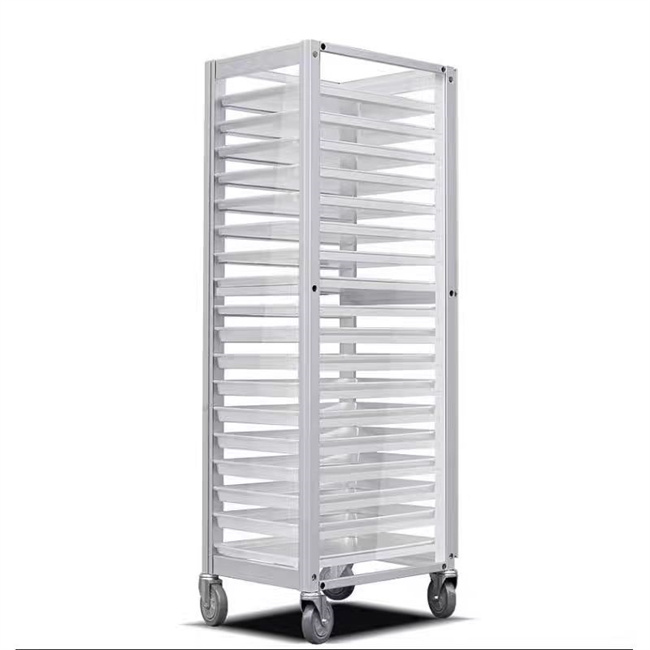
Industrial bakery environments are harsh: high humidity, flour dust, sugar residues, and daily washdowns with caustic cleaners. Therefore, a custom solution must be built around modular, heavy-gauge stainless steel frames rather than thin-gauge alternatives. The reinforced frame structure improves load stability during repeated transportation and industrial handling, particularly when conveying heavy dough pieces or full trays of proofed products.
Key structural and performance features include:
- Sanitary design: Continuous welded seams, radius corners, and sloped surfaces to prevent debris accumulation and facilitate cleaning.
- Modular conveying systems: Interchangeable belt types (wire mesh, plastic modular, or solid urethane) to handle everything from sticky dough to fragile baked goods.
- Precision temperature control: Zoned heating with PID controllers and independent thermocouples to maintain ±2°C accuracy across the baking chamber, critical for consistent crust color and crumb structure.
- Automated synchronization: Variable frequency drives (VFDs) that match conveyor speed to proofing time and oven residence time, eliminating bottlenecks.
Application Scenarios: Where Custom Solutions Deliver the Most Value
While standard equipment works for low-volume artisan shops, custom bakery equipment solutions shine in the following industrial contexts:
- High-volume bread and bun lines: Custom tunnel ovens with independent top/bottom heat control and steam injection for crusty artisan breads. These systems handle 2,000 to 12,000 pieces per hour and integrate with automatic depanning and cooling conveyors.
- Frozen dough and par-baked production: Blast freezers and spiral coolers designed to rapidly reduce core temperature from 90°C to -18°C within a specified time, preserving texture. Custom airflow patterns prevent surface dehydration.
- Pastry and laminated dough processing: Dough sheeters and laminators with chilled rollers and precise gap adjustments to prevent fat smearing, followed by custom conveyorized proofers with humidity control.
- Industrial cleaning and drying: Custom tray and rack washers with high-pressure nozzles and air-knife drying zones, designed to fit specific rack dimensions and throughput needs.
- Storage and transportation: Stainless steel racks and trolleys with reinforced casters and stackable designs for blast freezers and transport trucks, ensuring product integrity from factory to retail.
In each scenario, the solution is not just a machine but a process-matched system that reduces labor costs, minimizes product waste, and ensures food safety compliance (e.g., FDA, EFSA, BRC).
Material Specification: Choosing the Right Stainless Steel for Your Application
Material selection is a critical procurement decision that impacts service life, cleaning costs, and compliance. Here is a practical comparison:
- 304 stainless steel: The industry standard for most bakery equipment. Excellent corrosion resistance against flour, sugar, and mild cleaning agents. Suitable for ovens, proofers, and conveyors. Not recommended for high-chloride environments.
- 316 stainless steel: Preferred for high-humidity areas, coastal installations, or where aggressive cleaning chemicals (chlorinated foams) are used. Contains molybdenum for superior pitting resistance. Often specified for washers and drying tunnels.
- 201 stainless steel: A lower-cost alternative with lower nickel content. Acceptable for non-food-contact structural parts, trolley frames, or dry storage racks, but not recommended for wet or acidic product zones due to lower corrosion resistance.
- Aluminum: Used in some conveyor frames and baking trays for its light weight and high thermal conductivity. However, it requires protective coatings (e.g., anodizing) and is not suitable for highly alkaline cleaning agents. Not ideal for prolonged contact with salty or acidic doughs.
From a factory standpoint, we advise clients to specify 304 for all product-contact surfaces and 316 for critical washdown zones. This balances cost and longevity without compromising hygiene.
Specification Parameters: What to Confirm Before Ordering
When requesting a quote for a custom solution, purchasing teams should provide or confirm the following specifications to avoid rework and delays:
- Dimensions: Overall length, width, and height, plus available floor space and ceiling clearance. For conveyors, specify belt width and effective conveying length.
- Thickness: Frame tube thickness (e.g., 2.0 mm vs. 3.0 mm) and belt wire diameter (e.g., 1.2 mm vs. 2.0 mm). Thicker gauge increases load capacity but also weight and cost.
- Capacity: Throughput in pieces per hour (pph) or kg per hour. This determines motor power, belt speed range, and heating capacity.
- Number of layers: For proofers and ovens, specify the number of decks or conveyor tiers (e.g., 3-deck or single-tier).
- Load capacity: Maximum weight per meter or per tray (e.g., 50 kg/m). This dictates roller diameter and support spacing.
- Hole diameter and mesh opening: For wire mesh belts, specify aperture (e.g., 10 mm x 10 mm) to allow air flow while supporting product. For perforated trays, hole diameter (e.g., 5 mm) affects baking and cleaning.
- Tray compatibility: Standard tray sizes (e.g., 600 x 400 mm, 18" x 26") and rack configurations (e.g., 10 trays per rack). Custom sizes are possible but may increase lead time.
- Surface finish: Ra ≤ 0.8 µm for food contact surfaces, or bead-blasted for non-stick. Specify if passivation is required after welding.
Providing these details upfront allows our engineering team to generate a precise 3D model and quote within 5–7 working days.
Customization Services: OEM/ODM Capabilities for Global Buyers
As a manufacturer with over 15 years of experience serving food processing equipment distributors and end-users, we offer comprehensive OEM and ODM services. Our in-house capabilities include:
- Custom size and design: Modify existing models or develop new equipment from concept sketches. We use SolidWorks for design and finite element analysis (FEA) for structural validation.
- Logo and branding: Laser-etched or embossed logos on frames, control panels, and nameplates. We also provide custom packaging with your brand for direct shipment to your customers.
- Special requirements: Explosion-proof motors for dust-laden areas, washdown-rated IP65 control panels, and integration with your existing PLC or SCADA system.
- Packing: Export-grade wooden crates with moisture barrier and shock indicators for ocean transport. Custom pallet dimensions to optimize container loading.
For custom requirements, please contact our team to discuss your project. We provide dedicated project managers who speak English and German, ensuring clear communication throughout the design, production, and installation phases.
Procurement Guide: How to Select the Right Solution and Supplier
Buying custom bakery equipment is not like buying office supplies. A wrong decision can halt production for weeks. Here are practical guidelines from our experience with European and North American clients:
- How to choose the size? Start with your required throughput and available space. For example, if you need 3,000 croissants per hour, a 1.2 m wide belt with 2 zones may suffice, but if your building has a 3 m ceiling, a multi-tier spiral cooler can save floor space. Always request a layout drawing from the supplier.
- How to choose the material? Use 304 for dry areas, 316 for wet/chemical areas. Avoid 201 for product contact. If you use chlorine-based sanitizers, insist on 316 for all surfaces that may be splashed.
- How to confirm specifications? Ask for a detailed technical datasheet that includes material certificates (EN 10204 3.1), motor brand (e.g., SEW, Nord), and electrical components (e.g., Schneider, Siemens). A reputable supplier will provide these without hesitation.
- How to judge supplier capability? Request a virtual factory tour or visit in person. Check for in-house laser cutting, bending, and welding equipment. Ask for references from similar projects (e.g., a frozen dough line in Poland or a bread line in Texas). Also, review their quality control process: do they perform dye penetrant testing on welds? Do they run a dry test before shipping?
Finally, consider total cost of ownership (TCO): a cheaper machine with thin gauge steel may need replacement in 5 years, while a robust custom solution can last 15–20 years with proper maintenance.
Frequently Asked Questions (FAQ)
1. What is the typical lead time for a custom bakery equipment solution?
Lead time varies by complexity. Standard modifications take 6–8 weeks, while fully custom lines with integrated controls can take 12–16 weeks. We provide a detailed timeline after design approval.
2. Can you provide installation and training at our facility?
Yes. We offer on-site installation and commissioning services, as well as operator and maintenance training. Our technicians are available for global travel, and we can provide remote support via video call for minor issues.
3. Do you offer a warranty on custom equipment?
We provide a 24-month warranty on all mechanical and electrical components, excluding wear parts (e.g., belts, bearings). Extended warranty options are available.
4. What certifications do your machines carry?
Our equipment is CE and UL certified where applicable. We can also provide FDA-compliant materials and documentation for food safety audits.
5. Can you match our existing tray or rack size?
Absolutely. We require samples or detailed drawings of your trays/racks to ensure compatibility. We can also produce custom trays if needed.
6. How do you handle shipping and export documentation?
We ship FOB Shanghai or CIF to your nearest port. Our logistics team prepares all necessary documents, including commercial invoice, packing list, bill of lading, and certificate of origin.
7. What is your payment term?
Typically 30% deposit with the balance before shipment. For long-term partners, we can discuss LC at sight or other terms.
8. Do you provide spare parts after the warranty period?
Yes. We stock critical spares and can ship within 48 hours for urgent orders. We also offer a recommended spare parts list with your equipment.
Image ALT Text Suggestions
For optimal SEO and accessibility, use these ALT texts when uploading images of your custom equipment:
- "Custom tunnel oven with 304 stainless steel conveyor for high-volume bread production"
- "Industrial spiral cooler with 316 stainless steel frame and variable frequency drive"
- "OEM custom bakery equipment solution with laser-etched logo and modular design"
SEO Metadata
SEO Title: Custom Bakery Equipment Solutions | B2B Industrial Manufacturer
Meta Description: Engineered custom bakery equipment for food manufacturers. 304/316 stainless steel, OEM/ODM, full specs. Request a quote today.
SEO Keywords: custom bakery equipment solution, industrial bakery equipment, OEM bakery equipment, stainless steel bakery conveyor, custom tunnel oven, bakery equipment manufacturer, B2B bakery equipment, food processing equipment customization

