


Custom Food Processing Trolley: A Buyer's Guide for Industrial Applications
Product Introduction: What Is a Custom Food Processing Trolley?
A custom food processing trolley is a specialized wheeled cart designed to transport, store, and handle food products, ingredients, or equipment in industrial environments. Unlike standard carts, these trolleys are engineered to meet specific operational needs—whether it's moving heavy dough bins in a bakery, transferring raw meat in a processing plant, or drying components in a cleanroom. The primary purpose is to solve material handling challenges while maintaining hygiene standards and reducing labor. In essence, it bridges the gap between static storage and dynamic production lines, ensuring smooth workflow and minimizing contamination risks.
Product Features: Engineering for Industrial Durability
What sets a custom trolley apart is its construction. The frame is typically reinforced with cross-bracing or gussets to improve load stability during repeated transportation and industrial handling. Key features include:
- Structural Design: Welded frame or bolt-together modular options, with load ratings from 100 kg to 1000 kg. Corner bumpers and anti-vibration casters reduce product damage.
- Material Advantages: Stainless steel construction resists corrosion from frequent washdowns and chemical cleaners. Aluminum offers lightweight mobility where corrosion is less critical.
- Performance: Ergonomic handles, swivel casters with brakes, and optional shelves or trays enhance operator efficiency.
These features are not just about durability—they ensure compliance with HACCP and FDA guidelines by eliminating crevices where bacteria can hide.
Application Scenarios: Where Custom Trolleys Excel
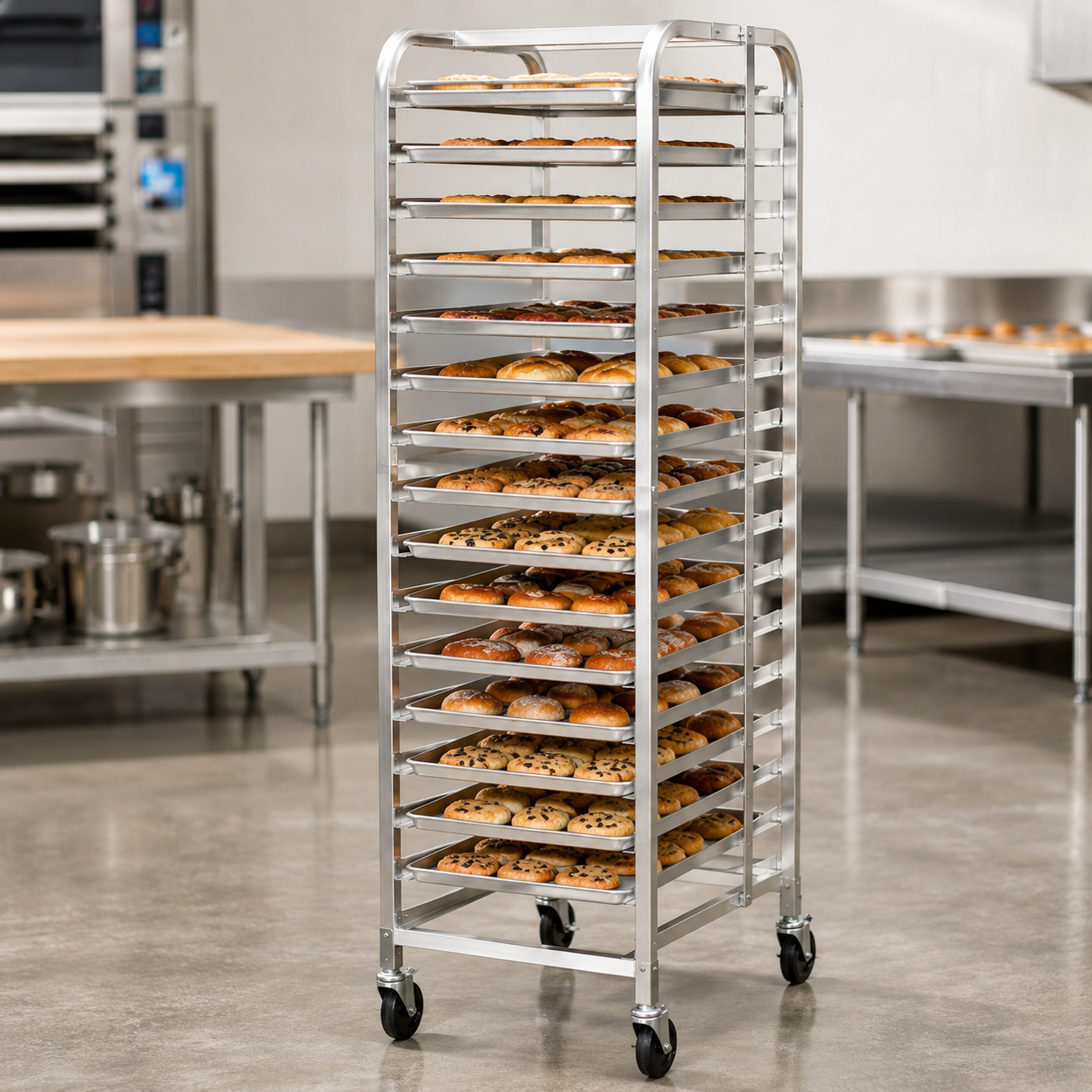
Custom food processing trolleys are indispensable across multiple industries. In food processing, they transport raw materials, work-in-progress, and finished goods between departments. In bakery operations, they hold dough troughs or baked goods on racks. Industrial manufacturing uses them to move components during assembly. Cleaning applications benefit from trolleys that carry hoses, chemicals, and waste. Drying racks allow air circulation for washed parts. Storage and transportation are optimized with nested or stacking designs to save space. For example, a meat processor might use a trolley with a perforated bottom for drainage, while a pharmaceutical cleanroom requires a fully sealed unit.
Material Selection: 201 vs. 304 vs. 316 Stainless Steel
Choosing the right material is critical for longevity and hygiene. 201 stainless steel is cost-effective but less corrosion-resistant, suitable for dry environments. 304 stainless steel is the industry standard for food contact, offering excellent resistance to most chemicals and moisture. 316 stainless steel adds molybdenum for superior resistance to chlorides and acids, ideal for seafood processing or coastal facilities. Aluminum is lightweight and rust-resistant but softer and not suitable for heavy loads. For wet or acidic environments, always specify 304 or 316. For dry storage, 201 or aluminum can reduce costs without compromising function.
Specifications: Key Parameters for Procurement
When specifying a custom trolley, procurement teams should consider:
- Dimensions: Length, width, height (commonly 800x600x900 mm or custom).
- Thickness: Frame tubing 1.5–3.0 mm; shelf thickness 1.0–2.0 mm.
- Capacity: Load capacity and volume (e.g., 200 L bin).
- Number of Shelves/Levels: 1 to 5 tiers.
- Load Rating: 150 kg to 800 kg dynamic load.
- Hole Diameter & Mesh: For drainage or ventilation, e.g., 5 mm holes or 10x10 mm mesh.
- Tray Compatibility: Standard GN pan sizes or custom inserts.
- Surface Treatment: Polished, brushed, or electropolished for easy cleaning.
Providing these details to a manufacturer ensures the trolley integrates seamlessly with existing equipment.
Customization Services: OEM/ODM Capabilities
A reliable manufacturer offers full OEM/ODM support. This includes custom size to fit through narrow aisles, custom design for unique racking or bin systems, logo branding for corporate identity, and tailored packing for sea freight. Special requirements like explosion-proof casters, grounding straps, or RFID tags can be accommodated. When evaluating a supplier, ask for 3D drawings or samples to verify fit and finish. Production capability should include in-house cutting, bending, welding, and polishing to control quality and lead times.
Procurement Guide: How to Choose the Right Trolley
Selecting a custom food processing trolley involves several decisions. First, how to choose size? Map your workflow: measure doorways, aisles, and storage areas. Consider future expansion. Second, how to choose material? Assess the environment—humidity, chemicals, temperature. For washdown areas, 304 is minimum. Third, how to confirm specifications? Request a detailed drawing with tolerances and load test reports. Fourth, how to judge supplier capability? Look for ISO 9001 certification, factory audit reports, and references from similar industries. A good supplier will ask about your process, not just sell a catalog item. For custom requirements, please contact our team to discuss your project.
Frequently Asked Questions (FAQ)
Q1: What is the typical lead time for a custom food processing trolley?
A1: Lead time varies by complexity. Standard custom designs take 4–6 weeks after drawing approval. Complex units with special materials may take 8–10 weeks. Always confirm production schedule before ordering.
Q2: Can you provide samples for evaluation?
A2: Yes, we can produce a prototype for testing, though sample costs and freight are typically borne by the buyer. For large orders, sample fees may be credited.
Q3: How do I ensure the trolley meets food safety standards?
A3: Specify 304 or 316 stainless steel with smooth, crevice-free welds. Request material certificates and compliance with FDA or EC 1935/2004. We provide full documentation.
Q4: What casters are best for my application?
A4: For high-temperature ovens, use heat-resistant phenolic casters. For wet floors, choose non-marking rubber or polyurethane. For heavy loads, consider forged steel casters with tapered bearings.
Q5: Can the trolley be nested or stacked to save space?
A5: Yes, we offer nested designs where empty trolleys interlock, reducing storage footprint by up to 60%. Stacking racks are also available.
Q6: Do you offer custom branding on the trolley?
A6: Absolutely. We can laser-etch or attach stainless steel plates with your logo. This is popular for fleet management and brand visibility.
Image ALT Text Suggestions
For SEO, use descriptive ALT text like: "Custom stainless steel food processing trolley with shelves and casters" or "304 stainless steel trolley for bakery rack transport".
SEO Meta Information
SEO Title: Custom Food Processing Trolley | Industrial Trolley Manufacturer
Meta Description: Custom food processing trolleys in 304/316 stainless steel. OEM/ODM, custom sizes, load ratings to 1000kg. Get a quote for your industrial needs.
SEO Keywords: custom food processing trolley, stainless steel trolley, industrial food cart, bakery trolley, food grade trolley, custom trolley manufacturer, food processing equipment, OEM trolley, 304 stainless steel trolley, food transport cart

