





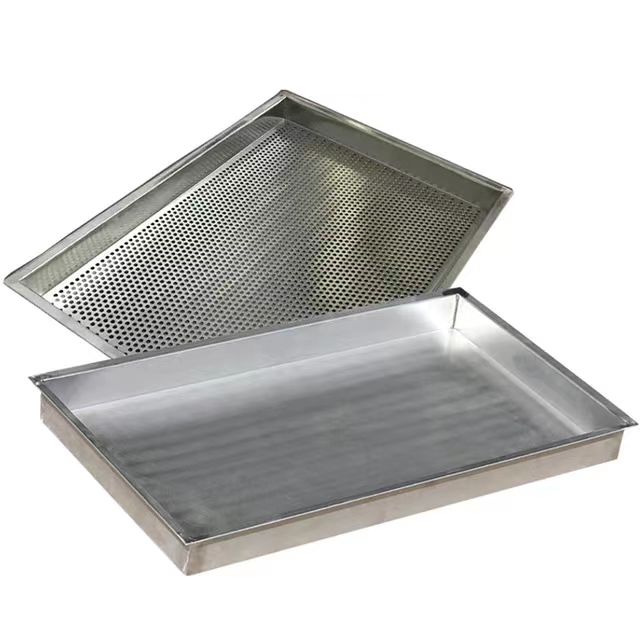
Custom Perforated Tray Manufacturer: Precision-Engineered Trays for Baking, Drying & Industrial Use
Why Choose a Custom Perforated Tray Manufacturer?
Off-the-shelf trays often compromise on fit, durability, or airflow. As a custom perforated tray manufacturer, we engineer trays around your equipment and processes. Whether you need a perforated stainless steel tray for uniform baking, a food drying tray that maximizes air circulation, or an industrial metal tray for heavy loads, a custom approach ensures efficiency, longevity, and perfect integration.
Key Specifications to Define Your Custom Perforated Tray
To produce the ideal tray, you need to provide detailed specifications. Here's what we need from you:
1. Length, Width, and Height (Overall Dimensions)
Custom trays can match your oven, dryer, rack, or conveyor system. Common sizes include 400×300 mm, 600×400 mm, and 800×600 mm, but we manufacture any dimension. Specify the tray length, width, and edge height to ensure a perfect fit for your racks or machines.
2. Sheet Thickness
We offer a range of thicknesses: 0.5, 0.6, 0.7, 0.8, 1.0, 1.1, 1.2, 1.3, 1.4, 1.5, and 2.0 mm. Thin sheets are ideal for lightweight applications, while thicker sheets provide extra strength for large trays or heavy loads. Choose based on the weight and rigidity your process demands.
3. Material Selection
Select from a variety of materials to match your environment:
- Stainless Steel 201: economical and suitable for general use.
- Stainless Steel 304: the go-to for most food processing and baking environments due to its corrosion resistance and hygiene.
- Stainless Steel 316: offers superior corrosion resistance for harsh or chemical-laden environments.
- Aluminum Alloys (1060, 3003, 5052): lightweight with excellent thermal conductivity, making them easy to handle and ideal for quick heating or cooling.
Choosing the right material impacts durability, food safety, and cost. We'll help you decide based on your application.
4. Hole Pattern, Hole Diameter, and Hole Spacing
The perforation design is crucial for airflow, drainage, and product support. We offer round holes as standard, with diameters including 1, 1.5, 2, 2.5, 3, 4, 5, 6, 8, and 10 mm. Specify the hole spacing (pitch), arrangement (staggered or straight), and open area percentage. Need a custom pattern? We can produce most shapes and layouts.
5. Perforated Area and Solid Borders
Define the perforated area inside the tray. Often, you'll want a solid border around the edges for strength and to contain liquids or small items. Specify the width of the unperforated margin (no-hole edge) on each side.
6. Edges, Reinforcements, and Handles
Choose your edge style: folded, rolled, or flat. For added strength on large trays, we can add reinforcing ribs. If you need to lift trays with gloves or tools, include handles on one or both sides for convenient handling.
7. Surface Finish and Temperature Requirements
Surface finish matters for cleaning and release. Options include brushed, matte, or electro-polished finishes. Also, specify the operating temperature range to ensure the material and finish can withstand your process without warping or degrading.
Applications of Custom Perforated Trays
Our trays serve diverse industries:
- Perforated Stainless Steel Tray: ideal for baking, roasting, and food processing, ensuring even heat distribution and fat drainage.
- Custom Baking Tray: tailored to your ovens, with precise hole patterns for consistent browning.
- Food Drying Tray: maximize airflow for dehydrators and dryers, speeding up moisture removal.
- Industrial Metal Tray: durable trays for parts washing, heat treatment, or material handling in factories.
RFQ Template for Custom Perforated Trays
To get an accurate quote, send us an RFQ with the following details:
- Material grade (e.g., 304 stainless steel)
- Overall dimensions (L × W × H) in mm
- Sheet thickness
- Hole diameter and spacing
- Open area percentage (if known)
- Perforated area boundaries
- Edge style, reinforcements, handles
- Surface finish
- Operating temperature
- Quantity and target price
Our team will respond with a detailed quote and production timeline.
Design Considerations for Optimal Performance
When designing your tray, keep in mind:
- Open Area: More holes increase airflow but reduce strength. Balance is key.
- Material Thickness: Thicker sheets allow larger holes without compromising rigidity.
- Warpage: Large trays with thin materials may warp. We can add ribs or fold edges to prevent this.
- Cleaning: Smoother finishes are easier to clean but may be more slippery. Choose accordingly.
- Food Safety: For food contact, use food-grade materials like 304 or 316 stainless steel.
Frequently Asked Questions
A: We cater to both prototypes and bulk orders. For custom dimensions and patterns, a minimum of 50 pieces is typically required, but we can discuss small-batch options.
A: Yes, we can make square, slotted, or custom-shaped holes. Please specify your exact shape and dimensions.
A: We offer brushed, matte, and electro-polished finishes. For aluminum, we can provide anodizing for extra corrosion resistance.
A: A smooth surface finish (like electro-polishing) and proper hole sizes help. For baking, consider using perforated trays with a non-stick coating (if available).
A: Yes, we can produce a sample for your approval before full production. Sample costs are usually deducted from the total order.
Get a Quote Today
Ready to optimize your process with custom perforated trays? Send us your specifications using the RFQ template above. Our engineers will review your needs and provide a cost-effective solution without compromising quality. Contact us now to discuss your project.Q: What is the minimum order quantity for custom perforated trays?Q: Can you produce trays with non-circular hole shapes?Q: What surface finishes are available?Q: How do I prevent food from sticking to the tray?Q: Can you provide samples before mass production?