


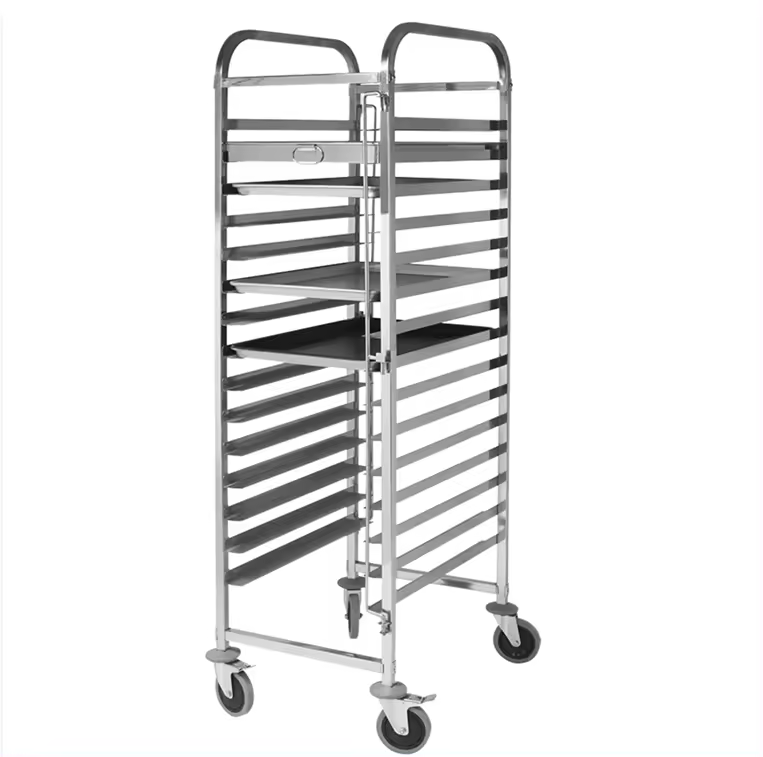
Export Bakery Trolley Supplier: A B2B Procurement Guide for Industrial Buyers
Product Introduction: What Is an Export Bakery Trolley?
An export bakery trolley, also known as a bakery rack trolley or pan transport cart, is a wheeled stainless steel or aluminum frame designed to hold multiple bakery trays or pans during production, cooling, proofing, baking, and transportation. As an export bakery trolley supplier, we manufacture these units specifically for industrial bakeries, food processing plants, and central kitchens that require reliable, hygienic, and efficient pan handling. The primary problem solved is the safe and organized movement of heavy loaded pans across different production zones, reducing manual handling, preventing product damage, and improving workflow efficiency. Unlike consumer-grade carts, export models are engineered for continuous heavy-duty use, often with reinforced welds, high-load casters, and corrosion-resistant finishes suitable for washdown environments.
Product Features: Structural Design and Performance Advantages
Industrial bakery trolleys are not simply frames on wheels. Their design directly impacts operational uptime and product safety. Key features include:
- Reinforced frame structure: The use of cross-bracing and thick-gauge tubing improves load stability during repeated transportation and industrial handling, preventing racking or deformation under uneven loads.
- High-capacity caster systems: Swivel casters with polyurethane or nylon wheels and sealed bearings ensure smooth rolling over thresholds and uneven floors, while withstanding temperatures from -20°C to 120°C in proofing or freezing rooms.
- Removable or fixed pan supports: Adjustable channel spacing allows compatibility with standard 18" x 26" bakery pans, baguette trays, or custom sheet sizes. This flexibility reduces the need for multiple trolley types.
- Hygienic design: Smooth surfaces, minimal crevices, and open tube ends (or welded caps) prevent debris accumulation, meeting HACCP and FDA requirements for food contact zones.
These features translate into fewer replacements, lower maintenance costs, and safer working conditions for operators.
Application Scenarios: Where Export Bakery Trolleys Are Used
Export bakery trolleys serve multiple industries beyond traditional bakeries. Understanding these applications helps buyers specify the right model:
- Food processing: Transporting raw ingredients, finished products, or freeze-dried items between processing lines and packaging areas. Stainless steel construction resists acidic and oily residues.
- Bakery and confectionery: Holding proofing trays, baking sheets, and cooling racks. Trolleys must withstand high temperatures from oven unloading and rapid cooling.
- Industrial manufacturing: Used for moving small parts, components, or tools in assembly lines where hygiene and durability are required.
- Cleaning and drying: In central washing areas, trolleys carry items through wash tunnels and drying ovens. Open designs allow water and air to pass freely.
- Storage and transportation: As mobile storage units in cold rooms, freezers, and dry warehouses. They reduce double handling by acting as both storage and transport.
Each scenario imposes specific requirements on materials, load capacity, and wheel type. For example, a freezer application demands low-temperature casters and non-corrosive materials, while a washdown area requires fully sealed bearings and 304 stainless steel.
Material Selection: 304 vs. 316 vs. 201 Stainless Steel and Aluminum
The material choice directly affects lifespan, hygiene, and cost. Here is a practical comparison for B2B buyers:
- 304 stainless steel: The industry standard for food contact. Excellent corrosion resistance to most acids, alkalis, and cleaning agents. Suitable for bakeries, food processing, and general washdown. Contains 18% chromium and 8% nickel.
- 316 stainless steel: Adds molybdenum for superior resistance to chlorides and harsh chemicals. Recommended for coastal areas, meat processing, and pharmaceutical applications where salt or brine is present. Higher cost but longer life in aggressive environments.
- 201 stainless steel: Lower nickel content, offering moderate corrosion resistance at a lower price. Suitable for dry storage or light-duty applications with minimal moisture. Not recommended for frequent washdown or acidic foods.
- Aluminum: Lightweight and rust-resistant, but softer and less durable under heavy loads. Often used for non-food industrial trolleys or where weight reduction is critical. Not suitable for high-temperature oven areas.
For export orders, we advise clients to specify the material based on their cleaning regime, load weight, and environmental conditions. A common mistake is selecting 201 for a wet environment, leading to premature rust and contamination risks.
Specifications: Key Parameters Buyers Must Confirm
When requesting a quote, providing precise specifications ensures you receive the correct product. Below are critical parameters:
- Overall dimensions: Length x width x height (e.g., 1200 x 800 x 1800 mm). Consider doorways, aisles, and oven openings.
- Tube thickness: Typically 1.0 mm to 1.5 mm for frame, 1.2 mm to 2.0 mm for load bars. Thicker walls increase load capacity but add weight.
- Number of layers: From 6 to 20+ tiers. More layers increase height and require stable base design.
- Load capacity: Static and dynamic load ratings. A common industrial trolley holds 250 kg to 500 kg evenly distributed.
- Pan compatibility: Channel spacing, width, and depth must match your existing pans. Standard bakery pan is 18" x 26" (457 x 660 mm). Custom sizes available.
- Surface treatment: Polished, brushed, or electrophoretic coating. Polished surfaces are easier to clean but show scratches; brushed hides wear.
- Caster specifications: Wheel diameter (100 mm to 200 mm), material (polyurethane, nylon, rubber), brake options, and temperature range.
We recommend buyers provide a sample pan or detailed drawing to avoid compatibility issues. Our engineering team reviews every specification before production.
Customization Services: OEM and ODM Capabilities
As a manufacturer with over 15 years of experience, we offer full OEM and ODM services for export bakery trolleys. Customization options include:
- Custom size and design: Non-standard dimensions, unique frame configurations, or integrated features like hooks or shelves.
- Logo and branding: Laser-etched or printed logos on frames or nameplates.
- Packing: Custom crates, palletized packaging, or knock-down designs to reduce shipping volume.
- Special requirements: Anti-static wheels, high-temperature casters, or reinforced bases for earthquake zones.
Our production capability includes automatic tube cutting, robotic welding, and pickling passivation lines, ensuring consistent quality across large orders. For custom requirements, please contact our team with your drawings or samples.
Procurement Guide: How to Choose the Right Supplier and Product
Selecting an export bakery trolley supplier involves more than comparing prices. Here are practical guidelines:
- How to choose size? Measure your largest pan and your narrowest aisle. Add 50-100 mm clearance for easy movement. Consider future pan sizes—adjustable channels offer flexibility.
- How to choose material? Match material to cleaning chemicals and environment. For daily washdown with alkaline cleaners, 304 is minimum. For salty or acidic products, upgrade to 316.
- How to confirm specifications? Request a detailed drawing with tolerances. Ask for load test reports and material certificates. A reputable supplier will provide these without hesitation.
- How to judge supplier capability? Look for in-house welding, passivation, and testing facilities. Check export experience to your region, and request references from similar industries. A factory audit or video tour is highly recommended.
Common pitfalls include underestimating load capacity, ignoring caster quality, and choosing a supplier without food-grade material certification. Always request a pre-production sample for large orders.
Frequently Asked Questions (FAQ)
Q1: What is the typical lead time for export bakery trolleys?
A: For standard models, lead time is 20-30 days after deposit. Custom orders may take 35-45 days depending on complexity and order quantity. We provide a production schedule upon order confirmation.
Q2: Can you produce trolleys that fit our existing pans?
A: Yes. We manufacture to your pan dimensions. Please provide a sample or detailed drawing (length, width, depth, and any flanges). We will confirm channel spacing and load bar design before production.
Q3: What is the difference between 304 and 316 stainless steel for bakery trolleys?
A: 304 offers good corrosion resistance for most bakery environments. 316 contains molybdenum for enhanced resistance to chlorides and harsh chemicals, making it suitable for meat processing, coastal areas, or frequent exposure to salty products. 316 costs about 20-30% more but extends service life in aggressive conditions.
Q4: Do you offer custom logo and packaging?
A: Yes. We can laser-etch or print your logo on the frame or nameplate. Packaging can be customized with your branding, and we offer knock-down designs to reduce shipping costs.
Q5: What is the load capacity of your standard bakery trolley?
A: Our standard 10-tier trolley with 1.2 mm tubes and 125 mm casters has a dynamic load capacity of 300 kg and static load of 500 kg. Higher capacities are available with reinforced frames and larger casters.
Q6: How do I maintain stainless steel bakery trolleys?
A: Regular cleaning with mild detergent and warm water is sufficient. Avoid chloride-based cleaners on 304. For stubborn stains, use a non-abrasive pad. Periodic passivation is recommended in harsh environments to maintain corrosion resistance.
Q7: What are the shipping terms and packaging methods?
A: We ship FOB, CIF, or DDP based on your preference. Trolleys are typically wrapped in protective film, then packed in plywood crates or pallets. Knock-down packing can reduce volume by up to 40%.
Q8: Can you provide samples for evaluation?
A: Yes, we offer pre-production samples for a fee, which is refundable upon bulk order. Sample lead time is 7-10 days. Please contact our team to discuss your sample requirements.
For custom requirements, please contact our team to receive a detailed quote and technical drawing within 24 hours.
Image ALT text suggestion: "Export bakery trolley with 10 tiers of stainless steel pans in a commercial bakery"
SEO Title: Export Bakery Trolley Supplier | Industrial Bakery Rack Manufacturer
Meta Description: Looking for a reliable export bakery trolley supplier? We manufacture 304/316 stainless steel bakery racks for food processing, with custom sizes and OEM service.
SEO Keywords: export bakery trolley supplier, bakery rack manufacturer, stainless steel bakery trolley, industrial bakery cart, custom bakery trolley, bakery pan trolley, food processing trolley, OEM bakery trolley

