


Fine Mesh Tray Sourcing Guide: What Industrial Buyers Need to Know Before Ordering
Why Fine Mesh Trays Matter in Industrial Procurement
When you're sourcing a fine mesh tray for a food processing line, a pharmaceutical drying operation, or a bakery production floor, you're not just buying a piece of metal. You're buying into a supply chain decision that affects hygiene compliance, throughput consistency, and long-term operating cost. Industrial buyers—whether importers, distributors, or OEM engineers—need to evaluate mesh trays the same way they evaluate any critical component: by looking at material traceability, manufacturing tolerances, and the supplier's ability to scale with demand.
This guide is written from the perspective of a manufacturer that has worked with European and North American buyers for years. It covers what actually matters when you're placing a purchase order for fine mesh trays, from material selection to custom fabrication and quality control.
Product Introduction: What a Fine Mesh Tray Actually Does
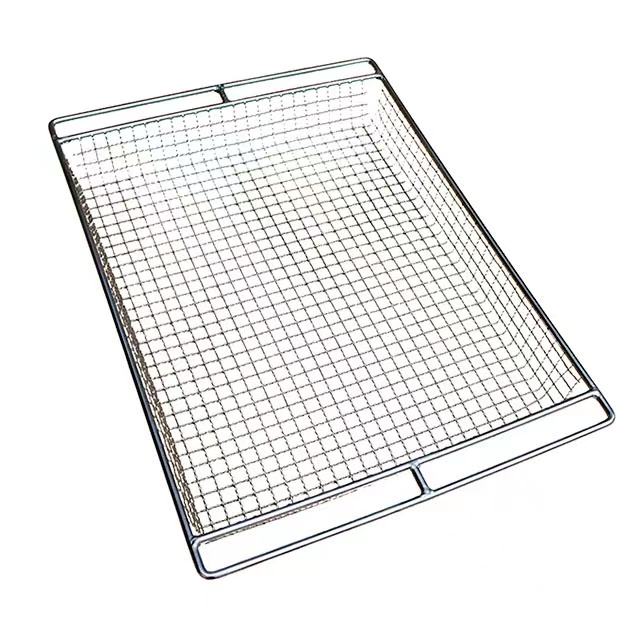
A fine mesh tray is a stainless steel or aluminum tray constructed with a woven wire mesh base and a reinforced frame. Unlike solid-sheet trays, the mesh design allows for rapid drainage, airflow, and heat transfer, making it ideal for processes where moisture, steam, or particulates need to pass through while the product stays contained.
In industrial settings, these trays are used in continuous production environments where hygiene, load stability, and long-term reliability are non-negotiable. They solve several production problems at once: they eliminate water pooling during washing, they enable uniform drying in oven and air-drying systems, and they reduce product loss by keeping small items contained. For food processors, pharmaceutical manufacturers, and industrial parts cleaning operations, the fine mesh tray is often a critical handling component rather than an afterthought.
From a procurement standpoint, the decision to source fine mesh trays usually comes down to three factors: compatibility with existing equipment, compliance with industry hygiene standards, and supplier reliability. A tray that doesn't fit your conveyor system or fails under repeated wash cycles creates downtime that costs far more than the tray itself.
Product Features and Engineering Advantages
Not all fine mesh trays are built to the same standard. The differences show up in structural design, welding quality, and surface treatment. Here's what to look for:
- Reinforced frame design – Improves load stability during repeated transportation and high-frequency industrial handling. A flimsy frame leads to deformation, which affects stacking and conveyor fit.
- Uniform mesh opening – Ensures consistent airflow and drainage. Irregular openings can cause uneven drying or allow small products to fall through.
- Precision welding or riveting – Reduces the risk of wire breakage and extends service life in high-vibration environments.
- Corrosion-resistant surface – Passivation or electropolishing improves resistance to cleaning chemicals and extends tray life.
- Stackable and nestable options – Saves storage space and improves handling efficiency in high-volume operations.
Manufacturing details matter. For example, a tray used in a bakery proofing room faces different stresses than one used in a pharmaceutical freeze-drying process. The wire diameter, mesh count, and frame thickness should be specified based on the load, temperature, and chemical exposure the tray will face.
Application Scenarios: Where Fine Mesh Trays Are Used
Fine mesh trays appear across a wide range of industries, but the requirements differ significantly by application:
- Food processing – Used for washing, blanching, cooling, and freezing. Mesh allows water and steam to pass through while keeping product contained. 304 stainless steel is the standard for food contact.
- Bakery and confectionery – Proofing, baking, and cooling trays. Mesh provides even heat distribution and prevents soggy bottoms.
- Pharmaceutical – Drying and sterilizing trays for granules, tablets, and glassware. 316 stainless steel is often required for chemical resistance and cleanability.
- Industrial parts cleaning – Degreasing, ultrasonic cleaning, and drying of small components. Mesh trays allow cleaning fluids to drain and air to circulate.
- Laboratory and research – Sample drying, storage, and autoclaving. Smaller mesh sizes are common.
- Commercial production – Any operation that requires batch handling with airflow or drainage, from meat processing to electronics manufacturing.
Each application has its own priorities. A food processor might prioritize easy cleaning and corrosion resistance, while an industrial cleaning operation might focus on load capacity and chemical compatibility. Understanding the end-use environment is the first step in specifying the right tray.
Material Options and Manufacturing Details
The material you choose affects cost, lifespan, and compliance. Here's a practical breakdown:
- 304 stainless steel – Provides reliable corrosion resistance for food contact applications and daily industrial cleaning environments. Suitable for most food processing, bakery, and general industrial uses. Good balance of cost and performance.
- 316 stainless steel – Offers superior resistance to chlorides, acids, and harsh chemicals. Recommended for pharmaceutical, chemical processing, and marine environments. Higher cost but longer service life in aggressive conditions.
- 201 stainless steel – Lower-cost option with moderate corrosion resistance. Suitable for dry environments or applications where chemical exposure is minimal. Not recommended for frequent wet or acidic contact.
- Aluminum – Lightweight and corrosion-resistant when anodized. Often used in baking and low-temperature drying. Not suitable for high-temperature or high-load applications.
Surface treatment also matters. Electropolishing creates a smooth, non-stick surface that resists bacterial adhesion and makes cleaning easier. Passivation removes free iron from the surface, improving corrosion resistance. For food and pharmaceutical applications, these treatments are often specified in the purchase order.
Specifications and Technical Parameters
When requesting a quotation, provide as much detail as possible. Here are the key parameters industrial buyers should confirm:
- Size – Length, width, and height. Custom sizes are available based on equipment dimensions and production requirements.
- Mesh opening – Measured in millimeters or mesh count. Determines what passes through and what stays on the tray.
- Wire diameter – Affects strength and open area. Typical range: 0.5 mm to 3 mm.
- Frame thickness – Usually 1 mm to 3 mm, depending on load requirements.
- Load capacity – Static and dynamic load ratings. Specify if trays will be stacked or moved on conveyors.
- Surface treatment – Passivation, electropolishing, or coating.
- Production tolerance – Typically ±1 mm to ±2 mm for custom trays. Tighter tolerances may be available for automated handling systems.
- Tray compatibility – Confirm that the tray fits your existing racks, ovens, or conveyor systems.
If you don't have exact specifications, describe the application and operating conditions. A reputable manufacturer can recommend suitable parameters based on experience.
Custom OEM Manufacturing Service
Many industrial buyers require trays that fit specific equipment or meet unique process requirements. OEM manufacturing services typically include:
- Custom size and design – Trays built to your drawings or samples.
- Material selection – Guidance on the best grade for your application.
- Logo marking – Laser-etched or stamped branding for distributors and OEMs.
- Special packaging – Custom cartons, pallets, or private labeling for wholesale distribution.
- Prototype development – Sample production before mass manufacturing.
- Bulk production – Scalable capacity for large orders with consistent quality.
For custom requirements, please contact our team with your specifications, quantity, and target delivery date. We can provide technical feedback and a quotation within a reasonable timeframe.
Purchasing Guide for Industrial Buyers
Here's a practical checklist for evaluating fine mesh tray suppliers and placing orders:
- Confirm the working environment – Temperature, humidity, chemical exposure, and load conditions.
- Check material requirements – Food contact, pharmaceutical, or industrial. Confirm compliance with relevant standards.
- Verify equipment compatibility – Dimensions, stacking, and conveyor fit.
- Evaluate supplier production capacity – Can they handle your volume? Do they have in-house welding and surface treatment?
- Request samples – Test trays in your actual process before committing to bulk orders.
- Review quality control processes – Dimensional checks, weld strength testing, and surface inspection.
- Confirm packaging and delivery – Export packaging, lead times, and shipping terms.
Price matters, but don't let it be the only factor. A lower-priced tray that fails early or doesn't fit your equipment creates hidden costs that dwarf the initial savings.
Frequently Asked Questions
Q1: What stainless steel grade is recommended for food processing applications?
304 stainless steel is the standard for most food processing applications. It offers good corrosion resistance, is easy to clean, and complies with food contact regulations in most markets. For acidic or high-chloride environments, consider 316 stainless steel.
Q2: Can the tray size be customized?
Yes. Most manufacturers offer custom sizes based on your equipment dimensions and production requirements. Provide drawings or measurements, and the factory will confirm feasibility and lead time.
Q3: Do you provide OEM manufacturing service?
Yes. OEM services include custom sizes, material selection, logo marking, special packaging, and private labeling. MOQ varies by product and customization level. Contact the manufacturer for specific terms.
Q4: What information should buyers provide before quotation?
Provide tray dimensions, material grade, mesh opening or wire diameter, load requirements, surface treatment, quantity, and any special packaging or marking needs. If unsure, describe the application and operating conditions.
Q5: How do you control product quality?
Quality control includes incoming material inspection, dimensional checks during production, weld strength testing, surface finish inspection, and final pre-shipment inspection. Some manufacturers provide inspection reports or allow third-party inspection.
Q6: What is the typical lead time for bulk orders?
Lead time depends on order quantity, customization level, and production capacity. Standard trays may ship in 2–4 weeks. Custom orders typically require 4–8 weeks. Confirm with the supplier before placing the order.
Q7: How should fine mesh trays be maintained?
Regular cleaning with mild detergent and warm water is sufficient for most applications. Avoid abrasive cleaners that can scratch the surface. For pharmaceutical or food contact, follow your facility's sanitation procedures. Periodic inspection for wire breakage or frame deformation is recommended.
Q8: Can you provide samples before bulk production?
Yes. Most manufacturers offer samples for evaluation. Sample costs and lead times vary. For custom designs, a prototype may be required before mass production. Confirm sample policy when requesting a quotation.

