


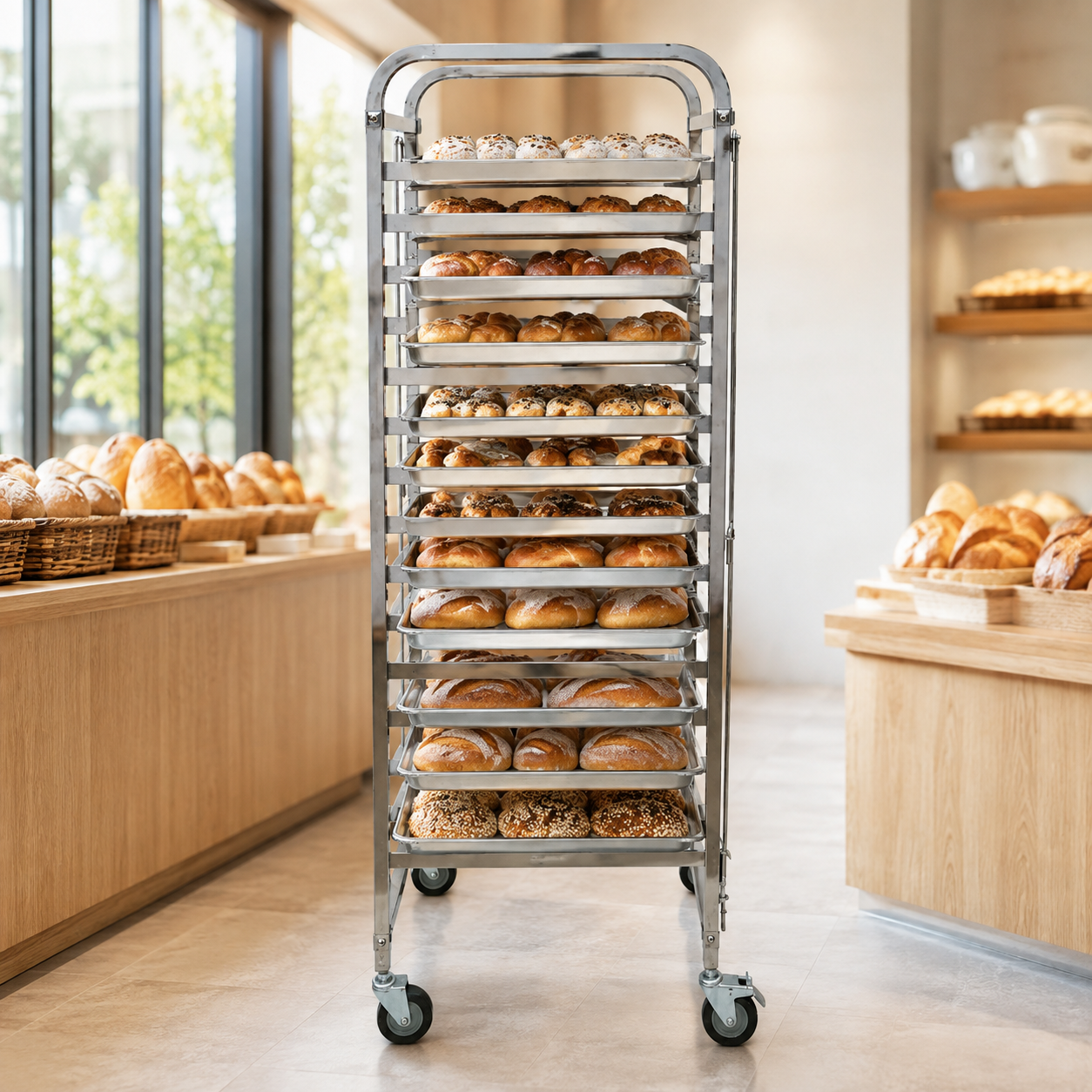
Food Drying Rack Trolley Stainless Steel: The B2B Buyer’s Guide to Industrial Drying Solutions
Product Introduction: What Is a Stainless Steel Food Drying Rack Trolley?
A food drying rack trolley stainless steel is a mobile, multi-tiered rack system designed to hold trays or mesh screens during drying, cooling, or storage processes. Unlike static racks, these trolleys feature casters for easy movement between production zones — from ovens and blast chillers to packaging lines. In industrial settings, they solve a fundamental problem: how to handle large batches of food products without compromising hygiene or worker safety. Typically used in bakeries, meat processing plants, and ready-meal factories, the trolley allows uniform airflow around each tray, accelerating drying and reducing spoilage. For B2B buyers, the key value lies in modularity, load capacity, and compliance with food safety standards (e.g., HACCP, FDA, EU 1935/2004).
Product Features: Engineering for Industrial Demands
Industrial drying trolleys are not simply scaled-up kitchen racks. Their design addresses repeated handling, heavy loads, and rigorous cleaning. Below are the core features that distinguish a professional-grade unit:
- Reinforced frame structure: Welded tube frames with cross-bracing improve load stability during repeated transportation over uneven floors. This prevents tray shifting and reduces product loss.
- Corrosion-resistant materials: 304 or 316 stainless steel construction withstands high-humidity environments and daily washdowns with alkaline or acidic detergents.
- Adjustable tray supports: Shelving pitches can be set at 50 mm, 75 mm, or 100 mm intervals to accommodate different tray depths — from 20 mm bakery trays to 65 mm meat lugs.
- High-temperature tolerance: Units can operate from -40°C (blast freezing) to +300°C (baking ovens) without warping or discoloration.
- Hygienic design: Open tube ends are sealed or capped to prevent bacterial traps. Smooth surface finishes (Ra ≤ 0.8 µm) facilitate cleaning.
- Ergonomic handles: Push/pull handles at both ends allow safe maneuvering by a single operator, reducing musculoskeletal injury risks.
These features are not marketing claims — they are driven by real-world failure modes: rack collapse under 500 kg loads, rust streaks contaminating products, or wheels seizing after grease exposure. A well-engineered trolley mitigates these risks.
Application Scenarios: Where Stainless Steel Drying Trolleys Deliver Value
Procurement engineers specify these trolleys across multiple industries, each with unique requirements:
- Food processing (meat, seafood, produce): Used for draining after washing, air-drying before packaging, or transporting between brine tanks and smokehouses. Stainless steel 316 is preferred for salty or acidic environments.
- Bakery and confectionery: Holds baguette trays, croissant screens, or chocolate molds during proofing, baking, and cooling. Trolleys must withstand 250°C oven exits and rapid cooling tunnels.
- Industrial manufacturing (non-food): In electronics or pharmaceutical plants, similar trolleys dry coated components or cleanroom garments. Here, 304 stainless steel with electropolished finish is common.
- Cleaning and sanitation: Mobile racks hold parts or utensils during ultrasonic cleaning and forced-air drying. Corrosion resistance is paramount due to detergent exposure.
- Storage and transportation: Acts as a dynamic storage system — loaded trolleys roll directly into cold rooms or trucks, eliminating double handling.
In a typical ready-meal factory, 20 trolleys with 15 shelves each can hold 1,200 trays per shift. The ability to wheel entire batches into a blast chiller then straight to packaging reduces labor by 30% compared to manual tray transfer.
Material Selection: 304 vs. 316 vs. 201 Stainless Steel and Aluminum
Material choice directly impacts service life, maintenance cost, and compliance. Here’s a practical comparison for B2B buyers:
- 304 stainless steel: The industry standard. Contains 18% chromium and 8% nickel. Excellent corrosion resistance in most food environments. Suitable for temperatures up to 870°C. Not ideal for high-chloride (salt) exposure.
- 316 stainless steel: Adds 2-3% molybdenum for superior resistance to chlorides and acids. Recommended for seafood processing, brine injection areas, and coastal facilities. Cost is 20-30% higher than 304.
- 201 stainless steel: Lower nickel, higher manganese. Cheaper but less corrosion-resistant. Only suitable for dry storage or low-humidity environments. Not recommended for washdown areas.
- Aluminum: Lightweight and conductive, but soft and prone to oxidation. Rarely used for structural frames; sometimes seen in trays or fins. Cannot withstand caustic cleaning.
For most food drying applications, 304 stainless steel offers the best balance of cost and performance. If your process involves salted products or daily acid cleaning, specify 316. Always request mill test certificates (EN 10204 3.1) to verify material composition.
Specifications: What to Include in Your RFQ
When requesting quotes from a manufacturer or supplier, provide these parameters to ensure accurate pricing and fit-for-purpose design:
- Overall dimensions: Length x width x height (e.g., 1200 x 800 x 1800 mm). Consider doorway and aisle widths.
- Tube thickness: 1.2 mm to 2.0 mm for frame; thicker for heavy loads.
- Number of shelves: 5 to 30, with adjustable pitch.
- Load capacity: Static and dynamic (e.g., 500 kg static, 300 kg moving).
- Tray compatibility: Standard Euronorm, Gastronorm, or custom sizes. Specify tray lip height.
- Wheel type: Polyurethane, nylon, or stainless steel casters. Brake options.
- Mesh opening: For drying screens, 3 mm to 10 mm aperture.
- Surface finish: Bright annealed, pickled, or electropolished. Ra value.
- Certifications: FDA, LFGB, HACCP, CE.
Example: A bakery might specify a trolley 1000 x 700 x 1750 mm, 20 shelves at 75 mm pitch, 1.5 mm tube, 304 stainless steel, 150 mm nylon wheels with brakes, electropolished finish, load 400 kg. This level of detail prevents costly rework.
Customization and OEM/ODM Services
Off-the-shelf trolleys rarely fit every production line. A capable manufacturer offers:
- Custom sizes: Modify height, width, or shelf count to match existing trays or oven chambers.
- Custom design: Removable shelves, side panels, or drainage channels.
- Logo and branding: Laser-etched or plate-mounted logos for fleet identification.
- Packaging: Knock-down or fully assembled, with custom crating for export.
- Special requirements: Anti-microbial coatings, RFID tags for tracking, or explosion-proof wheels for hazardous areas.
When evaluating a supplier’s customization capability, ask for 3D drawings, material certificates, and a sample unit lead time. A factory with in-house tube bending, welding, and polishing lines can typically deliver custom orders in 4-6 weeks.
Procurement Guide: How to Choose the Right Trolley and Supplier
B2B buyers should follow a structured approach:
- Define your process requirements: Temperature range, cleaning chemicals, load weight, and available space.
- Select material grade: 304 for general use, 316 for corrosive environments. Avoid 201 unless budget-constrained and dry.
- Confirm specifications: Request a detailed drawing with tolerances. Verify wheel load ratings and brake function.
- Assess supplier capability: Look for ISO 9001 certification, factory audit reports, and references in your industry. A manufacturer with in-house welding and polishing offers better quality control than a trading company.
- Evaluate total cost of ownership: Cheaper trolleys may need replacement in 2 years; a well-built 304 unit can last 10+ years.
- Request a sample or pilot order: Test in your actual environment before scaling.
For custom requirements, please contact our team to discuss your application. We provide engineered solutions with full documentation.
Frequently Asked Questions (FAQ)
Q1: What is the typical lead time for a custom stainless steel drying trolley?
A: For standard sizes, 3-4 weeks. For fully custom designs with new tooling, 6-8 weeks after drawing approval. Rush options may be available.
Q2: Can these trolleys be used in blast freezers at -40°C?
A: Yes, if specified with low-temperature wheels (e.g., silicone or special polyurethane) and 304 or 316 stainless steel. Standard nylon wheels may become brittle.
Q3: How do I clean and maintain the trolley to prevent rust?
A: Use alkaline or neutral cleaners, not chlorine-based. Rinse with warm water and dry. For 304, periodic passivation is recommended in high-chloride environments.
Q4: What is the maximum load capacity per shelf?
A: Depends on tube thickness and shelf design. Typically 30-50 kg per shelf for a 1.5 mm tube frame. Heavier loads require reinforced supports.
Q5: Do you offer OEM branding on the trolley?
A: Yes. We can laser-etch your logo on the frame or attach a stainless steel plate. Minimum order quantities may apply.
Q6: Are wheels included, and can I choose the type?
A: Yes. We offer polyurethane, nylon, and stainless steel casters with optional brakes. Specify your floor type and load.
Q7: What certifications should I look for?
A: FDA or EU 1935/2004 for food contact, CE for machinery, and ISO 9001 for the manufacturer. Ask for material certificates.
Q8: Can the trolley be disassembled for shipping?
A: Many designs are knock-down (KD) to save freight. Assembly takes 10-15 minutes with basic tools. We provide instructions.
Image ALT Text Suggestions
For product images, use descriptive ALT text such as: “Stainless steel food drying rack trolley with 20 shelves and nylon wheels in a bakery” or “304 stainless steel drying trolley loaded with meat trays in a processing plant”. This improves SEO and accessibility.
SEO Meta Information
SEO Title: Food Drying Rack Trolley Stainless Steel | Industrial Buyer’s Guide
Meta Description: Discover how to specify stainless steel food drying rack trolleys for food processing, bakery, and industrial drying. Custom sizes, 304/316, OEM. Get a quote.
SEO Keywords: food drying rack trolley stainless steel, industrial drying trolley, stainless steel drying rack, food processing trolley, bakery rack trolley, 304 stainless steel trolley, 316 stainless steel drying rack, custom drying trolley, OEM drying rack, food grade trolley manufacturer

