


Food Grade Stainless Steel Tray: A Sourcing Guide for Industrial Buyers
Product Introduction
In industrial food processing, the food grade stainless steel tray is not a commodity—it is a critical interface between product, process, and equipment. These trays are used for drying, cooling, freezing, baking, transporting, and storing food materials where direct contact demands hygienic, corrosion-resistant surfaces. From a manufacturer's perspective, the tray must perform under continuous production conditions: repeated washdowns, thermal cycling, and mechanical handling. A poorly specified tray can cause product contamination, line downtime, and premature replacement costs. That is why procurement teams must evaluate trays as engineered components, not simple containers. This guide is written for importers, distributors, and industrial buyers who need to source food grade stainless steel trays that meet operational and regulatory demands.
Product Features and Engineering Advantages
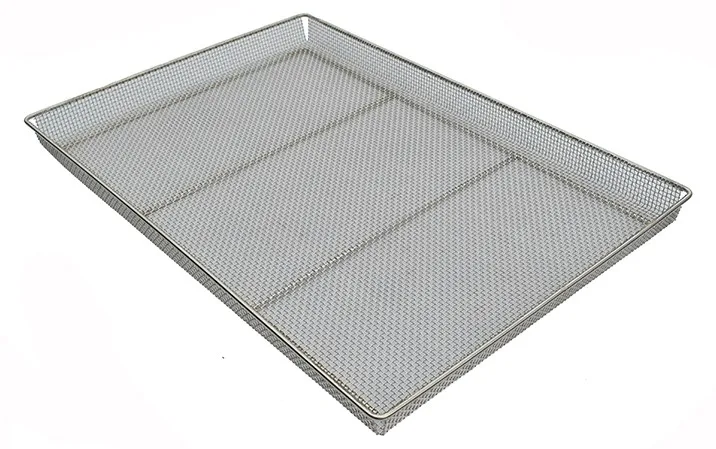
Industrial trays are engineered for durability and hygiene. The structure typically includes a reinforced frame that maintains load stability during high-frequency handling and stacking. Mesh or perforated designs allow airflow and drainage, which is essential for drying and cooling processes. Manufacturing details matter: spot welding, edge folding, and surface passivation directly affect cleanability and service life. A well-made tray resists deformation under repeated use and reduces the risk of bacterial harborage.
- High corrosion resistance – suitable for wet and acidic food environments
- Easy cleaning surface – smooth welds and burr-free edges prevent residue buildup
- Stable load capacity – reinforced frames support heavy batches without warping
- Custom manufacturing options – sizes, mesh patterns, and features tailored to equipment
For B2B buyers, these features translate to lower total cost of ownership: fewer replacements, less downtime, and easier compliance with food safety audits.
Application Scenarios
Food grade stainless steel trays are deployed across many industrial settings. In food processing, they carry raw materials through washing, blanching, and freezing lines. In bakery operations, they hold dough and baked goods during proofing and cooling. Industrial manufacturing uses trays for parts handling and drying after cleaning. Drying processes benefit from mesh trays that allow uniform airflow. Cleaning processes require trays that withstand chemical washdown and high-pressure sprays. Storage and transportation demand stackable, robust designs. Pharmaceutical and laboratory environments need trays with validated cleanability and material traceability. Commercial production lines rely on trays that integrate seamlessly with conveyor systems. Each application has specific requirements—for example, freezer trays need low-temperature toughness, while oven trays require thermal stability. Selecting the right tray for the scenario is essential to avoid process bottlenecks.
Material Options and Manufacturing Details
Material choice is a primary cost and performance driver. 304 stainless steel provides reliable corrosion resistance for food contact applications and daily industrial cleaning environments. It is the most common grade for general food processing. 316 stainless steel offers enhanced resistance to chlorides and acids, making it suitable for meat processing, marine environments, and pharmaceutical applications. 201 stainless steel is a lower-cost alternative with adequate corrosion resistance for dry or less aggressive environments, but it is not recommended for frequent wet contact. Aluminum trays are lightweight and offer good thermal conductivity, but they require coatings for food contact and are less durable in harsh washdowns. From a manufacturing standpoint, material thickness, mesh wire diameter, and surface finish (2B, BA, or electropolished) affect both performance and lead time. Buyers should specify material grade and finish based on the actual cleaning chemicals and operating temperatures.
Specifications and Technical Parameters
Industrial buyers should define key specifications to ensure compatibility and performance. Common parameters include:
- Size – customized to equipment dimensions and production requirements
- Thickness – typically 0.8mm to 2.0mm for frame and mesh
- Load capacity – from 10kg to over 100kg depending on design
- Mesh opening – 2mm to 20mm, selected for airflow and product size
- Wire diameter – 1.0mm to 3.0mm for mesh structures
- Surface treatment – passivation, electropolishing, or pickling
- Production tolerance – ±1mm for critical dimensions
For non-standard requirements, buyers should provide drawings or samples. A reputable manufacturer will confirm feasibility and offer prototypes before bulk production.
Custom OEM Manufacturing Service
Many industrial applications require custom trays that fit specific equipment or process flows. OEM manufacturing covers custom size, design, logo marking, special packaging, material selection, prototype development, and bulk production. Experienced suppliers can reverse-engineer existing trays or co-develop new designs based on process requirements. For buyers, OEM services reduce integration risks and ensure trays meet line-specific needs. It is important to evaluate a supplier's engineering support, tooling capability, and quality control systems. For custom requirements, please contact our team.
Purchasing Guide for Industrial Buyers
Effective sourcing requires a structured approach. First, define the working environment: temperature range, cleaning chemicals, and load patterns. Second, confirm material requirements based on corrosion resistance and food safety standards. Third, verify equipment compatibility by checking dimensions, stacking features, and conveyor interfaces. Fourth, evaluate supplier production capacity, quality certifications, and export experience. Fifth, clarify packaging and delivery terms to avoid transit damage and delays.
- Confirm working environment – temperature, humidity, and chemical exposure
- Check material requirements – grade, finish, and thickness
- Verify equipment compatibility – dimensions and handling features
- Evaluate supplier production capacity – lead times and quality control
- Review packaging and logistics – protection and delivery reliability
Request pre-production samples and third-party inspection reports for high-value orders. A supplier with in-house manufacturing and strict QC will provide consistent quality across batches.
FAQ
What stainless steel grade is recommended for food processing applications?
304 stainless steel is the standard for most food processing due to its corrosion resistance and cleanability. For high-chloride or acidic environments, 316 is recommended. Always confirm with your food safety team.
Can the tray size be customized?
Yes, most manufacturers offer custom sizes based on equipment dimensions and production line requirements. Provide drawings or samples for accurate quoting.
Do you provide OEM manufacturing service?
Yes, OEM services include custom design, logo marking, special packaging, and material selection. Prototypes can be developed before bulk production.
What information should buyers provide before quotation?
Buyers should provide size, material grade, load capacity, surface finish, quantity, and any special requirements such as mesh pattern or stacking features.
How do you control product quality?
Quality control includes incoming material inspection, in-process checks, dimensional verification, surface inspection, and final pre-shipment inspection. Certificates of analysis are available upon request.
What is the typical lead time for bulk orders?
Lead time varies by order size and customization. Standard trays may take 15–25 days, while custom orders may require 30–45 days after sample approval.
Do you offer samples for evaluation?
Yes, samples can be provided for buyer evaluation. Sample costs and shipping terms are negotiable based on order potential.
SEO Meta Information
SEO Title: Food Grade Stainless Steel Tray Supplier for Industrial Use
Meta Description: Source food grade stainless steel trays for industrial food processing. Custom sizes, 304/316 options, and OEM service from a reliable manufacturer.
SEO Keywords: food grade stainless steel tray, industrial stainless steel tray, stainless steel drying tray, custom stainless steel tray, OEM stainless steel tray manufacturer, food processing tray supplier

