


Fruit Drying Trolley Stainless Steel: The Industrial Procurement Guide for B2B Buyers
Product Introduction: What Is a Stainless Steel Fruit Drying Trolley?
A fruit drying trolley stainless steel is a wheeled rack system specifically engineered to hold drying trays or mesh screens during the dehydration of fruits such as apples, mangoes, bananas, berries, and citrus peels. Unlike generic transport carts, these trolleys are designed to withstand high-temperature drying chambers (typically 50–90°C), high-humidity environments, and frequent washdowns with caustic or acidic cleaning agents. The primary problem it solves is batch consistency and labor efficiency: instead of manually loading and unloading individual trays, operators move entire trolleys in and out of drying rooms, reducing handling damage and improving airflow uniformity. For food processing plants, bakeries, and industrial drying facilities, a well-specified trolley directly impacts yield, drying cycle time, and compliance with food safety standards such as FDA or EC 1935/2004.
Product Features: Structural Design, Material Advantages, and Performance
Industrial drying trolleys are not simply welded frames. The critical performance differentiators lie in the frame design, welding quality, and surface treatment. First, the reinforced frame structure—typically using 25×25 mm or 30×30 mm square tubes—improves load stability during repeated transportation and industrial handling. Cross-bracing and diagonal supports prevent racking when trolleys are pushed over uneven floors or loaded to maximum capacity. Second, fully welded joints (rather than spot welding) eliminate crevices where fruit residue and bacteria can accumulate, which is essential for HACCP compliance. Third, the wheel configuration matters: heavy-duty polyurethane or nylon casters with stainless steel brackets resist corrosion and rolling resistance, even at loads exceeding 500 kg. Fourth, tray support rails are often designed with adjustable spacing or fixed pitch (e.g., 50 mm, 75 mm, or 100 mm) to accommodate different tray heights and airflow requirements. Finally, surface finish—either 2B, BA, or electropolished—affects cleanability and product contact safety.
Application Scenarios: Where Stainless Steel Drying Trolleys Are Used
Stainless steel drying trolleys are deployed across multiple industries, each with specific demands. In food processing, they carry trays of sliced fruit through conveyorized or batch drying ovens; the trolley must resist sugar caramelization and acidic fruit juices. In bakery operations, they hold proofing or drying racks for dried fruit inclusions, requiring easy sanitation between allergen-containing batches. In industrial manufacturing, similar trolleys are used for drying components after washing, but fruit-specific trolleys must meet stricter hygiene standards. Cleaning applications include holding wet fruit pieces during pre-drying blanching or post-drying cooling. Drying itself is the core use case: trolleys are loaded into tunnel dryers, cabinet dryers, or solar drying rooms. Storage and transportation between processing lines, cold rooms, and packing areas require trolleys with lockable casters and stackable or nesting designs to save floor space. A typical example: a mango processing plant in Thailand uses 316-grade trolleys with 20 trays per trolley, each tray holding 5 kg of fresh mango slices, achieving 40% faster loading compared to manual tray handling.
Material Selection: 304 vs. 316 vs. 201 Stainless Steel and Aluminum
Material choice is the single most important cost-performance decision. 304 stainless steel is the industry standard for most fruit drying applications: it offers excellent corrosion resistance to organic acids and moisture, is easy to weld and clean, and complies with FDA requirements. 316 stainless steel is preferred for high-acid fruits (e.g., pineapple, citrus, berries) or facilities using chloride-based sanitizers; the added molybdenum prevents pitting corrosion, but the material cost is 20–30% higher. 201 stainless steel is a lower-cost alternative with lower nickel content; it offers adequate corrosion resistance for low-acid, low-humidity drying but is not recommended for washdown environments or long-term contact with fruit juices. Aluminum trolleys are lightweight and cheaper, but they cannot withstand caustic cleaning agents, are prone to oxidation, and may not meet food-contact regulations in some countries. For industrial fruit drying, 304 is the baseline; 316 is specified when fruit pH is below 4.5 or when the facility uses aggressive cleaning protocols. Buyers should request material certificates (Mill Test Certificates) to verify grade.
Specifications and Technical Parameters: What to Confirm Before Ordering
Procurement teams must specify the following parameters to avoid costly mismatches. A standard industrial fruit drying trolley might have:
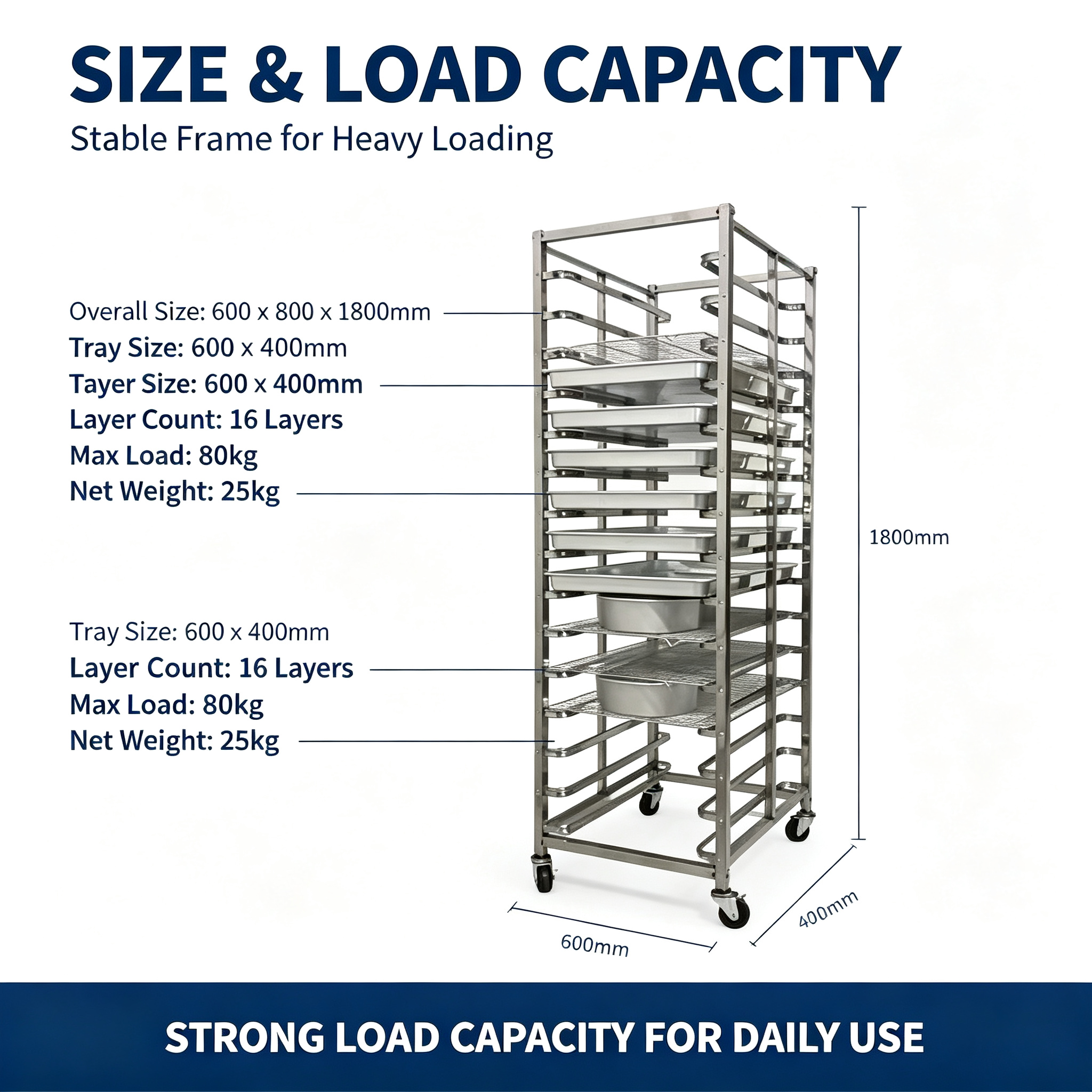
- Dimensions: 1000×800×1800 mm (L×W×H) or custom; internal tray width often 700–900 mm.
- Tube thickness: 1.2 mm to 2.0 mm wall thickness; thicker walls improve load capacity but increase weight.
- Number of layers: 10, 20, 30, or 40 tiers; layer pitch typically 50–150 mm.
- Load capacity: 200 kg to 800 kg per trolley, depending on caster rating and frame design.
- Mesh size / hole diameter: For mesh trays, 3–10 mm apertures; for perforated trays, 2–5 mm holes.
- Tray compatibility: Specify tray size (e.g., 600×400 mm, 800×600 mm) and whether trays are included or user-supplied.
- Surface treatment: 2B mill finish, BA bright annealed, electropolished, or passivated.
- Wheel type: 100–200 mm diameter, swivel with brake, or fixed; polyurethane or nylon.
These parameters must be documented in a drawing and approved before production. A common mistake is ordering trolleys without confirming tray dimensions—leading to wasted trays or unstable loading.
Customization Services: OEM/ODM Capabilities for B2B Buyers
Reputable manufacturers and suppliers offer full OEM and ODM services. Customization includes: custom size (length, width, height, layer count), custom design (reinforced base, drainage holes, fork pockets, nesting features), logo (laser-etched or stamped on the frame), packing (wooden crates, pallets, or custom foam protection for export), and special requirements (e.g., anti-microbial coatings, high-temperature wheels, ESD-safe versions for electronics drying). Production capability matters: a factory with in-house tube cutting, bending, welding, polishing, and testing can control lead times and quality. For custom requirements, please contact our team to discuss drawings, samples, and MOQ. Typical lead times for custom orders are 15–30 days after drawing approval, depending on order volume.
Procurement Guide: How to Choose the Right Trolley and Supplier
When selecting a stainless steel fruit drying trolley, follow these steps:
- How to choose size? Match trolley dimensions to your drying chamber opening, tray size, and available aisle width. Allow at least 100 mm clearance on each side for airflow.
- How to choose material? Use 304 for general fruits, 316 for high-acid or high-chloride environments, and avoid 201 or aluminum for washdown areas.
- How to confirm specifications? Request a detailed drawing with tolerances, a material certificate, and a load test report. Verify caster load ratings independently.
- How to judge supplier capability? Ask for factory audit reports, existing client references in food processing, and whether they have in-house welding and polishing. A supplier that outsources these processes may have inconsistent quality.
Additionally, consider total cost of ownership: a cheaper trolley that corrodes in 18 months costs more than a 304 trolley that lasts 10 years. For industrial buyers, warranty terms (typically 1–2 years) and spare parts availability (casters, trays) are also important. Always request a sample or pilot order before mass production.
Frequently Asked Questions (FAQ)
Q1: What is the difference between 304 and 316 stainless steel for fruit drying trolleys?
A1: 304 offers good corrosion resistance for most fruits and cleaning agents. 316 contains molybdenum, which provides superior resistance to chlorides and acids—essential for high-acid fruits like pineapple or when using chloride-based sanitizers. 316 costs more but extends service life in aggressive environments.
Q2: How many trays can a standard trolley hold?
A2: Standard trolleys hold 10 to 40 trays, with 20 layers being the most common for industrial fruit drying. The number depends on tray thickness, layer pitch, and total height limits of your drying chamber.
Q3: Can I customize the trolley dimensions and logo?
A3: Yes. Most manufacturers offer OEM/ODM services including custom sizes, layer counts, wheel types, and logo etching. Provide a drawing or sample; production typically takes 15–30 days.
Q4: What is the typical load capacity?
A4: Load capacity ranges from 200 kg to 800 kg per trolley. It depends on tube thickness, caster rating, and frame design. Always specify the maximum load per tray and total load when requesting a quote.
Q5: Are stainless steel trolleys suitable for high-temperature drying?
A5: Yes, 304 and 316 stainless steel withstand temperatures up to 500°C intermittently, but continuous drying is usually below 100°C. Ensure wheels and any plastic components are rated for your operating temperature.
Q6: How do I clean and maintain the trolley?
A6: Use warm water with mild detergent or food-safe sanitizer. Avoid chloride-based cleaners on 304 to prevent pitting. Rinse and dry after cleaning. Inspect casters and welds monthly for cracks or corrosion.
Q7: What is the minimum order quantity (MOQ)?
A7: MOQ varies by supplier. For standard sizes, MOQ may be 10–50 units. For custom designs, MOQ is often 50–100 units. Contact the manufacturer for specific terms.
Q8: Do you provide image ALT text for product photos?
A8: Yes, for SEO purposes, we recommend ALT text such as: "Stainless steel fruit drying trolley with 20 layers and mesh trays in a food processing plant" or "304 stainless steel drying trolley with swivel casters for industrial fruit dehydration."
SEO Metadata
SEO Title: Stainless Steel Fruit Drying Trolley | Industrial B2B Guide
Meta Description: Industrial guide to stainless steel fruit drying trolleys for B2B buyers. Compare 304 vs 316, specs, customization, and supplier selection. Get a quote today.
SEO Keywords: fruit drying trolley stainless steel, industrial drying trolley, stainless steel drying rack, fruit drying tray trolley, 304 stainless steel trolley, 316 stainless steel drying trolley, custom drying trolley, food processing trolley, drying trolley manufacturer, B2B drying trolley supplier

