


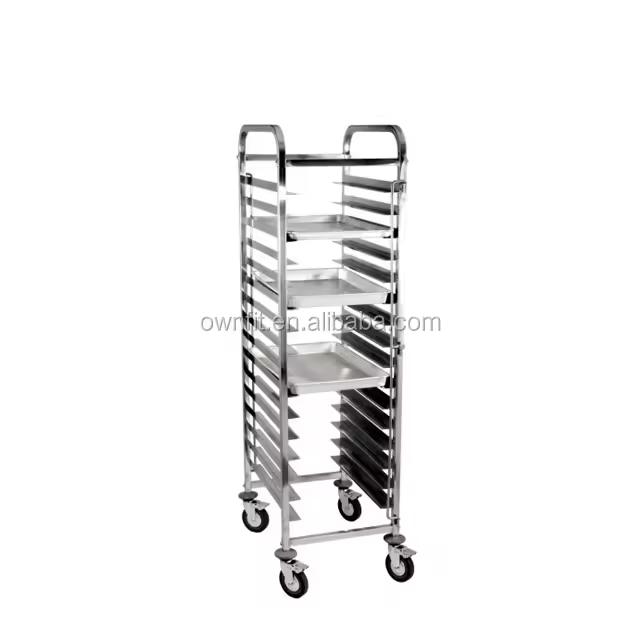
Hotel Bakery Trolley: The Complete B2B Procurement Guide for Industrial Buyers
Product Introduction: What Is a Hotel Bakery Trolley?
A hotel bakery trolley is a specialized mobile rack designed for transporting, storing, and displaying baked goods within commercial kitchens, pastry shops, and food service facilities. Unlike standard utility carts, these trolleys are engineered to withstand the rigors of daily industrial use—from high-temperature ovens to humid proofing rooms and rapid cooling areas. They solve critical pain points: minimizing product damage during movement, optimizing space utilization, and ensuring compliance with hygiene standards. For procurement managers, selecting the right trolley directly impacts operational efficiency and reduces long-term replacement costs.
Product Features: Engineered for Durability and Performance
Industrial bakery trolleys are not generic shelving units. They feature a reinforced frame structure that enhances load stability during repeated transportation and industrial handling. Key design elements include:
- Welded tubular construction: Ensures structural integrity under dynamic loads, unlike bolted alternatives that loosen over time.
- Anti-corrosion surface treatment: Electropolishing or passivation for stainless steel models extends lifespan in humid environments.
- Ergonomic handles and swivel casters: Smooth maneuverability in tight aisles, with options for brake systems and shock-absorbing wheels.
- Modular shelving: Adjustable heights accommodate various tray sizes and product dimensions.
These features reduce product loss, improve worker safety, and lower maintenance costs—key metrics for any procurement decision.
Application Scenarios: Beyond the Hotel Kitchen
While the name suggests hospitality, these trolleys are versatile assets across multiple industries:
- Food Processing: Transporting raw ingredients, intermediate products, and finished goods between processing stages. Stainless steel models meet HACCP and FDA requirements.
- Bakery and Confectionery: Moving dough, proofed items, and baked goods through production lines. Heat-resistant casters and frames are essential.
- Industrial Manufacturing: Used for component drying, curing, and storage in cleanroom environments. Aluminum models offer lightweight alternatives for non-corrosive applications.
- Cleaning and Sanitation: Holding dirty dishes or equipment before washing. Trolleys with drainage holes and corrosion-resistant materials are preferred.
- Drying and Cooling: Open-wire mesh designs facilitate airflow, speeding up cooling processes for baked goods.
- Storage and Transportation: Maximizing vertical space in warehouses and cold rooms. Stackable or nesting options save floor space.
In each scenario, the trolley's design must align with specific environmental challenges—whether it's extreme temperatures, chemical exposure, or heavy loads.
Material Selection: 304 vs. 316 vs. 201 Stainless Steel and Aluminum
Material choice is a critical procurement decision that impacts cost, lifespan, and compliance. Here's a technical breakdown:
- 304 Stainless Steel: The industry standard for food-grade applications. Offers excellent corrosion resistance, easy cleaning, and durability. Suitable for most bakery and hotel environments.
- 316 Stainless Steel: Superior corrosion resistance, especially against chlorides and harsh chemicals. Ideal for coastal facilities or meat processing plants where salt and cleaning agents are prevalent.
- 201 Stainless Steel: A cost-effective alternative with lower nickel content. Offers moderate corrosion resistance but may be prone to rust in high-humidity or acidic environments. Suitable for dry storage or light-duty applications.
- Aluminum: Lightweight and resistant to oxidation, but softer than stainless steel. Often used for non-load-bearing components or where weight reduction is critical. Not recommended for heavy-duty or high-temperature applications.
Procurement Tip: Always verify material certificates (Mill Test Reports) to ensure compliance with ASTM or EN standards. For food contact surfaces, 304 or 316 is mandatory in most jurisdictions.
Specifications: Key Parameters for Procurement
When specifying a hotel bakery trolley, consider these technical details:
- Dimensions: Standard lengths range from 24" to 72", widths from 18" to 36", and heights from 36" to 72". Custom sizes available.
- Thickness: Stainless steel tubing typically 1.0mm to 1.5mm; wire mesh 3mm to 6mm diameter.
- Capacity: Load ratings from 200 lbs to 1000 lbs, depending on design and casters.
- Number of Shelves: 3 to 12 tiers, adjustable or fixed.
- Load Capacity per Shelf: 50 lbs to 200 lbs uniformly distributed.
- Mesh Size: Common openings: 1"x1", 2"x2", or custom. Smaller openings for small items.
- Tray Compatibility: Designed to hold standard 18"x26" bakery trays, or custom sizes.
- Surface Treatment: Electropolished, passivated, or powder-coated for specific aesthetics or corrosion resistance.
- Caster Type: Polyurethane, rubber, or nylon wheels; swivel or rigid; with or without brakes.
Provide these specs to suppliers to receive accurate quotes and ensure optimal performance.
Customization Services: OEM and ODM Capabilities
As a manufacturer with over 15 years of experience, we understand that off-the-shelf solutions rarely fit every operation. Our OEM/ODM services include:
- Custom Sizes: Tailored dimensions to fit your specific oven, proofing cabinet, or storage area.
- Custom Design: Modifications to shelf configuration, handle placement, or caster type.
- Logo and Branding: Laser-etched or printed logos for brand consistency.
- Packing: Custom crating and labeling for efficient logistics and warehouse management.
- Special Requirements: Anti-microbial coatings, ESD-safe versions, or high-temperature wheels.
For custom requirements, please contact our team to discuss your project. We provide rapid prototyping and samples for evaluation.
Procurement Guide: How to Choose the Right Trolley
Selecting a trolley involves more than comparing prices. Use this checklist:
- How to choose size? Measure your oven, proofing area, and transport paths. Ensure trolley width allows passage through doors and around corners. Consider future needs—oversizing can waste space, undersizing limits capacity.
- How to choose material? Assess the environment: humidity, temperature, chemicals. For wet or acidic conditions, 316 stainless steel is best. For dry storage, 201 or aluminum may suffice.
- How to confirm specifications? Request detailed drawings and material certificates. Verify load ratings and test reports from the supplier.
- How to judge supplier capability? Evaluate their production capacity, quality control processes, and lead times. Ask for references from similar industries. A factory with in-house welding, polishing, and assembly ensures better quality control than outsourced operations.
We recommend requesting a sample or visiting the factory (or virtual tour) before placing bulk orders. This mitigates risks and ensures alignment with your expectations.
Frequently Asked Questions (FAQ)
Q1: What is the typical lead time for a custom hotel bakery trolley?
For custom designs, lead time is typically 25-35 days after sample approval, depending on complexity and order volume. Standard models can ship within 15 days.
Q2: Can these trolleys be used in freezers or high-temperature ovens?
Yes, with appropriate modifications. For freezers, we use low-temperature casters and lubricants. For high-temperature applications (up to 500°F), we offer stainless steel frames without plastic components and high-temp wheels.
Q3: What is the warranty on your bakery trolleys?
We offer a 2-year warranty against manufacturing defects under normal use. Extended warranties are available for large orders.
Q4: Do you provide samples for evaluation?
Yes, samples are available for a fee, which is refundable upon bulk order. Sample lead time is 7-10 days.
Q5: How do you ensure the trolleys meet food safety standards?
Our stainless steel trolleys are made from FDA-approved materials and are designed for easy cleaning. We can provide material certificates and comply with HACCP and ISO 22000 requirements.
Q6: Can I mix different shelf types in one trolley?
Absolutely. We offer hybrid designs combining wire mesh shelves, solid shelves, and tray slides to accommodate diverse products.
Q7: What are the shipping terms and packaging methods?
We ship FOB, CIF, or DDP as per your preference. Packaging includes bubble wrap, foam, and sturdy wooden crates to prevent damage during transit.
Q8: How do I maintain the trolley for optimal lifespan?
Regular cleaning with mild detergent and water, avoiding abrasive cleaners. Lubricate casters periodically. Inspect welds and fasteners for loosening.
Image ALT Text Suggestions
For website images, use descriptive ALT text such as: "Stainless steel hotel bakery trolley with wire mesh shelves and swivel casters" or "Custom bakery trolley with logo etching for industrial kitchen". This improves SEO and accessibility.
SEO Metadata
SEO Title: Hotel Bakery Trolley | Industrial Bakery Trolley Manufacturer
Meta Description: Source hotel bakery trolleys for commercial kitchens. Custom stainless steel trolleys with 304/316 options. OEM/ODM services. Get a quote today.
SEO Keywords: hotel bakery trolley, bakery trolley manufacturer, stainless steel bakery trolley, industrial bakery cart, custom bakery trolley, bakery trolley supplier, food service trolley, bakery rack trolley, commercial bakery trolley, OEM bakery trolley

