


How to Choose a Commercial Bakery Equipment Supplier: A B2B Procurement Guide
Product Introduction: What Commercial Bakery Equipment Entails
When sourcing a commercial bakery equipment supplier, you are not simply buying an off-the-shelf item; you are investing in a production asset. Commercial bakery equipment encompasses a wide range of machinery and tooling designed for industrial-scale baking, including planetary mixers, dough sheeters, proofers, rotary rack ovens, conveyor ovens, and automated handling systems. These machines solve critical production challenges: consistent dough hydration, uniform heat distribution, high-volume throughput, and minimizing downtime. For B2B buyers, the goal is to integrate equipment that aligns with existing production lines, meets food safety standards (e.g., FDA, CE, NSF), and delivers a predictable return on investment.
Product Features: Engineering for Industrial Durability
Industrial bakery equipment differs significantly from retail-grade models. A supplier’s product line should demonstrate specific design advantages:
- Reinforced frame structure: Constructed from heavy-gauge stainless steel or aluminum alloys, the frame maintains alignment under continuous vibration and heavy loads, preventing premature wear in high-speed mixing or dividing operations.
- High-torque drive systems: Gearboxes and motors are sized with a service factor of 1.5 or higher to handle stiff doughs and sudden load spikes without stalling.
- Modular components: Quick-release bowls, tool-free scraper arms, and interchangeable dies reduce changeover time between recipes.
- Sanitary design: Smooth welds, minimal crevices, and IP65-rated electrical enclosures facilitate cleaning and reduce bacterial harborage, meeting HACCP requirements.
These features directly address industrial pain points: unplanned downtime, inconsistent product quality, and excessive maintenance labor.
Application Scenarios Across Industries
A versatile commercial bakery equipment supplier serves multiple sectors beyond traditional bakeries. Understanding these applications helps you evaluate whether a supplier’s equipment can adapt to your specific process:
- Food processing: Mixers and forming machines for pizza dough, tortillas, and frozen dough balls. Equipment must handle high-volume batches with repeatable texture.
- Bakery (artisan & industrial): Rack ovens and proofers for crusty breads, croissants, and muffins. Steam injection and programmable dampers are essential for crust development.
- Industrial manufacturing: Custom conveyor systems for automated pastry lines, including sheeters, cutters, and depositors integrated with PLC controls.
- Cleaning and drying: Stainless steel washing tunnels and air-knife dryers for trays, pans, and utensils. These reduce water usage and labor compared to manual washing.
- Storage and transportation: Stackable bakery racks, proofing cabinets, and insulated transport containers that maintain temperature and humidity during logistics.
For example, a frozen dough manufacturer requires equipment that operates at -20°C without brittle failure. A supplier with experience in low-temperature materials selection (e.g., 304 stainless steel with low-carbon content) can prevent catastrophic cracks.
Material Selection: Stainless Steel and Aluminum Trade-offs
The choice of material directly impacts service life, hygiene, and cost. A knowledgeable supplier should explain the differences:
- 304 stainless steel: The industry standard for food contact surfaces. Excellent corrosion resistance against most bakery ingredients (flour, sugar, yeast, salt). Suitable for mixers, bowls, and conveyor frames.
- 316 stainless steel: Superior resistance to chlorides and acidic environments. Recommended for equipment exposed to salty doughs, cleaning chemicals, or coastal installations. Higher cost but extended lifespan in harsh conditions.
- 201 stainless steel: Lower nickel content, reduced corrosion resistance. Often used for non-critical structural parts or budget models. Not suitable for high-moisture or acidic contact.
- Aluminum: Lightweight, good thermal conductivity. Used for baking trays, sheet pans, and some structural components. Requires anodizing or coating to prevent reaction with alkaline doughs.
Ask your supplier for material certificates (e.g., mill test reports) to verify compliance with ASTM or EN standards.
Specifications That Matter to Procurement
When comparing quotes, focus on these quantifiable parameters:
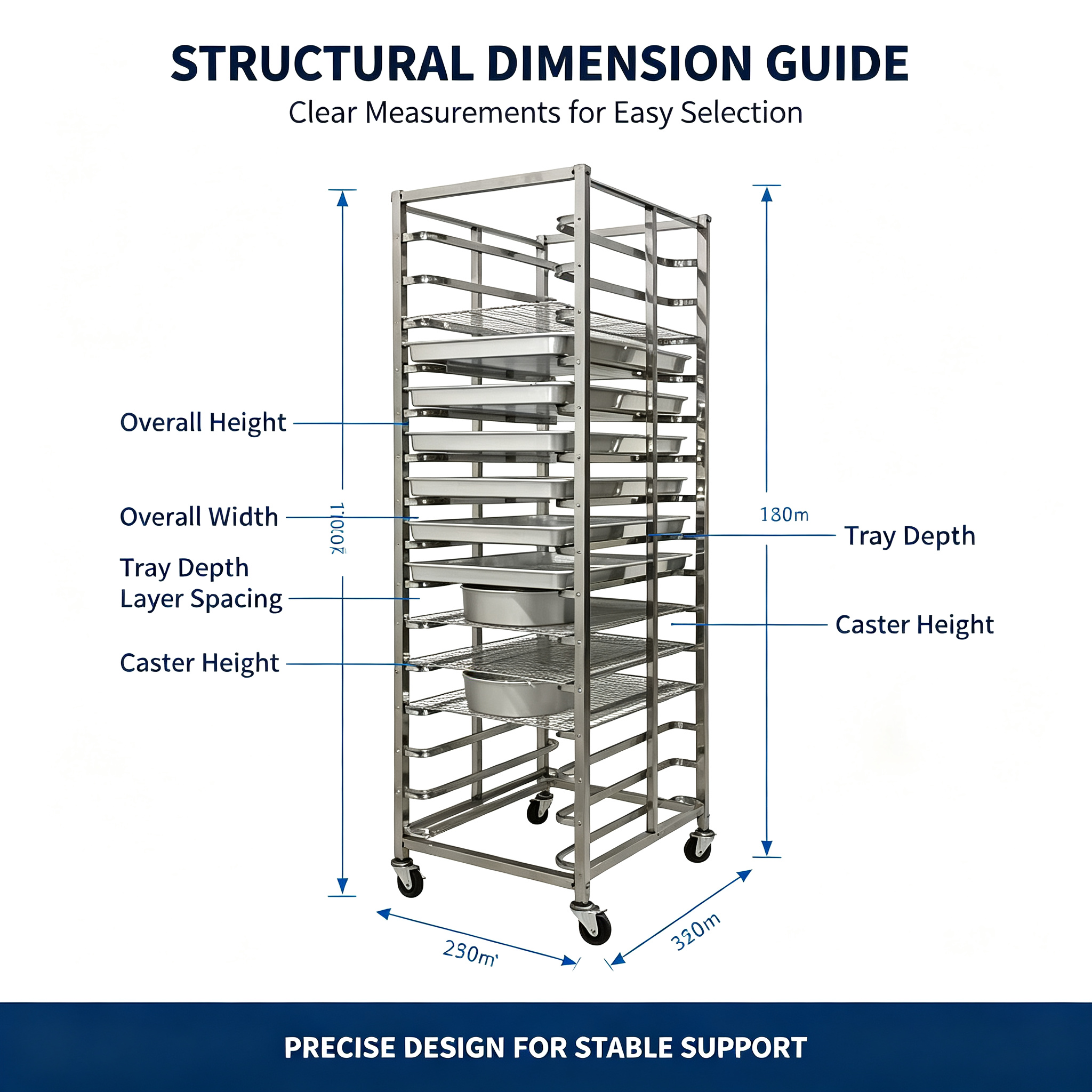
- Dimensions: Overall footprint (L×W×H) and working height must fit your floor plan and ergonomic standards.
- Thickness: Bowl and hopper wall thickness (e.g., 2 mm vs. 3 mm) affects durability and heat retention.
- Capacity: Batch size (e.g., 100L, 200L) or throughput (e.g., 500 kg/hour). Ensure it matches your production schedule.
- Number of layers/racks: For ovens and proofers, layer count determines batch volume. Standard 10-tray or 20-tray configurations are common.
- Load capacity: Rack load limits (e.g., 200 kg per rack) and conveyor belt strength.
- Mesh/aperture: For sieving or cooling belts, aperture size (e.g., 2 mm to 10 mm) affects product handling.
- Surface finish: Ra ≤ 0.8 µm for food contact areas to prevent bacterial adhesion. #4 brushed or mirror polish options.
Always request a detailed specification sheet and, for critical equipment, a factory acceptance test (FAT) report.
Customization and OEM/ODM Capabilities
Rarely does an off-the-shelf machine fit perfectly into an existing line. A capable commercial bakery equipment supplier offers:
- Custom size and design: Adjusting width, height, or conveyor length to interface with your upstream/downstream equipment.
- Logo and branding: Laser-etched or plate-mounted company logos on control panels and frames.
- Packing specifications: Export-grade wooden crates, vacuum sealing for sensitive components, and container loading plans.
- Special requirements: Voltage (e.g., 480V/60Hz for North America), PLC brand (Allen-Bradley, Siemens), and communication protocols (Ethernet/IP, Modbus).
When evaluating customization, ask for previous project examples and lead times. A manufacturer with in-house engineering and fabrication can typically deliver within 6–10 weeks, while trading companies may take longer.
Procurement Guide: How to Select the Right Supplier
Use this checklist to separate reliable manufacturers from intermediaries:
- How to choose size? Map your production volume, available floor space, and future expansion plans. A supplier should provide layout drawings and simulation data.
- How to choose material? Base it on your dough pH, cleaning chemicals, and ambient humidity. Request corrosion test data if unsure.
- How to confirm specifications? Insist on a pre-production sample or a video walkthrough of a similar unit in operation. Verify electrical components (e.g., UL/CE marks).
- How to judge supplier capability? Audit their factory: check for CNC machining centers, welding certifications (e.g., AWS D1.1), and quality control labs. Ask for a list of existing customers in your region.
For custom requirements, please contact our team to discuss your project. We provide OEM/ODM services backed by 15+ years of manufacturing experience.
Image ALT Text Suggestions
For product images, use descriptive ALT text to improve accessibility and SEO:
- ALT: "Industrial spiral mixer with 200L stainless steel bowl for commercial bakery"
- ALT: "304 stainless steel rotary rack oven with 10-tray capacity and steam injection"
- ALT: "Custom conveyorized dough sheeter with adjustable thickness and safety guards"
SEO Metadata
SEO Title: Commercial Bakery Equipment Supplier | B2B Procurement Guide
Meta Description: Learn how to choose a commercial bakery equipment supplier. Covers materials, specs, customization, and supplier evaluation for B2B buyers.
SEO Keywords: commercial bakery equipment supplier, industrial bakery machines, stainless steel bakery equipment, custom bakery equipment, OEM bakery equipment, bakery equipment procurement, food processing equipment, dough mixer supplier, rotary oven manufacturer.
Frequently Asked Questions (FAQ)
1. What is the typical lead time for custom commercial bakery equipment?
For custom orders, lead time ranges from 6 to 12 weeks depending on design complexity and material availability. Standard models may ship in 4–6 weeks. Always confirm with the supplier’s production schedule.
2. How do I verify a supplier’s manufacturing capability?
Request a virtual or in-person factory audit. Check for in-house CNC machining, welding certificates, and testing facilities. Ask for references from similar-sized bakeries or food plants in your region.
3. What is the difference between 304 and 316 stainless steel for bakery equipment?
304 offers good corrosion resistance for most bakery applications. 316 contains molybdenum, providing better resistance to chlorides and acids—ideal for salty doughs or harsh cleaning chemicals. 316 costs 20–30% more.
4. Can you customize equipment to meet local electrical standards?
Yes. Reputable suppliers can configure motors, control panels, and wiring to match your voltage, frequency, and plug type (e.g., 480V/60Hz, 400V/50Hz). Specify UL, CE, or CSA certification requirements early.
5. What surface finish is required for food safety?
Food contact surfaces should have a roughness average (Ra) of 0.8 µm or less. A #4 brushed finish is common; mirror polish (Ra < 0.2 µm) is used for high-risk areas. Avoid rough welds or crevices.
6. How do I handle spare parts and after-sales support?
Negotiate a spare parts kit (e.g., belts, seals, heaters) with your initial order. Confirm warranty terms (typically 12–24 months) and ask for a local service partner or remote troubleshooting support.
7. Do you provide installation and training?
Many manufacturers offer on-site installation and operator training for large systems. For smaller equipment, detailed manuals and video guides are standard. Clarify costs and availability in your contract.
8. What payment terms are typical for B2B bakery equipment orders?
Common terms are 30% deposit with 70% balance before shipment. For custom or large orders, milestone payments may be negotiated. Use secure payment methods (e.g., T/T, L/C) and verify the supplier’s bank details.

