


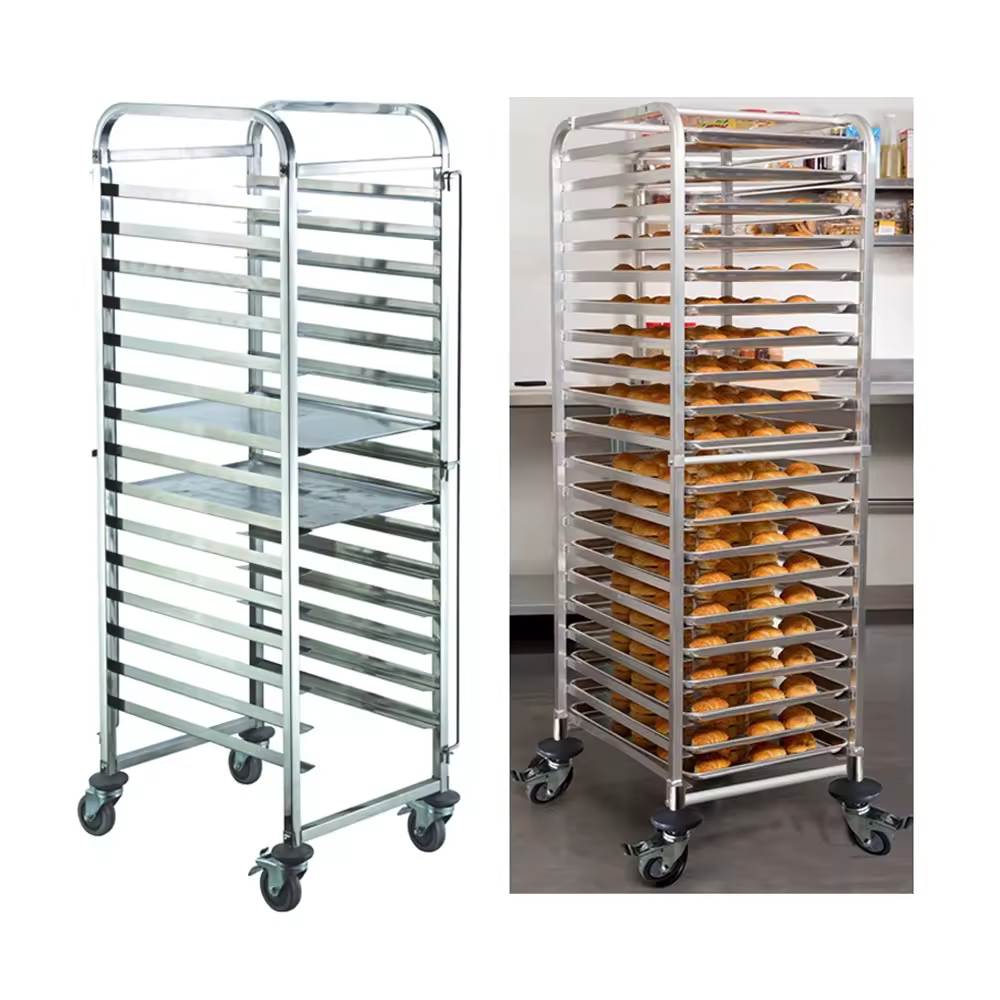
How to Choose a Reliable Stainless Steel Food Trolley Manufacturer: A B2B Procurement Guide
Product Introduction: What Is a Stainless Steel Food Trolley and Why It Matters in Industrial Settings
When you are sourcing a stainless steel food trolley manufacturer, you are not just buying a cart – you are investing in a critical logistics asset that directly impacts hygiene, efficiency, and workplace safety. A stainless steel food trolley is a wheeled platform designed to transport food products, trays, pans, or ingredients in commercial kitchens, food processing lines, bakeries, and industrial manufacturing facilities. Unlike generic utility carts, food trolleys must meet stringent hygiene standards, resist corrosion from frequent washing, and withstand heavy daily loads. The core problem they solve is safe, sanitary, and efficient movement of goods between production, storage, and cleaning zones, reducing manual handling and cross-contamination risks.
Product Features: Structural Design, Material Advantages, and Performance Characteristics
A well-engineered food trolley is defined by its frame construction and material selection. Most industrial-grade trolleys use 304 stainless steel or 316 stainless steel for frames, shelves, and handles. The reinforced frame structure improves load stability during repeated transportation and industrial handling, preventing wobbling or deformation under uneven loads. Key features include:
- Welded or bolted construction: Welded frames offer higher rigidity but are harder to repair; bolted frames allow on-site maintenance and flat-pack shipping to save freight costs.
- Perforated or mesh shelves: Improve drainage and airflow, essential for drying or cooling applications. Perforations also reduce weight without compromising strength.
- Heavy-duty casters: Typically 4–8 inch wheels, with options for polyurethane, rubber, or nylon treads. Brake systems are critical for sloped floors or high-traffic areas.
- Ergonomic handles: Positioned at optimal height (usually 900–1000 mm) to reduce operator strain during pushing and pulling.
These features are not cosmetic – they are direct responses to industrial demands such as high-temperature washing, chemical exposure, and continuous load cycling.
Application Scenarios: Where Stainless Steel Food Trolleys Are Used Across Industries
Different industries require different trolley configurations. Below are common applications and the specific design considerations for each:
- Food Processing: Trolleys must withstand caustic cleaning agents and high-pressure washdowns. Fully welded, 304 or 316 stainless steel with polished surfaces prevents bacterial harborage. Removable shelves or tray racks facilitate deep cleaning.
- Bakery: Often used for moving dough troughs, baking sheets, or finished bread. Trolleys may include multiple tiers (10–20 shelves) with narrow spacing to hold standard 18" x 26" baking pans. Heat-resistant casters are essential if trolleys enter proofers or ovens.
- Industrial Manufacturing: Transporting heavy components, tools, or chemical containers. Here, load capacity (500–1500 kg) and frame thickness (1.5–3.0 mm) matter more than hygiene. Reinforced corner gussets and solid shelves are typical.
- Cleaning and Drying: In central washing areas, trolleys hold racks of utensils or parts during automated cleaning. Mesh or perforated shelves allow water and air to pass through, speeding drying.
- Storage and Transportation: In warehouses or cold rooms, trolleys act as mobile storage units. Stackable or nesting designs save space when not in use. For export, knock-down trolleys reduce shipping volume by up to 60%.
Understanding your specific application is the first step to specifying a trolley that will perform reliably for years.
Material Selection: 304 vs. 316 vs. 201 Stainless Steel and Aluminum
Material choice drives cost, corrosion resistance, and lifespan. Here is a practical comparison based on industry standards:
- 304 Stainless Steel: The workhorse for food-grade applications. Contains 18% chromium and 8% nickel. Excellent resistance to most acids, alkalis, and cleaning chemicals. Suitable for temperatures up to 870°C. Recommended for most food trolleys.
- 316 Stainless Steel: Adds 2–3% molybdenum, providing superior resistance to chlorides (salt) and strong acids. Ideal for seafood processing, pharmaceutical cleanrooms, or coastal environments. Typically 20–30% more expensive than 304.
- 201 Stainless Steel: Lower nickel and higher manganese. Offers moderate corrosion resistance at lower cost. Often used for budget trolleys or dry environments. Not recommended for wet or acidic food contact – may rust over time.
- Aluminum: Lightweight and corrosion-resistant (naturally forms oxide layer), but softer and prone to denting. Suitable for light-duty bakery or retail trolleys. Cannot withstand aggressive caustic cleaning.
A reputable manufacturer will provide mill certificates for material traceability. Always verify the grade matches your specification, especially when sourcing from overseas suppliers.
Specifications: What to Look For in a Food Trolley Datasheet
When requesting quotes, ensure the manufacturer provides the following parameters. Missing details often lead to rework or returns.
- Overall Dimensions (L x W x H): Common sizes: 800x600x900 mm, 1000x700x950 mm, 1200x800x1000 mm. Custom sizes are available from most OEM factories.
- Material Thickness: Frame tubing: 1.2–2.0 mm; shelf panels: 0.8–1.5 mm. Thicker is not always better – excessive thickness increases weight and cost without proportional strength gain.
- Load Capacity: Static load (uniformly distributed) vs. dynamic load (during movement). A 500 kg static rating may only support 300 kg when moving over rough floors.
- Number of Shelves / Tiers: 2–5 for general use; up to 20 for bakery pan racks. Shelf spacing must match your tray or pan height.
- Perforation / Mesh Size: Hole diameter 5–10 mm for drainage; mesh opening 10x10 mm to 25x25 mm for airflow. Smaller holes slow drying but prevent small items from falling through.
- Surface Finish: #4 brushed, #8 mirror, or electropolished. Brushed is standard for food; mirror is easier to clean but shows scratches.
- Caster Specifications: Wheel diameter, tread material, bearing type (ball vs. roller), and brake options. Swivel casters with brakes on at least two wheels are standard.
Always request a detailed drawing (PDF or CAD) before placing an order. This avoids misinterpretation and serves as a quality reference.
Customization Services: OEM/ODM Capabilities from a Professional Manufacturer
A capable stainless steel food trolley manufacturer should offer full customization to match your workflow. Typical services include:
- Custom Size: Adjust length, width, height, and shelf spacing to fit your existing racks, ovens, or transport vehicles.
- Custom Design: Modify frame structure, add side panels, hooks, or bumpers. CAD and 3D modeling provided for approval.
- Logo and Branding: Laser-engraved or stenciled logos on frames or handles. Ideal for distributors or rental fleets.
- Packing: Custom cartons, palletizing, or knock-down flat-pack for optimized container loading. Some manufacturers offer drop-test certified packaging for export.
- Special Requirements: ESD-safe casters for electronics, insulated shelves for temperature-sensitive goods, or stainless steel mesh covers for security.
For custom requirements, please contact our team. We provide quick turnaround on drawings and samples (typically 7–15 days).
Procurement Guide: How to Choose the Right Trolley and Verify Supplier Capability
Based on years of sourcing experience, here are answers to the most common buyer questions:
How to choose the right size? Measure your doorways, aisles, and turning radius. A trolley that is 100 mm too wide can block entire production lines. Also consider the height of your work surfaces – a trolley 50–100 mm lower than the bench allows easy loading.
How to choose the right material? For wet, acidic, or high-hygiene environments, use 304 or 316. For dry storage or occasional use, 201 may suffice. Never compromise on casters – cheap casters fail first.
How to confirm specifications? Ask for a pre-production sample or a detailed QC report covering dimensions, material grade (with mill cert), weld quality, and load test results. A reputable manufacturer will provide third-party inspection reports (e.g., SGS, BV).
How to judge supplier capability? Check: (1) factory audit reports, (2) export history to your region, (3) references from similar industries, (4) in-house capabilities (laser cutting, bending, welding, polishing), and (5) responsiveness to technical questions. A true manufacturer will answer with specific parameters, not generic claims.
What about lead times and MOQ? Standard trolleys: 15–25 days for 100–500 units. Custom: 30–45 days. MOQ varies – some factories accept 50 units for trial orders, others require 200+. Always clarify Incoterms and packaging costs.
Frequently Asked Questions (FAQ)
1. What is the typical load capacity of a stainless steel food trolley?
Standard models range from 150 kg to 500 kg. Heavy-duty industrial trolleys can handle up to 1500 kg. Always specify dynamic load (during movement) rather than static load.
2. Can I use a 201 stainless steel trolley in a wet environment?
Not recommended. 201 has lower corrosion resistance and may rust when exposed to water, steam, or acidic foods. Use 304 or 316 for wet areas.
3. What is the difference between welded and knock-down trolleys?
Welded trolleys are more rigid and ready to use, but cost more to ship. Knock-down (bolted) trolleys are flat-packed, reduce freight by up to 60%, and can be assembled on-site with basic tools.
4. How do I clean a stainless steel food trolley?
Use warm water, mild detergent, and a soft cloth or nylon brush. Avoid steel wool or chloride-based cleaners, which can scratch or corrode the surface. For 304, periodic passivation restores the passive layer.
5. What caster type is best for my application?
Polyurethane casters are quiet and non-marking – good for indoor food areas. Nylon casters resist chemicals and high temperatures. Rubber casters absorb shock but may leave marks. Always choose casters with sealed bearings for washdown environments.
6. Can you customize the trolley to fit my existing trays?
Yes. Provide tray dimensions (length, width, height) and we will design shelf spacing and guides accordingly. We also offer adjustable shelves for flexibility.
7. What is your MOQ and sample policy?
MOQ typically 50–200 units depending on customization. Samples are available for a fee, refundable against bulk order. Sample lead time: 7–15 days.
8. Do you provide export documentation and certifications?
Yes. We supply mill certificates, material test reports, and certificates of origin. For food contact, we can provide FDA or LFGB compliance statements upon request.
Image ALT text suggestion: "Stainless steel food trolley with perforated shelves and heavy-duty casters in a commercial bakery – manufacturer export quality"
SEO Title: Stainless Steel Food Trolley Manufacturer | Custom & Export
Meta Description: Source stainless steel food trolleys from a reliable manufacturer. 304/316 grades, custom sizes, OEM/ODM, export experience. Get a quote today.
SEO Keywords: stainless steel food trolley manufacturer, food trolley supplier, custom food trolley, 304 stainless steel trolley, bakery trolley manufacturer, industrial food cart, stainless steel trolley factory, OEM food trolley, food trolley export, commercial food trolley.

