





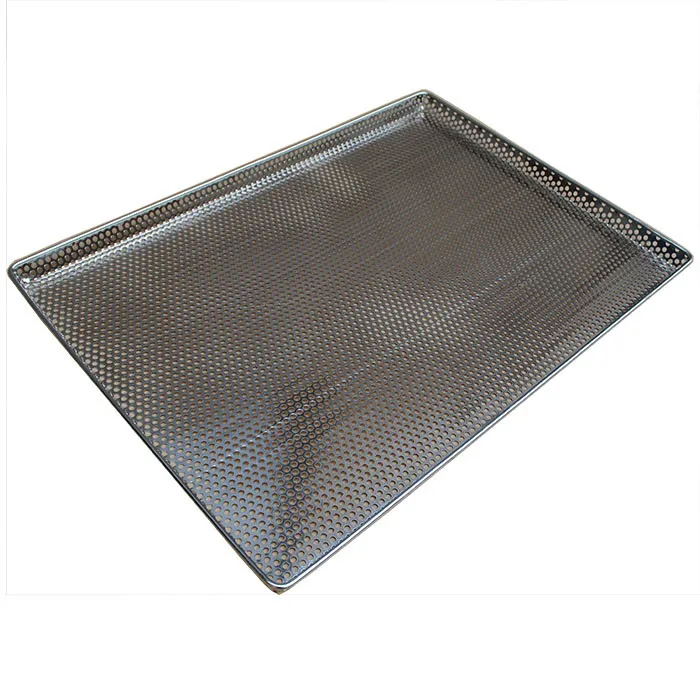
How to Choose a Reliable Stainless Steel Tray Manufacturer: A B2B Supplier Evaluation Guide
Understanding Your Requirements: Custom Stainless Steel Tray
Before approaching any manufacturer, clearly define your specifications. For custom stainless steel trays, consider dimensions, thickness, hole patterns, and material grade. For industrial tray manufacturers, specify load capacity and environment. For baking tray suppliers, note temperature resistance and food safety standards. Document your drawings or detailed descriptions to share with potential suppliers.
Evaluating Material Traceability and Quality
A reliable manufacturer should provide material certificates (MTC) from reputable mills. Inquire about the source of stainless steel (e.g., 201, 304, 316). For custom stainless steel trays, 304 is common for food contact; 316 for corrosive environments. Ask about their incoming inspection process to ensure material integrity.
Assessing Technical Capabilities: Drawing, Stamping, and Bending
Review the manufacturer's ability to read and interpret drawings. For OEM metal tray projects, they should offer design support (DFM). Evaluate their stamping and bending equipment—though avoid fabricating numbers. Ask about their tolerance ranges and how they control them. Inquire about their experience with complex shapes and tight tolerances.
Welding, Grinding, and Hole Punching
Welding quality affects durability and hygiene. Ask about welding processes (TIG, MIG, spot) and post-weld grinding for smooth surfaces. For trays with holes (like perforated baking trays), discuss hole size, spacing, and burr removal. Request examples of similar products they've made.
Surface Treatment and Finishing Options
Surface finish matters for aesthetics and cleaning: brushed, mirror polished, or powder-coated (if not stainless). For baking tray suppliers, ensure food-safe finishes. Ask about passivation to enhance corrosion resistance. Discuss how they achieve consistency in finish across large orders.
Dimensional Tolerances and Quality Inspection
Define acceptable tolerances (e.g., ±0.5mm) in your specification. Ask how they measure and document tolerances. A robust manufacturer will have QC checkpoints: incoming, in-process, and final. Request their inspection reports and quality control procedures. They should be willing to provide samples for verification.
Sample Verification and Prototyping
Always order samples before bulk production. Evaluate sample dimensions, finish, and weld quality. For custom stainless steel trays, ensure the sample meets your functional needs. Use a structured sample evaluation checklist. Discuss lead time for samples and production.
Packaging and Logistics
Proper packaging prevents damage. Inquire about packaging materials (e.g., foam, shrink wrap, carton) for trays. For industrial tray manufacturers, ask about palletization and container loading. Who is responsible for shipping? Ask for photos of packing before dispatch. Consider moisture protection for sea freight.
Communication and After-Sales Support
Effective communication is key. Assess their responsiveness and language skills. Do they provide engineering feedback? Can they adapt to changes? Inquire about warranty and after-sales support. A dedicated account manager is ideal. Request references or case studies.
Supplier Audit Checklist for Stainless Steel Tray Manufacturer
Use this checklist: 1) Material traceability system, 2) Equipment list (no numbers, but type), 3) Inspection tools and calibration, 4) Welding/grinding skills, 5) Surface finish capabilities, 6) Tolerance control, 7) Sample policy, 8) Packaging and logistics, 9) Communication responsiveness, 10) Quality certifications (but do not assume).
RFQ Template for OEM Metal Tray
When requesting quotes, provide: 1) Detailed drawings or specs, 2) Material grade (e.g., 304), 3) Thickness, 4) Dimensions (length/width/height), 5) Hole pattern (if any), 6) Surface finish, 7) Tolerance requirements, 8) Order quantity (annual/ per order), 9) Packaging requirements, 10) Incoterms and destination.
Common Questions (FAQ)
What is the minimum order quantity?
MOQ varies by manufacturer; expect 100-500 pieces for custom trays.
How long is lead time?
Typical lead time for samples is 2-3 weeks, production 4-6 weeks based on quantity.
Can you provide material certificates?
Yes, we recommend asking for MTC with each shipment; reliable suppliers should comply.
Contact Us for Your Next Project
If you're looking for a dependable stainless steel tray manufacturer, we invite you to send your RFQ. Our team will respond within 24 hours with detailed feedback and a competitive quote.