





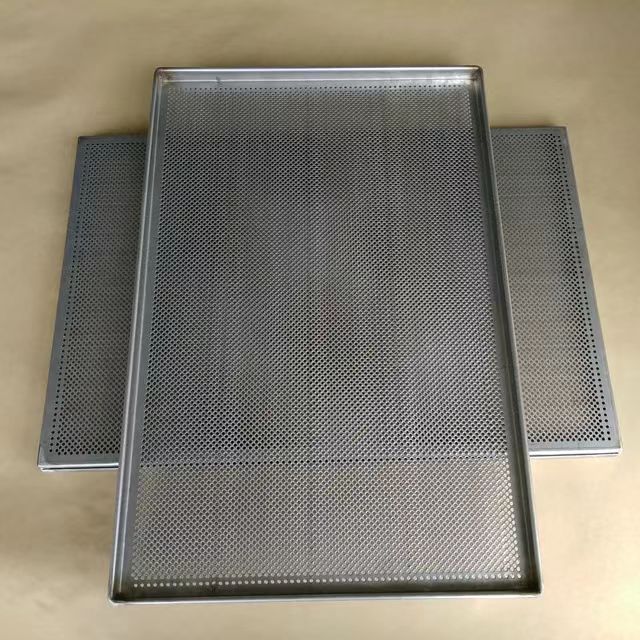
How to Choose Baking Tray Thickness: A Practical Guide for 600×400 mm Commercial and Industrial Trays
Why Tray Thickness Matters More Than You Think
When buying commercial sheet pans or industrial food trays, thickness is often the first spec considered. However, no single stainless steel baking tray thickness works for all scenarios. The right gauge depends on a combination of factors: tray dimensions, edge design, reinforcements, expected load, heating conditions, perforation pattern, and how the tray is handled. This guide unpacks these variables to help you make an informed choice.
Understanding the Relationship Between Thickness and Tray Size
Larger trays experience more stress because the surface area increases while the support points (like oven racks) remain spaced similarly. For a standard 600×400 mm baking tray, a thinner sheet—say 0.5 mm—might be acceptable for light cookies, but the same thickness on a 800×600 mm tray would likely bow under its own weight when hot. As a rule of thumb, as the tray gets longer or wider, you need to increase the commercial sheet pan gauge to maintain rigidity. For 600×400 mm, common choices range from 0.8 mm to 1.2 mm, but the final decision hinges on other factors below.
Edge Height and Reinforcements: Your Allies Against Warping
A tray with low edges (like a flat sheet pan) relies more on material thickness for strength, whereas a deep-drawn tray with high edges (e.g., 40 mm or more) gains inherent stiffness from its shape. Adding reinforcement ribs—either pressed into the base or welded on the underside—can significantly reduce flex even with thinner material. If you opt for a thinner stainless steel tray, look for designs with peripheral rims and crosswise ribs. Similarly, a rolled edge not only provides a comfortable grip but also adds rigidity, allowing you to choose a slightly lighter gauge without compromising stability.
Load Weight: Match Thickness to Your Heaviest Product
Consider the maximum weight your tray will carry in production. A tray loaded with 10 kg of dough requires a thicker sheet than one holding 2 kg of pastries. Heavier loads increase the bending moment on the tray, especially during transport. For heavy-duty industrial use, a thickness of 1.2 mm to 1.5 mm is often recommended. Conversely, for light bakery items, a 0.6 mm to 0.8 mm sheet might suffice if the tray is well-supported. Always test with your actual load and handling conditions.
Heating Cycles: Thermal Expansion and Stress
Every bake cycle subjects the tray to thermal expansion and contraction. Rapid temperature changes can cause warping if the tray isn't thick enough to distribute stress evenly. Thicker materials (e.g., 1.0 mm and above) have better thermal mass, which reduces localized overheating and subsequent distortion. Additionally, the type of oven—convection, deck, or tunnel—affects air circulation and heat uniformity. If your process involves frequent temperature spikes (e.g., from room temperature to 250°C), a commercial sheet pan gauge of at least 1.0 mm is advisable.
Perforation Rate: More Holes, More Care Needed
Perforated trays are popular for airflow and faster baking, but every hole weakens the sheet metal's structural integrity. With high hole ratios (e.g., 60% open area), the effective load-bearing cross-section is reduced, so you need a thicker base material to compensate. For example, a tray with 10 mm holes at 30% open area might be fine at 0.8 mm, but if you increase the perforation to 50%, consider upgrading to 1.0 mm or 1.2 mm. The arrangement also matters: a staggered pattern can preserve more rigidity than a straight grid.
Handling and Transport: The Hidden Stressors
How you move trays—manually, via carts, or automated conveyors—directly impacts the required thickness. Manual handling introduces uneven forces, especially if workers grip only one edge. In such cases, a thicker border or reinforced edges are helpful. For automatic loading, trays might be pushed or lifted, causing torsional stress. A stainless steel baking tray thickness of 1.0 mm or more is often safer for mechanical handling, while 0.8 mm might work for gentle manual use. Also, consider the weight of the tray itself: thicker trays are heavier, which can increase operator fatigue and energy costs in conveyor systems.
Selection Logic: A Step-by-Step Approach
To choose the right thickness, follow this logic: 1. Define your tray size (e.g., 600×400 mm). 2. Estimate the maximum load weight per tray, including food and the tray's own weight. 3. Determine your heating profile: temperature range, cycle duration, and any cooling phases. 4. Specify the perforation rate and hole pattern, if any. 5. Assess how trays will be handled: manual, cart, or automation. 6. Decide on the material (stainless steel grades 201, 304, 316, or aluminum). 7. Use the interaction matrix: for each combination of high size, heavy load, extreme heat, or high perforation, escalate the industrial tray thickness to the next level. For example, a 600×400 mm tray with 10 kg load, 200°C oven, 40% perforation, and cart transport would likely need 1.2 mm in 304 stainless steel.
RFQ Checklist: What to Specify to Suppliers
When requesting quotes, provide these details to get accurate recommendations: • Tray dimensions (length, width, edge height). • Material (e.g., SS304, thickness). • Perforation pattern (hole size, center distance, open area%). • Load per tray and product type. • Oven temperature range and cycle frequency. • Handling method (manual or machine). • Desired lifespan and any certifications (e.g., FDA). A reliable supplier will test prototypes or provide FEM analysis for critical applications.
Frequently Asked Questions
Q1: What is the minimum thickness for a 600×400 mm stainless steel baking tray?A1: For light use with gentle handling, 0.6 mm might work, but we recommend at least 0.8 mm for standard commercial use. It's essential to consider your specific load and heating conditions.
Q2: Can I use a thinner tray if it has reinforced edges?A2: Yes, reinforcement edges or ribs can allow you to reduce the base thickness by about 0.2 mm, but always verify with prototyping and stress tests under real conditions.
Q3: Does perforation rate drastically affect thickness choice?A3: Absolutely. Higher perforation reduces structural integrity. For 40% open area or more, increase thickness by 0.2-0.4 mm compared to a solid tray.
Q4: What's the typical thickness for industrial baking trays?A4: Industrial food trays often range from 1.0 mm to 2.0 mm, depending on the load and automation. Heavier loads and high-volume production favor thicker gauges.
Q5: How does aluminum compare to stainless steel for tray thickness?A5: Aluminum is lighter and has better heat conductivity, but it's softer. To achieve similar stiffness, you may need a slightly thicker sheet (e.g., 1.5 mm aluminum vs. 1.0 mm steel), but overall weight is still lower.