





How to Choose Stainless Steel Basket for Industrial Applications: A Buyer's Guide
Introduction
In industries such as food processing, pharmaceuticals, and precision parts washing, custom stainless steel wire mesh baskets are indispensable. They facilitate safe handling, efficient drainage, and uniform exposure to cleaning or sterilization agents. This guide focuses on how to choose stainless steel basket designs that deliver long-term performance in harsh environments.
Material Selection: 201, 304, or 316 Stainless Steel
Choosing the right stainless steel grade is the first step. SUS 201 offers cost savings for light-duty, dry applications but is susceptible to corrosion in humid or acidic conditions. Most industrial processes require SUS 304, which provides excellent corrosion resistance and formability for alkaline cleaners, food acids, and moderate temperatures. For environments with chlorides, saltwater, or harsher chemicals, SUS 316 includes molybdenum, greatly enhancing resistance to pitting and crevice corrosion. Your choice must align with the cleaning chemicals, operating temperatures, and expected lifespan.
Mesh Structure and Manufacturing Quality
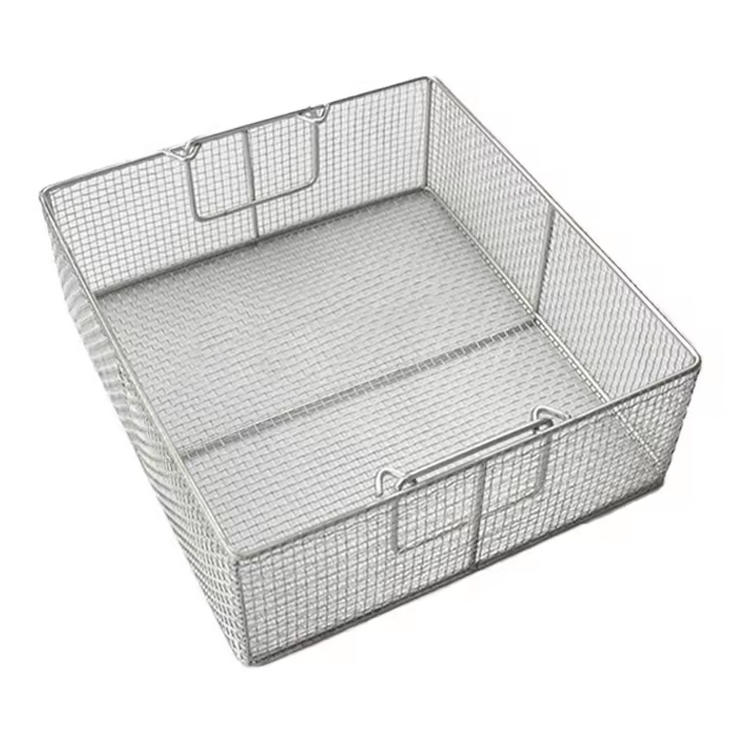
The wire mesh pattern determines the basket's drainage, airflow, and ability to hold small parts. Mesh opening and wire diameter are twin factors: smaller openings prevent parts from falling through but may restrict flow, while thicker wires increase strength but reduce open area. A reputable manufacturer uses precision resistance welding to ensure every intersection holds under dynamic loads. Reinforced edges, optional rolled rims, and welded handles reduce deformation during lifting. For suspended parts or minimized contact, an extra support structure is added. Surface treatment such as pickling and passivation removes contaminants and improves corrosion resistance, leaving the surface smooth and easier to clean.
Key Design Considerations for Different Applications
- Ultrasonic cleaning: The open mesh maximizes cavitation, while high-grade steel withstands aggressive detergents.
- Food and bakery: Smooth welds meet sanitation standards, and handles allow safe transport out of ovens or fryers.
- Medical sterilization: Baskets with fine wire and polished surfaces resist autoclave conditions and facilitate steam penetration.
- Industrial parts washing: Reinforced, heavy-duty baskets endure abrasive loads while maintaining liquid flow.
Customization Options for Your Specific Needs
As a manufacturer, we offer full OEM customization. You can define height, length, width, mesh count, wire gauge, and handle type (swing, stand-up, or side-mounted). Baskets can be produced with divided compartments, specialized stacking lips, or lid frames to secure products. Custom loading capacity is critical; test a prototype under expected weight before mass production. Additionally, choose from various packaging options to protect baskets during shipping.
How to Choose Stainless Steel Basket: A Practical Guide
Start by analyzing your process: define the expected temperature, chemical exposure, and mechanical load. Select the material grade accordingly – often 304 for general use, 316 for chloride-heavy environments. Next, determine the mesh size based on the smallest component and the required liquid flow. Match the wire diameter to the load, ensuring no permanent distortion. Inspect the welding quality and edge reinforcement to predict service life. Finally, request samples and test them under real conditions before committing to bulk production.
Quality Control and Supplier Capabilities
Ensure your supplier is a professional manufacturer with certifications like ISO 9001. Confirm they perform visual inspection, dimensional checks, and weld strength tests on each batch. An experienced factory will provide comprehensive documentation values like material test certificates and tolerance reports. effective communication on custom specifications avoids misunderstood dimensions. A partner with international export experience understands the importance of good packaging and on-time delivery for B2B buyers in the United States and Europe.
Common Issues and Maintenance
To maximize the life of your stainless steel basket, avoid simply using any steel wool that could contaminate the surface. Rinse off harsh residues after use, especially in high-chloride environments. Periodic passivation may restore the protective oxide layer. If damage occurs, minor weld repairs can extend service life, but severe corrosion indicates the material grade may not match the environment.
Frequently Asked Questions (FAQ)
Can stainless steel mesh baskets be fully customized?
Yes, leading manufacturers offer custom dimensions, mesh openings, wire diameters, shapes, handles, and other features. We collaborate on drawings or samples to achieve the exact geometry you need for your specific parts and process.
Which stainless steel grade should I choose for industrial cleaning processes?
For general industrial cleaners (aqueous alkaline solutions), SUS 304 is a balanced choice. If you use chlorinated solvents, salt baths, or acidic solutions with chlorides, SUS 316 offers superior resistance. Our engineers recommend picking the lowest grade that meets your chemical and temperature requirements to manage costs.
What process is used to manufacture these baskets?
Our baskets are made of fully drawn stainless steel wire, woven or welded into a uniform mesh, then formed and resistance-welded. Critical joints are spot-welded, edges are reinforced, and the entire assembly is cleaned and passivated. This method ensures a clean and durable product.
How long can I expect my basket to last?
Lifespan varies with usage. With proper material selection for temperature and chemicals, regularly cleaned, and handled correctly, a basket can last decades. A 316L basket in a low-stress environment will naturally outlast a 201 basket in a caustic hot bath. Regular inspection catches early fatigue.
Can you share references from food processing companies?
Yes. We supply baskets for produce washing and bakery racks. Upon request, we can share case studies and contact details (with permission) from customers in related fields.
Contact us today to discuss your custom stainless steel basket requirements. Our engineering team is ready to recommend materials, meshes, and dimensions for your specific application and to provide a quotation.