





How to Choose the Best Commercial Bakery Tray for Every Baking Task
Why There’s No Single Best Commercial Bakery Tray
In commercial baking, the best commercial bakery tray depends on what you bake, how you bake it, and how you handle it. A tray that works perfectly for crusty bread may ruin delicate cookies. Instead of hunting for one universal solution, professional bakers match tray design to their production line. This guide breaks down the key differences so you can choose the right tool for each job.
Understanding Tray Materials: Stainless Steel vs. Aluminum
The two most common materials for commercial bakery trays are stainless steel and aluminum. Each offers distinct advantages.
Stainless steel baking trays are prized for their durability, corrosion resistance, and ability to withstand high temperatures without warping. They are ideal for heavy-duty use, such as bread baking or roasting, and are easy to sanitize. However, stainless steel is heavier and does not conduct heat as evenly as aluminum, which can affect browning.
Aluminum trays, on the other hand, provide superior heat conductivity, leading to more uniform browning and faster baking times. They are lightweight, making them easier to handle, especially when loaded with heavy dough. The downside is that aluminum is softer and can dent or warp, especially at high temperatures. Anodized aluminum offers a harder surface, but it is more expensive.
Tray Styles: Solid vs. Perforated vs. Deep Edge
Beyond material, the tray’s construction—solid, perforated, or deep edge—determines its best use.
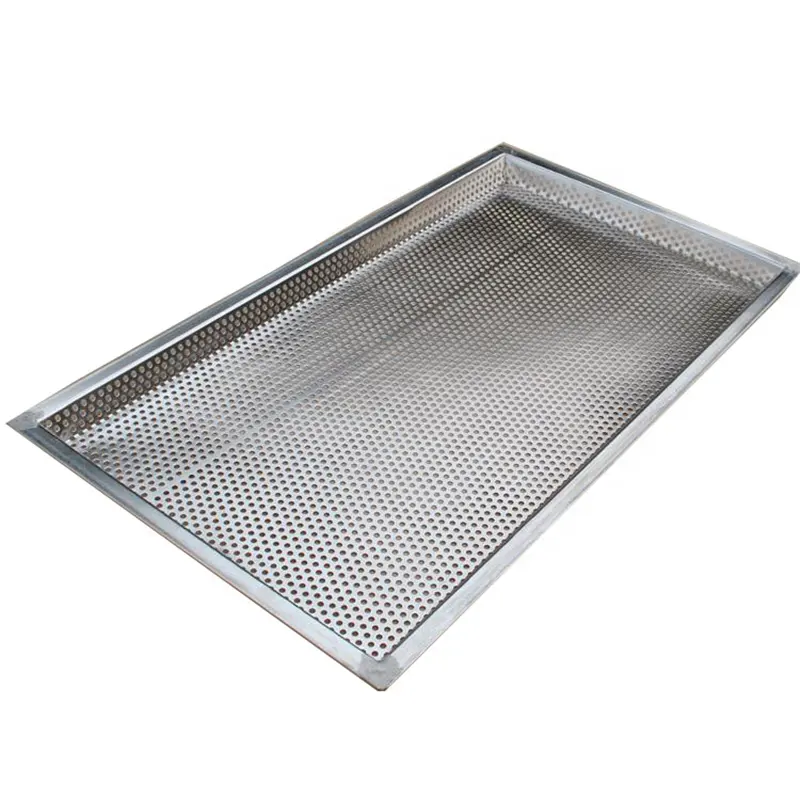
Perforated trays feature a pattern of holes that promote air circulation. This is perfect for products that need a crisp bottom, like pizza, breadsticks, or cookies. The holes allow heat to reach the underside, reducing baking time and preventing soggy bases. Perforated trays also help with even drying and cooling. When you need a perforated tray, look for options with customizable hole size and pattern to match your product size.
Solid trays are best for products with runny batter, such as cakes, brownies, or sheet cakes, where you need to contain the batter. They also work well for roasting vegetables or baking items that should not have direct air flow.
Deep edge trays (or sheet pans) have raised sides, which are ideal for items that might spill or for baking that requires a water bath. They are also stackable, saving space in your bakery. Shallow trays are better for easy removal of flat items like cookies or pizzas.
Matching the Tray to Your Bakery Application
Bread Tray Bakery: Perfecting Crust and Crumb
For artisan breads and baguettes, a bread tray bakery setup typically uses a heavy-gauge stainless steel or aluminum tray with a deep edge. The material’s heat retention helps build a crisp crust, while the sturdy construction supports the weight of dense dough. Perforated bread trays are also popular for baguettes, as they allow steam to escape and promote even crust formation.
Cookies and Pastries: The Perforated Advantage
For cookies and pastries, a perforated tray is the top choice. The holes allow hot air to circulate, so the bottoms bake evenly and don’t burn. This is crucial for thin cookies or pastry that needs a delicate, crisp texture. Aluminum perforated trays are lightweight and heat up quickly, reducing energy costs.
Cakes and Brownies: Solid, Deep Edge Trays
For cakes, brownies, and other batter-based products, a solid tray with a deep edge is necessary to hold the batter. A rimmed tray prevents spillage and allows you to fill it with water for a bain-marie, ensuring even baking for cheesecakes. Choose a heavy-gauge stainless steel tray to prevent warping and ensure even heat distribution.
Pizza and Flatbreads: Perforated or Solid?
Pizza benefits from a perforated tray to get a crispy crust, but if you prefer a softer crust, a solid tray works. For high-volume pizza production, consider a screen (a mesh tray) that allows maximum air flow, but for regular use, a perforated sheet pan is more versatile.
Cooling and Drying: The Critical Role of Perforation
After baking, cooling is essential. A perforated tray speeds up cooling by allowing air to circulate around the product, preventing condensation and sogginess. For drying fruits, herbs, or even breadcrumbs, perforated trays are indispensable. You can also use them for proofing dough, as the airflow helps develop a skin.
Comparing Tray Types: A Quick Reference
| Application | Recommended Tray Type | Material |
|---|---|---|
| Bread (artisan, baguettes) | Deep edge, solid or light perforation | Stainless steel or heavy-gauge aluminum |
| Cookies & pastries | Perforated, flat or low edge | Aluminum (lightweight, quick heat) |
| Cakes & brownies | Deep edge, solid | Stainless steel (for weight and durability) |
| Pizza & flatbreads | Perforated or screen | Aluminum or stainless steel |
| Cooling & drying | Perforated, flat | Aluminum or stainless steel |
A Simple Decision Tree for Choosing Your Tray
Follow this logic to narrow down your options:
1. What are you baking? If it’s batter (cakes, brownies) → Solid, deep edge tray. If it’s shaped dough (bread, cookies) → proceed to step 2.
2. Do you need a crisp bottom? Yes → Perforated tray. No → Solid tray.
3. What is your production volume? High volume → choose aluminum for lightweight handling. Low volume but heavy loads → choose stainless steel for durability.
4. Do you stack trays? Yes → choose a deep edge or rimmed tray for stability. No → any style works.
Frequently Asked Questions
The best material depends on your application. For even baking and lightness, choose aluminum. For durability and resistance to warping, choose stainless steel. Many bakeries use both.
Yes, but you must be careful. Perforated trays are ideal for both baking and cooling because they allow air flow. Solid trays may cause condensation when cooling, so use a wire rack instead.
A sheet pan typically has a rimmed edge, while a baking tray is flat. Sheet pans are more versatile because they can hold batter and prevent spills.
Avoid sudden temperature changes. Always let trays cool before washing. Choose thicker gauge trays (1.0mm or more) for heavy use.
They can be, but many are non-stick or have a coating. Soak them in warm, soapy water and use a soft brush.
Meta Information for SEO
Meta Title: Best Commercial Bakery Tray Guide | Materials, Styles & Uses
Meta Description: Discover the best commercial bakery tray for bread, cookies, cakes, pizza, and cooling. Compare stainless steel vs. aluminum, solid vs. perforated, and deep edge trays. Expert tips for your bakery.
Keywords: commercial bakery tray, bread tray bakery, stainless steel baking tray, perforated trayWhat is the best material for a commercial bakery tray?Can I use one tray for both baking and cooling?What is the difference between a sheet pan and a baking tray?How do I prevent trays from warping?Are perforated trays harder to clean?