





How to Choose the Perfect Stainless Steel Rectangle Baking Pan: A Comprehensive Guide for Commercial Buyers
Introduction
In the commercial kitchen, the stainless steel rectangle baking pan is a workhorse. But with so many options—rectangle baking pan, sheet pan, roasting pan, serving tray, and industrial tray—how do you choose? This guide breaks down each type, explains key features, and offers a size measurement guide to ensure you buy the right pan for your specific needs.
Rectangle Baking Pan vs. Sheet Pan vs. Roasting Pan vs. Serving Tray vs. Industrial Tray
Understanding the differences is crucial for commercial buyers. Here’s a quick comparison:
| Type | Primary Use | Key Features | Common Sizes |
|---|---|---|---|
| Rectangle Baking Pan | Baking cakes, brownies, pastries | Flat bottom, shallow sides (1-2 inches), often rolled edges | 12x8x1in, 13x9x1in |
| Sheet Pan | Baking cookies, roasting vegetables, catching drips | Flat bottom, low sides (1 inch), rolled edges, sometimes insulated | Half-size (18x13in), Full-size (26x18in) |
| Roasting Pan | Roasting meat, poultry, large cuts | Deep sides (2-4 inches), sturdy handles, often with rack | 16x12x3in, 18x13x4in |
| Serving Tray | Presenting food, buffets, catering | Shallow, decorative, easy to carry | Varies, often 15x10in |
| Industrial Tray | Food processing, proofing, drying, conveying | Heavy gauge, often perforated, stackable, custom sizes | Custom (e.g., 400x300mm, 600x400mm) |
Rectangular stainless steel pan is a broad term; understanding these distinctions ensures you choose the right tool for the job.
Key Factors in Choosing the Right Pan
1. Flat vs. Deep Sides
Flat pans (like sheet pans) are ideal for even browning and easy sliding. Deep pans (like roasting pans) hold juices and accommodate large roasts. For baking, choose a pan with sides around 1-2 inches; for roasting, go deeper.
2. Rolled vs. Straight Edges
Rolled edges add strength and prevent warping, making them perfect for commercial baking. Straight edges are easier to seal and are common in lidded pans. For heavy use, rolled edges are recommended.
3. Lidded Options
Lids are essential for moisture retention during slow cooking or transportation. A rectangular stainless steel pan with a lid is versatile for baking and storage.
4. Perforated Structure
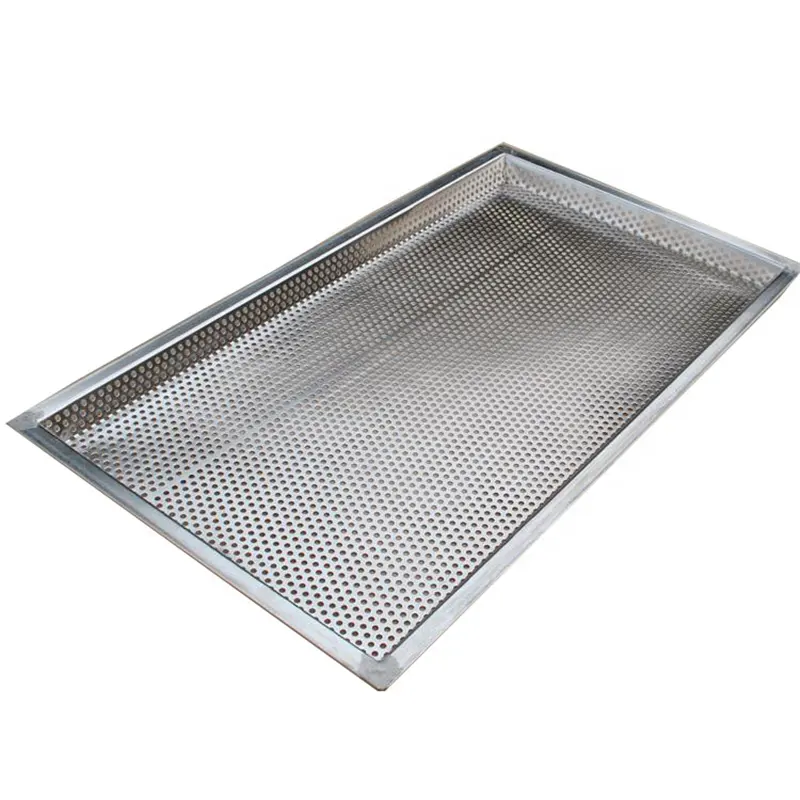
Perforated trays are ideal for air circulation, perfect for drying, smoking, or baking items that need crispness. They are common in industrial tray applications, featuring customizable hole sizes and patterns.
Material and Gauge Considerations
Stainless steel baking trays come in various grades: 201 (economical), 304 (standard for food contact), and 316 (superior corrosion resistance). Aluminum (1060, 3003, 5052) is lightweight and heats quickly, ideal for high-volume operations.
Gauge matters: from 0.5mm for light tasks to 2.0mm for heavy-duty use. Thicker pans resist dents and warping.
Size Measurement Guide
To measure a pan correctly, use the following steps:
- Length and Width: Measure from outer edge to outer edge.
- Depth: Measure from inside bottom to top edge.
- Volume: Multiply length × width × depth (in inches) and divide by 231 to get gallons.
For custom baking trays, always provide precise dimensions, including handle width if applicable.
Common Applications and Customization
Whether you need commercial baking pans for a bakery or industrial trays for a food processing line, customization is available. You can specify:
- Size (e.g., 400×300mm, 600×400mm, 800×600mm)
- Thickness (0.5–2.0mm)
- Hole size (1–10mm), spacing, and pattern for perforated trays
- Material (201, 304, 316 stainless, or aluminum)
This ensures the tray fits your oven, dryer, or conveyor exactly.
Frequently Asked Questions
Q: What is the difference between a stainless steel baking tray and a sheet pan?
A: A baking tray is often deeper with rolled edges, while a sheet pan is shallower and designed for cookies and roasting. Both are made of stainless steel, but sheet pans are typically lighter.
Q: Can I use a rectangle baking pan for roasting?
A: Yes, but only if it has deep sides and is large enough. For large roasts, a dedicated roasting pan with handles and a rack is safer.
Q: How do I measure a pan for a custom order?
A: Measure the top length and width, the interior depth, and the thickness if known. Include handle dimensions if needed. Our team can guide you.
Q: What material is best for a commercial baking pan?
A: 304 stainless steel is the standard for most commercial baking due to its durability and corrosion resistance. For acidic foods, 316 is better. Aluminum is a cheaper, lighter alternative but may react with some foods.
Q: Are perforated trays only for industrial use?
A: No, they are also great for baking pizza, drying herbs, or smoking. You can customize hole size and pattern for your specific airflow needs.
Meta Title and Description
Meta Title: Stainless Steel Rectangle Baking Pan | Custom & Commercial Pans | [Your Brand]
Meta Description: Discover the ideal stainless steel rectangle baking pan for your bakery or kitchen. Explore sheet pans, roasting pans, and custom industrial trays. Sizes, gauges, and materials customized.
Ready to Upgrade Your Kitchen?
Whether you need a durable rectangular stainless steel pan for daily baking or a custom perforated tray for processing, we have the expertise to deliver. Contact us today for a quote or to discuss your specifications.