





How to Prevent Stainless Steel Baking Trays from Warping: A Comprehensive Guide
Understanding Why Stainless Steel Baking Trays Warp
Warping occurs when stainless steel sheet pans are subjected to uneven thermal expansion or mechanical stress. The metal expands and contracts at different rates across its surface, leading to permanent distortion. Common triggers include rapid temperature changes, uneven loading, and inadequate tray design. By understanding the root causes, you can take steps to mitigate warping, though it's important to note that no tray is absolutely warp-proof.
Key Factors Influencing Warping
The tendency of a commercial baking tray to warp depends on several design and usage factors:
1. Sheet Thickness: Thicker steel offers more rigidity. For heavy loads or large trays, a minimum of 1.0 mm is recommended, while 0.5-0.8 mm is suitable for light-duty tasks. A thicker industrial oven tray is less likely to deform under stress.
2. Material Condition: The grade and temper of stainless steel matter. For example, 304 stainless steel with a full-hard temper (like 1/4 or 1/2 hard) is more resistant to warping than fully annealed soft steel. Choose a high-quality 304 or 316 grade for demanding environments.
3. Bending and Edging: Sharp bends and rolled edges add structural strength. A reinforced baking tray with a double-folded edge or a wire frame on the rim distributes stress more evenly, preventing distortion at the borders.
4. Reinforcements: Adding embossed ribs or welded crossbars on the underside increases stiffness. This is especially beneficial for large trays that span wide oven gaps.
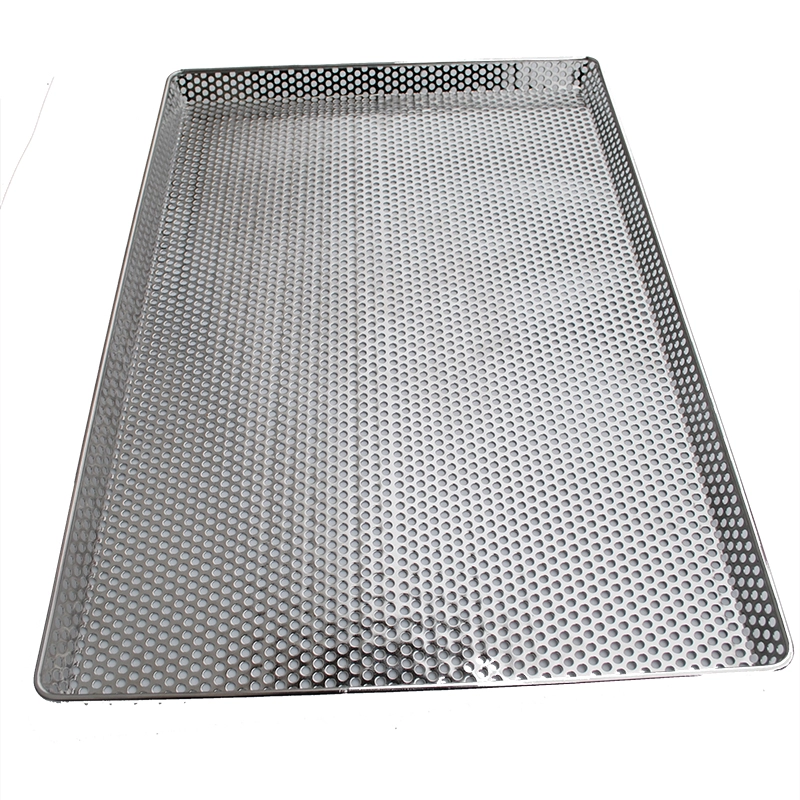
5. Perforation Layout: If you use a perforated tray, the hole pattern affects stress distribution. Evenly spaced holes with a balanced open area reduce weak spots. Avoid large unperforated zones that create uneven expansion.
6. Temperature Changes: Rapid heating or cooling shocks the metal. Always preheat the oven to the desired temperature before inserting the tray. Avoid placing cold trays into a hot oven, as the sudden expansion can cause warping.
7. Loading Distribution: Distribute products evenly across the surface. Concentrated heavy loads in the center can cause sagging. Use multiple smaller trays for heavy items instead of overloading a single tray.
8. Cooling Method: Allow trays to cool gradually at room temperature. Do not immerse a hot tray in cold water or place it on a cold surface, as thermal shock is a leading cause of warping.
Common Causes and Prevention: A Quick Reference Table
Here is a summary of common causes and corresponding preventive measures:
Table: Warping Causes and Prevention
- Thin metal → Use thicker steel (≥1.0 mm) for heavy-duty applications.
- Soft annealed material → Choose work-hardened or tempered steel.
- Sharp corners without reinforcement → Opt for rounded, rolled edges.
- Large unsupported areas → Incorporate ribs or crossbars.
- Uneven perforation → Ensure a symmetric hole pattern.
- Sudden temperature shifts → Preheat oven and cool gradually.
- Uneven loading → Spread products evenly.
- Thermal shock → Never quench hot trays in water.
Practical Prevention Checklist
To minimize the risk of warping, follow this checklist:
✔ Choose a reinforced baking tray design with a sturdy rim and ribs.
✔ Select an appropriate plate thickness based on load and size.
✔ Ensure material grade matches your temperature and corrosion requirements.
✔ Preheat the oven fully before placing the tray.
✔ Always place trays on flat, even surfaces.
✔ Allow trays to cool naturally; avoid cold-water quenching.
✔ Rotate trays periodically in the oven to ensure even heating.
✔ For heavy loads, use multiple trays instead of overfilling one.
✔ Store trays carefully to avoid accidental bending.
Frequently Asked Questions
Q: Can any stainless steel baking tray ever warp?
A: No, even the best trays can warp under extreme conditions. The goal is to reduce risk, not to promise absolute immunity.
Q: What's the best material for a commercial baking tray?
A: 304 stainless steel with a thickness of at least 1.0 mm and a reinforced rim is ideal for most commercial settings.
Q: How can I fix a warped tray?
A: It is difficult to fully restore a warped tray. Prevention is the best approach.
Q: Are perforated trays more prone to warping?
A: They can be if the hole pattern is uneven, but a well-designed pattern with proper reinforcement can be as durable as solid trays.