


Industrial Drying Rack Trolley: The Complete B2B Procurement Guide for Manufacturers and Suppliers
What Is an Industrial Drying Rack Trolley and Why It Matters in Production Lines
An industrial drying rack trolley is a wheeled frame structure designed to hold multiple trays, racks, or components during drying, cooling, baking, or storage processes. Unlike generic carts, these trolleys are engineered for seamless integration into production lines—from oven loading to ambient drying and final packaging. The core problem they solve is material handling efficiency: manually moving individual trays slows throughput and increases labor costs. A well-designed trolley enables batch processing, reduces product damage, and ensures consistent airflow for uniform drying. For B2B buyers, the decision hinges on load capacity, material compatibility, and long-term durability under continuous operation. As a manufacturer with over 15 years of experience serving food, pharmaceutical, and automotive clients, we've seen how a poorly specified trolley can bottleneck an entire line. This guide covers the technical and commercial factors you need to evaluate before placing an order.
Product Features: Structural Design, Material Advantages, and Performance Characteristics
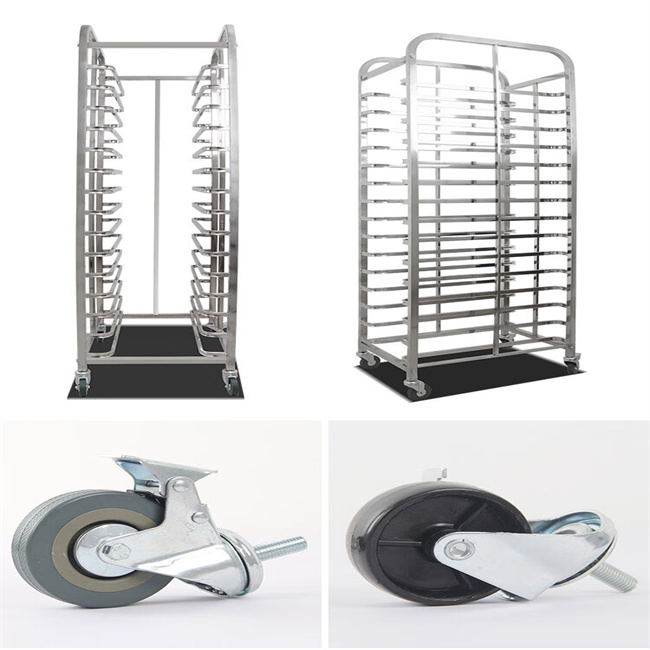
Industrial drying rack trolleys differ from standard utility carts in several critical ways. First, the reinforced frame structure—typically constructed from square or round tubing—improves load stability during repeated transportation and industrial handling. Cross-bracing and gusseted corners prevent racking and deformation under dynamic loads. Second, the wheel configuration matters: heavy-duty casters (often 4 to 8 inches in diameter) with precision bearings and optional brakes allow smooth movement over uneven floors, thresholds, and into ovens or drying tunnels. Third, ventilation design—whether through open frames, perforated panels, or mesh shelves—ensures uniform air circulation, which is critical for reducing drying time and preventing moisture pockets. Finally, surface treatment such as electropolishing or passivation enhances corrosion resistance and simplifies cleaning, meeting hygiene standards in food and pharmaceutical environments. These features are not marketing extras; they directly affect cycle times, maintenance intervals, and total cost of ownership.
Application Scenarios Across Industries
The versatility of industrial drying rack trolleys makes them indispensable in multiple sectors. In food processing, they transport trays of smoked meats, dried fruits, or pet treats through smokehouses and dehydrators. Bakeries use them to move bread, pastries, and biscuits from ovens to cooling racks, often requiring heat-resistant wheels and stainless steel construction. In industrial manufacturing, these trolleys carry machined parts, castings, or coated components through drying ovens or paint curing lines. Cleaning applications include holding parts during ultrasonic cleaning or spray washing, followed by air drying. For storage and transportation, trolleys with mesh shelves or solid trays organize work-in-progress inventory and move it between departments. Pharmaceutical and electronics manufacturers rely on static-dissipative or cleanroom-compatible versions. Each application imposes specific demands: food plants prioritize corrosion resistance and cleanability, while automotive suppliers focus on load capacity and wheel durability. Understanding your process temperature, chemical exposure, and load profile is the first step in selecting the right trolley.
Material Selection: 304 vs. 316 vs. 201 Stainless Steel and Aluminum
Material choice is the single most important factor in trolley longevity and cost. 304 stainless steel is the industry standard for food, dairy, and general wet environments—it offers excellent corrosion resistance and durability at a moderate cost. 316 stainless steel contains molybdenum, providing superior resistance to chlorides and harsh chemicals; it's specified for seafood processing, pharmaceutical cleanrooms, and coastal facilities. 201 stainless steel is a lower-cost alternative with reduced nickel content, suitable for dry environments or light-duty applications where corrosion is not a primary concern, but it may rust in prolonged moisture exposure. Aluminum trolleys are lightweight and easy to maneuver, often used in bakeries or electronics assembly where loads are lighter and corrosion resistance is less critical, though aluminum can dent under heavy impact. For B2B buyers, the decision should be based on operating environment, cleaning frequency, and expected lifespan. We typically recommend 304 for most food and industrial drying, 316 for aggressive chemical or marine conditions, and 201 or aluminum only when budget constraints are extreme and the environment is controlled.
Specifications and Technical Parameters Buyers Must Confirm
When requesting quotes, provide or ask for these specifications: Overall dimensions (length × width × height) to ensure compatibility with ovens, proofers, and doorways. Tube thickness (commonly 1.2 mm to 2.0 mm) affects load capacity and rigidity. Number of shelves or layers—typically 10 to 40—determines batch size. Load capacity per shelf and total capacity (often 200 kg to 1000 kg) must match your product weight. Wheel type and size (casters vs. fixed, with or without brakes) influence maneuverability. Mesh or perforation specifications (aperture size, open area percentage) affect airflow and small-part retention. Tray compatibility—ensure shelf spacing and depth match your existing trays (e.g., 600×400 mm, 18×26 inches). Surface finish (polished, brushed, electropolished) impacts cleanability and appearance. Operating temperature range—critical if the trolley enters ovens or freezers. Providing these details upfront prevents costly rework and ensures the trolley integrates smoothly into your line.
Customization and OEM/ODM Services
Standard trolleys rarely fit every production line. As a manufacturer with in-house design and fabrication capabilities, we offer full OEM and ODM services. Custom sizes accommodate unique oven dimensions or floor layouts. Custom designs include specialized shelf configurations, removable racks, drainage systems, or integration with automated guided vehicles (AGVs). We can apply your logo via laser etching or metal tags for brand consistency. Custom packing—including knock-down designs for cost-effective shipping—reduces freight costs for overseas buyers. Special requirements such as static-dissipative wheels, high-temperature casters, or food-grade lubricants are available. Our engineering team works from your drawings or provides recommendations based on your process parameters. For custom requirements, please contact our team to discuss your project—we typically respond within 24 hours with a feasibility assessment and preliminary quote.
Procurement Guide: How to Choose the Right Trolley and Supplier
Choosing the right industrial drying rack trolley involves four key decisions. First, size selection: measure your oven or drying chamber, door clearances, and turning radius. Consider future product changes—a slightly larger trolley may offer flexibility. Second, material selection: match to your environment as discussed earlier; don't over-specify 316 if 304 suffices, but never compromise on food safety. Third, specification confirmation: request a detailed drawing with tolerances, material certificates (e.g., EN 10204 3.1), and load test reports. Fourth, supplier evaluation: look for a factory with proven production capability, quality control processes (ISO 9001), and experience in your industry. Ask for references, request a sample or pilot unit, and review their warranty and after-sales support. A reliable supplier will provide transparent lead times, shipping terms, and spare parts availability. Avoid suppliers who cannot provide material traceability or who quote unusually low prices—they often cut corners on tube thickness or weld quality. As a manufacturer supplying global brands for over a decade, we recommend auditing potential suppliers via video tour or third-party inspection.
Frequently Asked Questions (FAQ)
Q1: What is the typical lead time for a custom industrial drying rack trolley?
A1: For standard models, lead time is 15–20 days. Custom designs with new tooling or special materials typically require 25–35 days, depending on order quantity and complexity. We provide a firm delivery date after design approval.
Q2: Can your trolleys withstand high-temperature ovens?
A2: Yes. We offer models with high-temperature casters (up to 250°C) and heat-resistant finishes. However, 201 stainless steel may discolor at elevated temperatures; 304 or 316 is recommended for repeated oven exposure. Please specify your maximum operating temperature when inquiring.
Q3: What is the difference between mesh and perforated shelves?
A3: Mesh shelves offer higher open area (up to 70%) for faster drying and are ideal for small parts. Perforated shelves provide a flat surface with 30–50% open area, better for trays or items that might fall through mesh. Both are available in various aperture sizes.
Q4: Do you provide samples for evaluation?
A4: For standard models, we can provide a sample at a reduced cost, with the sample fee refundable against a bulk order. Custom samples require a tooling fee, which is also refundable upon order confirmation. Shipping costs are borne by the buyer.
Q5: How do I ensure the trolley fits my existing trays?
A5: Provide us with your tray dimensions (length, width, height) and desired shelf spacing. We will design the trolley accordingly and send a CAD drawing for your approval before production. Alternatively, send us a sample tray for precise fitting.
Q6: What are your payment and shipping terms?
A6: We accept T/T (30% deposit, 70% before shipment) and L/C at sight. For repeat orders, we can discuss more flexible terms. We ship FOB, CIF, or DDP as per your preference, and we work with reliable freight forwarders to ensure safe delivery.
Q7: Do you offer a warranty?
A7: Yes. All our trolleys come with a 2-year warranty against manufacturing defects. Wear parts like casters and wheels are covered for 1 year. We also provide spare parts at cost for the lifetime of the product.
Q8: Can you produce trolleys that meet FDA or EU food contact standards?
A8: Absolutely. We use 304 or 316 stainless steel with food-grade welds and finishes. We can provide material certificates and compliance declarations for FDA, EU 1935/2004, and other relevant standards upon request.
Image ALT Text Suggestions
For SEO and accessibility, use these ALT texts when uploading product images: "Industrial drying rack trolley with 20 shelves in stainless steel for bakery oven loading", "Heavy-duty drying trolley with mesh shelves and high-temperature casters in food processing plant", "Customized stainless steel drying rack trolley with logo for pharmaceutical cleanroom".
SEO Meta Information
SEO Title: Industrial Drying Rack Trolley | B2B Manufacturer & Supplier
Meta Description: Custom industrial drying rack trolleys in 304/316 stainless steel. Ideal for food, bakery, and manufacturing. OEM/ODM, factory-direct pricing. Request a quote today.
SEO Keywords: industrial drying rack trolley, stainless steel drying trolley, bakery rack trolley, food processing trolley, custom drying rack, industrial oven trolley, manufacturer, supplier, OEM, heavy-duty drying cart.

