


Manual Bakery Trolley: A Strategic Guide for B2B Industrial Procurement
Product Introduction: What Is a Manual Bakery Trolley and Why It Matters in Industrial Settings
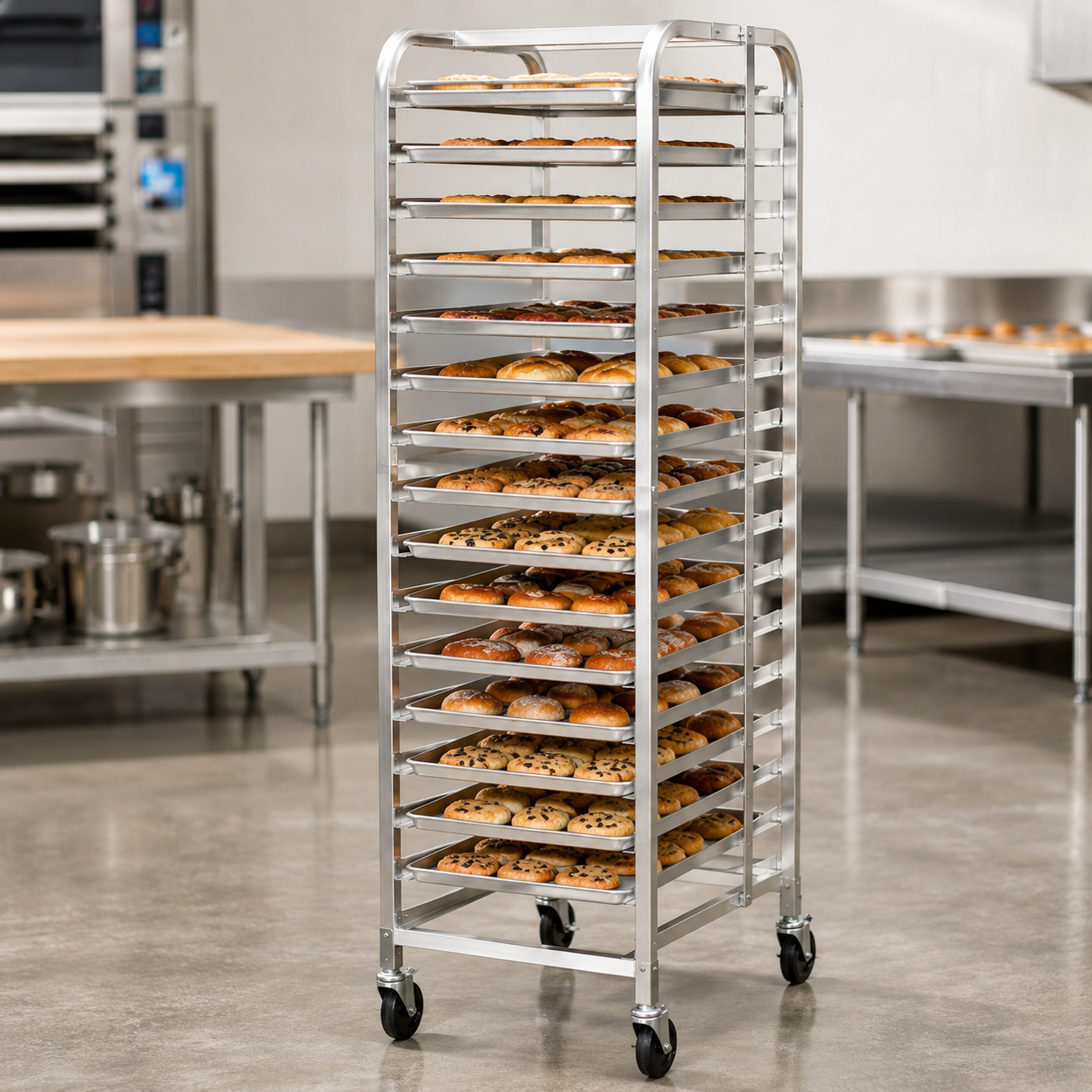
A manual bakery trolley is a wheeled frame specifically designed to hold multiple baking trays or sheet pans, allowing for the efficient transport of dough, proofed goods, and finished baked items through various stages of production. Unlike standard carts, these trolleys are engineered to withstand the rigors of industrial bakeries—from the scorching heat of deck ovens to the freezing temperatures of blast freezers. They solve a fundamental problem in high-volume operations: the need to move large quantities of product with minimal labor while maintaining product integrity and hygiene standards. In a typical industrial bakery, a single manual trolley can replace dozens of individual tray movements, directly reducing labor costs and the risk of product damage. For B2B buyers, this translates to a faster, more predictable production flow and a lower total cost of ownership.
Product Features: Engineering That Goes Beyond the Basics
At first glance, a manual bakery trolley may appear to be a simple rack on wheels. However, the difference between a generic rack and a professionally engineered unit lies in the details—details that directly impact your bottom line. High-quality trolleys feature reinforced frame structures that improve load stability during repeated transportation and industrial handling. The welding is often seamless and polished to eliminate crevices where dough or bacteria can accumulate, meeting stringent food safety regulations. The wheel design is another critical feature: heavy-duty casters with non-marking, oil-resistant polyurethane tires ensure smooth rolling over uneven floors and around tight corners, while locking mechanisms secure the trolley during loading and unloading. Additionally, many models incorporate removable or fixed tray slides that allow for quick adjustments without tools, accommodating various tray sizes and optimizing space utilization. These features are not merely conveniences—they are the result of extensive R&D aimed at reducing downtime and extending the trolley's service life in demanding environments.
Application Scenarios: Where Manual Bakery Trolleys Prove Their Worth
The versatility of manual bakery trolleys makes them indispensable across a wide range of industries. In food processing plants, they are used to transport raw ingredients, intermediate products, and finished goods between processing stations. In industrial bakeries, they facilitate the movement of dough through proofers, ovens, and cooling racks. Beyond baking, these trolleys are also employed in pharmaceutical manufacturing for drying and storing materials, in commercial cleaning operations for moving supplies, and in warehousing and logistics for order picking and storage. A notable application is in meat and poultry processing, where stainless steel trolleys are used to move product through chillers and freezers. The common thread across all these scenarios is the need for a durable, hygienic, and mobile platform that can handle heavy loads repeatedly. By standardizing on a well-designed trolley, plant managers can achieve significant gains in both efficiency and safety.
Material Selection: Choosing the Right Stainless Steel or Aluminum
The material of construction is one of the most critical decisions for B2B buyers, as it affects durability, hygiene, and cost. The most common options are 304 stainless steel, 316 stainless steel, 201 stainless steel, and aluminum. Each has distinct properties suited to different environments.
- 304 Stainless Steel: The industry standard for food-grade applications. It offers excellent corrosion resistance, durability, and ease of cleaning. Ideal for most bakery and food processing environments.
- 316 Stainless Steel: Contains molybdenum, which provides superior resistance to chlorides and acids. Recommended for highly corrosive environments, such as seafood processing or chemical plants.
- 201 Stainless Steel: A lower-cost alternative with good strength but less corrosion resistance. Suitable for dry storage or light-duty applications where budget is a primary concern.
- Aluminum: Lightweight and excellent for applications requiring frequent lifting or where weight is a factor. However, it is softer and may not withstand the same abuse as stainless steel.
When selecting a material, consider the specific chemicals, cleaning agents, and temperatures the trolley will encounter. For most bakeries, 304 stainless steel is the optimal balance of cost and performance. For harsh environments, investing in 316 may be necessary to avoid premature replacement.
Specifications and Technical Parameters: What to Look For
To ensure you procure the right manual bakery trolley for your operation, you must specify key parameters. Understanding these details prevents costly mismatches and ensures compatibility with your existing equipment.
- Dimensions (L x W x H): Standard sizes range from 600x400mm to 800x600mm tray footprints, with heights from 1000mm to 1800mm. Custom sizes are available for unique tray configurations.
- Tube Thickness: Typically 1.0mm to 2.0mm for stainless steel. Thicker walls increase load capacity but also weight and cost.
- Number of Shelves/Levels: Commonly 6 to 20 levels, depending on tray pitch. Adjustable pitch is a valuable feature for flexibility.
- Load Capacity: Static load ratings from 100kg to 500kg. Dynamic load (while moving) is usually lower; always check both.
- Mesh/Perforation: For drying applications, the mesh size and open area are critical. Standard mesh openings range from 5mm to 25mm.
- Tray Compatibility: Ensure the slide spacing matches your existing tray dimensions (e.g., 18" x 26", 600x400mm, etc.).
- Surface Finish: Polished or brushed stainless steel. Polished surfaces are easier to clean but may show scratches; brushed finishes hide wear better.
Providing these specifications to your supplier ensures you receive a product that fits seamlessly into your production line.
Customization and OEM/ODM Services: Tailoring to Your Needs
Every production facility has unique requirements. A reputable manufacturer offers extensive customization to meet your specific needs. Custom size adjustments ensure the trolley fits your available space and tray dimensions. Custom design modifications, such as adding shelves, hooks, or drainage systems, can be engineered to your specifications. Logo printing or etching on the frame helps with branding and inventory management. Special packing requirements for export, including palletization and protection against moisture, are available. Moreover, OEM/ODM capabilities allow you to develop proprietary designs that give you a competitive edge. When evaluating suppliers, ask about their engineering support and prototyping lead times. A factory with in-house design and tooling can often turn around custom requests in weeks, not months. For custom requirements, please contact our team to discuss your project.
Procurement Guide: How to Choose the Right Trolley and Supplier
Procuring manual bakery trolleys is a strategic decision that impacts your operations for years. Here are key considerations to guide your purchasing process.
How to choose the size? Measure your existing trays and the space between production stages. Consider the turning radius of your aisles and doorways. A trolley that is too wide may not fit through narrow passages, while one that is too tall may not clear overhead equipment. If unsure, consult with your supplier's technical team—they can provide CAD drawings for layout simulation.
How to choose the material? Assess your operating environment. For general bakery use, 304 stainless steel is sufficient. For high-humidity or acidic environments, specify 316. If weight is a concern and corrosion is not, aluminum may be appropriate. Always request material certificates to verify compliance with food safety standards.
How to confirm specifications? Insist on a detailed specification sheet that includes tube thickness, weld quality, wheel type, and load ratings. Ask for a sample or a 3D model to verify dimensions. A reputable supplier will provide full documentation and even third-party test reports.
How to judge supplier capability? Look beyond price. Evaluate their manufacturing processes, quality control systems, and production capacity. A factory with automated welding and polishing lines can deliver consistent quality at scale. Check certifications (ISO 9001, FDA compliance) and request references from other B2B customers. A supplier with a proven track record in the food industry is more likely to understand your needs and provide reliable support.
Frequently Asked Questions (FAQ)
Q1: What is the typical lead time for a custom manual bakery trolley order?
A1: Lead time varies based on complexity and order volume. For standard sizes, it's usually 2-4 weeks. Custom designs may require 4-8 weeks, including prototyping and approval. Always confirm with your supplier, as factors like material availability can affect timelines.
Q2: Can these trolleys be used in freezer environments?
A2: Yes, provided they are made from appropriate materials (e.g., 304 or 316 stainless steel) and use wheels designed for low temperatures. Standard polyurethane wheels may become brittle in freezers; specify cold-resistant wheels for such applications.
Q3: What is the difference between a bakery trolley and a standard platform cart?
A3: A bakery trolley is specifically designed with multiple shelves or slides to hold trays, maximizing vertical space and protecting products during transport. Platform carts are flat and better suited for bulk items, not individual trays.
Q4: How do I clean and maintain stainless steel trolleys?
A4: Regular cleaning with mild detergent and water is sufficient. Avoid abrasive cleaners that can scratch the surface. For sanitation, use approved food-grade sanitizers. Periodically inspect wheels and welds for wear and replace as needed.
Q5: Are replacement parts available?
A5: Yes, most manufacturers offer replacement wheels, slides, and other components. When ordering, specify your trolley model and year of purchase to ensure compatibility.
Q6: Can I mix tray sizes on the same trolley?
A6: Some trolleys feature adjustable slides that accommodate different tray sizes. If you need to switch frequently, look for models with tool-free adjustment. Otherwise, dedicated trolleys for each tray size may be more efficient.
Q7: What is the warranty on these products?
A7: Warranties vary by manufacturer and product line. Typically, a 1-2 year warranty covers defects in materials and workmanship. Discuss warranty terms during procurement and ensure they are documented in the contract.
Q8: Do you provide image ALT text for product photos?
A8: Yes, for SEO and accessibility, we recommend ALT text such as: "Stainless steel manual bakery trolley with 20 tray slides in a commercial bakery" or "Heavy-duty manual bakery trolley with reinforced frame and swivel casters."
SEO and Meta Information
SEO Title: Manual Bakery Trolley | Industrial B2B Buying Guide
Meta Description: Discover how to choose the right manual bakery trolley for your industrial bakery or food plant. Compare materials, specs, and supplier capabilities. Get a quote today.
SEO Keywords: manual bakery trolley, bakery trolley manufacturer, stainless steel bakery trolley, industrial bakery trolley, bakery tray trolley, custom bakery trolley, commercial bakery trolley, bakery trolley supplier, bakery trolley specifications, B2B bakery equipment.

