


OEM Stainless Steel Bakery Trolley Factory: A Strategic Guide for B2B Procurement
Product Introduction: What Is an OEM Stainless Steel Bakery Trolley?
An OEM stainless steel bakery trolley is a mobile racking system designed specifically for the baking and food processing industries. Unlike generic shelving, these trolleys are engineered to withstand the rigors of daily use in high-temperature, high-humidity environments. They solve critical problems: efficient transport of dough, baked goods, and ingredients between production stages; space-saving storage; and compliance with strict hygiene standards. When you source from an OEM stainless steel bakery trolley factory, you're not just buying a product—you're investing in a solution tailored to your production line.
Product Features: Engineering for Industrial Durability
Industrial bakery trolleys are not merely carts; they are precision-built tools. Key features include:
- Reinforced frame structure: The frame is typically constructed from 1.2mm to 2.0mm thick stainless steel tubing, with cross-bracing that improves load stability during repeated transportation. This design prevents swaying and deformation even when fully loaded.
- High-quality casters: Heavy-duty swivel casters with brakes, often made of heat-resistant nylon or polyurethane, ensure smooth movement over uneven floors and withstand temperatures up to 200°C in baking ovens.
- Welded joints: Fully welded and polished joints eliminate crevices where bacteria can harbor, meeting food safety standards such as HACCP and FDA.
- Modular design: Many models feature adjustable shelf heights or removable racks, allowing quick reconfiguration for different product sizes.
These features directly address the pain points of industrial baking: reducing downtime, preventing product damage, and extending equipment lifespan.
Application Scenarios: Beyond the Bakery
While the name emphasizes bakery, these trolleys are versatile assets across multiple industries:
- Food Processing: Transporting raw materials, intermediate products, and finished goods in meat, dairy, and ready-meal plants. Stainless steel resists corrosion from salts, acids, and cleaning agents.
- Bakery & Confectionery: Holding dough trays, cooling racks, and decorating stations. The open wire mesh design allows airflow for even cooling.
- Industrial Manufacturing: Moving small parts, tools, or components in assembly lines. The rugged construction handles heavy loads up to 500kg.
- Cleaning & Drying: In commercial dishwashing areas, trolleys hold racks of utensils or parts during washing and drying cycles. The stainless steel withstands steam and chemicals.
- Storage & Transportation: In warehouses and logistics, they serve as mobile storage units, optimizing space and reducing manual handling.
Each application demands specific configurations—a point we'll explore in the customization section.
Material Selection: 304, 316, 201 Stainless Steel, or Aluminum?
The choice of material directly impacts cost, durability, and compliance. As an experienced OEM factory, we guide clients through the trade-offs:
- 304 Stainless Steel: The industry standard for food contact. Offers excellent corrosion resistance, easy cleaning, and good strength. Suitable for most bakery and food processing environments.
- 316 Stainless Steel: Superior corrosion resistance, especially against chlorides and acids. Recommended for harsh environments, such as seafood processing or plants using aggressive sanitizers. Higher cost but longer service life.
- 201 Stainless Steel: A lower-cost alternative with moderate corrosion resistance. Best for dry storage or light-duty applications where exposure to moisture and chemicals is minimal. Not recommended for direct food contact in wet environments.
- Aluminum: Lightweight and rust-resistant, but softer and less durable than stainless steel. Often used for non-structural components or where weight is a critical factor. However, it can dent under heavy impact and may not meet hygiene standards for direct food contact.
We provide material certificates and testing reports to ensure compliance with your market's regulations.
Specifications: Key Parameters for Procurement
When specifying a bakery trolley, these parameters are critical:
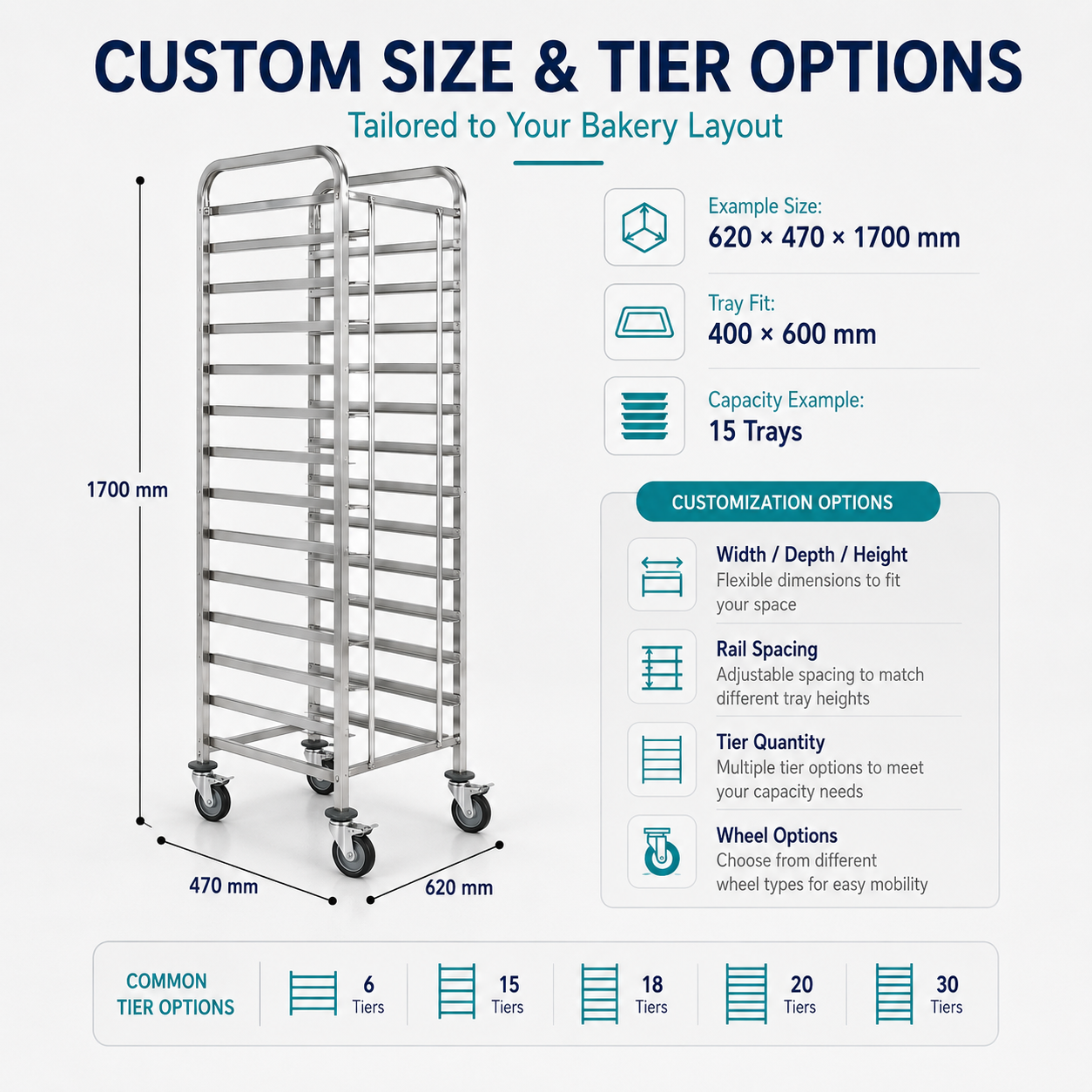
- Dimensions: Common sizes include 600x400mm, 800x600mm, and custom sizes to fit your existing racks and ovens. Overall height typically ranges from 1000mm to 1800mm.
- Thickness: Tube wall thickness from 1.0mm to 2.5mm; wire mesh diameter from 3mm to 6mm. Thicker materials handle higher loads but add weight.
- Capacity: Load capacity per shelf from 50kg to 150kg; total trolley capacity up to 500kg.
- Number of Shelves: Typically 10 to 20 tiers, with adjustable pitch (e.g., 50mm increments).
- Load Bearing: Static load vs. dynamic load—ensure casters are rated for the total weight.
- Mesh Size: Openings from 10x10mm to 50x50mm; smaller mesh prevents small items from falling through.
- Tray Compatibility: Standard tray sizes (e.g., 600x400mm, 530x325mm) or custom racks.
- Surface Treatment: Polished, brushed, or electropolished for enhanced hygiene and corrosion resistance.
Provide us with your production line layout, and our engineers will recommend optimal specifications.
Customization Services: OEM/ODM Capabilities
As a dedicated OEM stainless steel bakery trolley factory, we offer full customization:
- Custom Size: Modify length, width, height, and shelf spacing to fit your equipment.
- Custom Design: From simple trolleys to complex multi-function units with braking systems, foldable sides, or integrated weighing scales.
- Logo & Branding: Laser-engraved or stamped logos on frames or nameplates.
- Packing: Customized packaging for safe sea transport, including wooden crates or pallets with edge protection.
- Special Requirements: Anti-microbial coatings, ESD-safe versions for electronics, or high-temperature wheels for oven loading.
Our in-house R&D team collaborates with you from concept to production. For custom requirements, please contact our team to discuss your project.
Procurement Guide: How to Choose the Right Supplier
Selecting an OEM partner is a strategic decision. Here are key questions to ask:
- How to choose the right size? Map your existing trays, ovens, and aisles. Consider future expansion. A slight oversize may limit maneuverability, while undersize reduces capacity.
- How to choose the material? Assess your environment: humidity, temperature, chemicals. For wet, acidic conditions, insist on 304 or 316. For dry storage, 201 may suffice.
- How to confirm specifications? Request detailed drawings with tolerances. Check load ratings from third-party labs. Ask for samples to test in your facility.
- How to judge supplier capability? Visit the factory (or request a virtual tour). Look for advanced welding equipment, in-house polishing lines, and quality control documentation. Check certifications: ISO 9001, FDA, CE. Review past projects and client references.
A reliable OEM factory provides transparency and technical support throughout the procurement process.
Frequently Asked Questions (FAQ)
1. What is the typical lead time for OEM bakery trolleys?
Standard models: 15-20 days. Custom designs: 25-35 days after sample approval, depending on complexity and order quantity.
2. Can you produce trolleys that fit our existing oven racks?
Yes. Provide us with the rack dimensions and we will design the trolley to match. We can also reverse-engineer from a sample you send.
3. Do you offer samples for quality evaluation?
We can provide a sample at a reasonable cost, which is refundable upon bulk order. Sample lead time is about 10-15 days.
4. What is the minimum order quantity (MOQ)?
For standard models, MOQ is 50 units. For custom designs, MOQ is 100 units. We can negotiate for trial orders.
5. How do you ensure product quality?
We conduct raw material inspection, in-process checks, and final load testing. Each trolley is inspected for weld integrity, caster function, and surface finish before packing.
6. What are your payment terms?
Typically 30% T/T deposit, 70% balance against B/L copy. For long-term partners, we can discuss L/C at sight.
7. Can you handle shipping and export documentation?
Yes. We have a dedicated export team and can arrange FOB, CIF, or DDP terms. We provide all necessary certificates for customs clearance.
8. Do you offer after-sales support?
We provide a 2-year warranty on structural integrity and casters. Replacement parts are available at cost. Technical support is available via video call.
Image ALT Text Suggestions
For product images, use descriptive ALT text: "OEM stainless steel bakery trolley with 15 shelves and heavy-duty casters" or "Custom 304 stainless steel bakery trolley in food processing plant". This improves SEO and accessibility.
Meta Information
SEO Title: OEM Stainless Steel Bakery Trolley Factory | Custom Solutions
Meta Description: Partner with a leading OEM stainless steel bakery trolley factory. Custom sizes, 304/316 steel, heavy-duty casters. Get a quote for durable bakery trolleys.
SEO Keywords: OEM stainless steel bakery trolley, bakery trolley factory, custom bakery trolley, stainless steel trolley manufacturer, industrial bakery trolley, 304 stainless steel trolley, bakery rack trolley, food processing trolley, OEM bakery equipment, stainless steel trolley supplier.

