





Optimizing Bread Production Lines with Custom Commercial Baking Trays: A Comprehensive Solution for Bread Factories
The Role of Baking Trays in the Bread Production Cycle
In a bread factory, the baking tray is not just a passive carrier; it is an active participant in the entire production process. From the moment dough is loaded onto the tray, through proofing, baking, cooling, depannning, and cleaning, the tray’s design directly impacts workflow, product consistency, and operational costs. Therefore, selecting the right bread baking trays is a strategic decision that affects every downstream operation.
Trays must be compatible with dough shape (e.g., baguettes, loaves, rolls) to ensure even heat distribution and consistent crust development. They also need to fit precisely into your racks, ovens, and conveyors. For instance, the widely used 600x400 oven tray is a standard in many commercial bakeries because it maximizes oven capacity while allowing seamless transfer from proofing to baking and cooling. Our industrial baking tray solutions are designed with these integration points in mind.
Matching Tray Design to Dough Shape and Product Variety
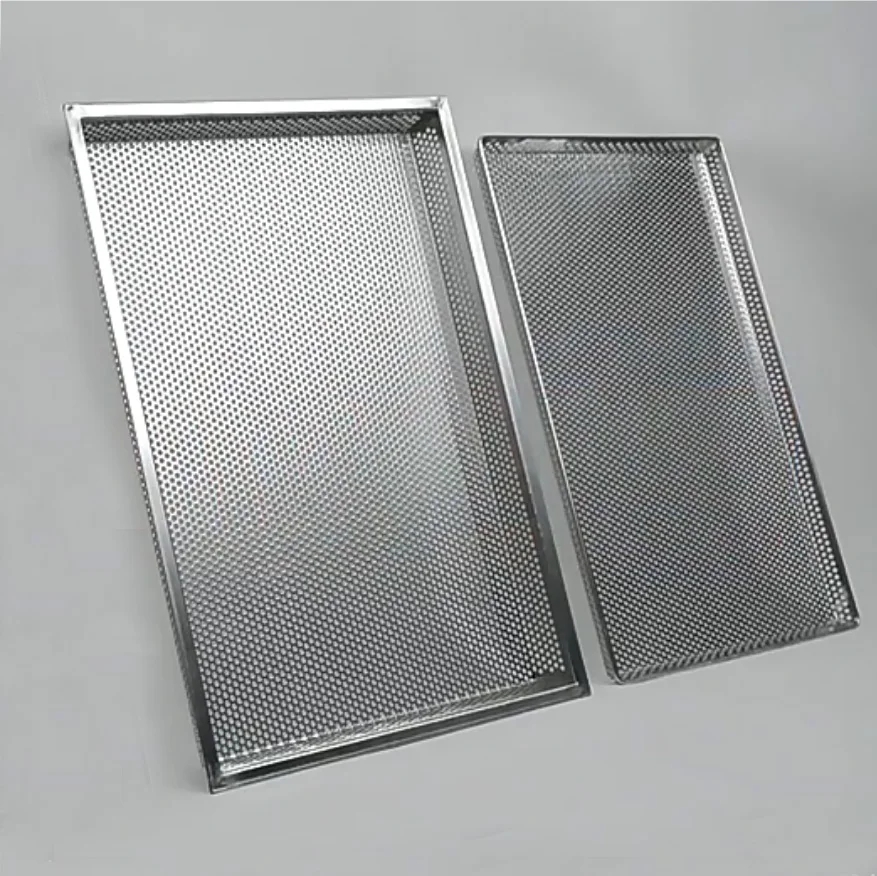
Every bread product has unique dimensional requirements. A baguette tray, for example, has grooved surfaces to keep long loaves straight, while a roll tray may have indents to prevent sticking and promote uniform rounding. Our commercial baking tray can be customized with various hole patterns, rim heights, and surface textures to suit your product lineup. The choice of material—stainless steel (201, 304, 316) or aluminum alloys (1060, 3003, 5052)—also affects thermal conductivity, weight, and corrosion resistance.
For most baking environments, 304 stainless steel offers an excellent balance of durability and food safety. Aluminum, on the other hand, is lighter and heats up faster, making it ideal for rapid baking cycles. Whichever you choose, our trays can be fabricated with precise dimensions—length, width, and edge height—to match your specific line. Standard sizes include 400x300 mm, 600x400 mm, and 800x600 mm, but we can produce any custom size you require.
Integration with Proofing and Baking Equipment
The bakery trolley tray is the link between your proofing cabinet and oven. Trays must slide smoothly into trolley slots, withstand repeated handling, and not warp under temperature fluctuations. Our trays are reinforced with rolled edges and sturdy rims to prevent bending, even when fully loaded with dough. Additionally, the tray’s hole pattern is engineered to promote even airflow during proofing and baking, which is critical for consistent rising and browning.
When it comes to ovens, a 600x400 oven tray is often used in rack ovens, deck ovens, and tunnel ovens. Our trays are compatible with these systems, ensuring you can maximize the number of trays per batch without sacrificing heat distribution. For automated production lines, we offer trays with special features like flat flanges for conveyor systems and locating tabs that align with shuttle arms and indexing stops.
Cooling, Depanning, and Cleaning Considerations
After baking, trays move to cooling tunnels or racks. The tray material and design should facilitate rapid heat dissipation to speed up the cooling process. For instance, aluminum trays cool faster than stainless steel, reducing the time before depannning. In addition, a well-designed tray—with smooth surfaces and appropriate hole patterns—ensures that bread releases easily, minimizing product damage and reducing the need for excessive flour or oil usage.
Cleaning is another critical step. Trays must be able to withstand harsh detergents, high-pressure washing, and steam. Stainless steel trays are especially resistant to corrosion and can be cleaned repeatedly without degrading. We also offer trays with perforated bases that allow water and cleaning agents to flow through, ensuring thorough sanitation. Our bakery trolley trays are designed to interlock with trolley wheels and support frames, making them easy to move between process stages and into washing stations.
Automated Conveyor and Washing System Compatibility
In modern bread factories, automation is key to maintaining consistency and reducing labor costs. Our commercial baking tray is engineered to work seamlessly with automatic loading, unloading, and conveying systems. The trays have flat, smooth surfaces that are compatible with vacuum suction, mechanical pushers, and belt conveyors. We can also add magnetic strips or barcode holders to support tracking and automation.
For washing systems, trays must be stackable for space efficiency and have drainage capabilities. Our industrial baking tray features stackable designs with self-spacing lugs that protect non-stick coatings and ensure water runs off easily. Whether you use a batch-type washer or a continuous tunnel wash system, our trays are built to survive hundreds of wash cycles.
Process Flow Table
Here is a typical workflow for bread production using our trays:
Loading → Dough pieces are placed onto trays
Proofing → Trays on bakery trolleys are moved into proofing cabinets
Baking → Trolleys are transferred to ovens; trays withstand high heat
Cooling → Trays and bread move through cooling tunnels
Depanning → Bread is removed; trays are emptied
Cleaning → Empty trays are washed and sanitized
Return → Trays are stacked and returned to the loading area
Project Inquiry Checklist
When you contact us for a tailored solution, please have the following information ready:
1. Bread product type (loaf, roll, baguette, etc.)
2. Dough weight per piece
3. Oven type and internal dimensions
4. Trolley size and slot spacing
5. Production capacity (pieces per hour)
6. Automation level (manual, semi-auto, full-auto)
7. Washing system specifications
8. Required tray material and thickness
Frequently Asked Questions
Q: Can you manufacture custom sizes for our existing trolleys?
A: Yes, we can produce trays in any size, including non-standard dimensions. Our process allows for custom length, width, and edge height to fit your current trolley slots and oven racks.
Q: What is the difference between 201 and 304 stainless steel for baking trays?
A: 201 stainless steel is more economical but has lower corrosion resistance. 304 is more durable and resistant to rust and chemicals, making it the preferred choice for most food processing environments. For high-chloride cleaning agents or marine-like conditions, we recommend 316 stainless steel.
Q: Do you provide stacks or nests for storage?
A: Absolutely. Most of our trays are designed with angled or straight flanges that allow safe stacking without damaging the surface. This saves space and protects the trays during storage and transport.
Get a Custom Quote Today
Choosing the right commercial baking tray is vital for optimizing your bread factory’s performance. We specialize in manufacturing industrial baking trays that enhance workflow and product quality. Contact our team with your specifications, and we’ll provide a tailored solution that fits your budget and production demands. Request your free consultation and quote now!