


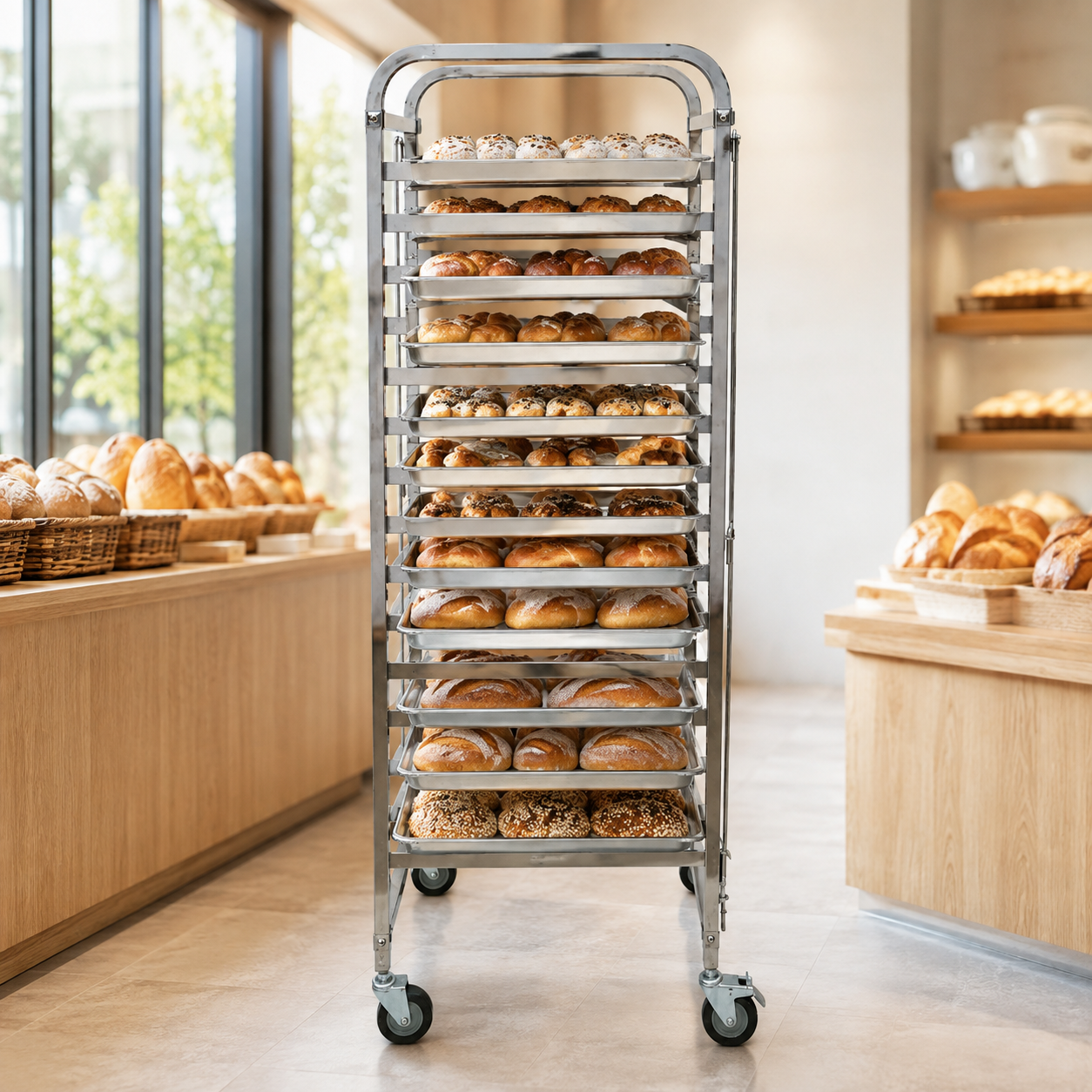
Restaurant Bakery Trolley: The Backbone of Efficient Bakery Logistics
Product Introduction: What Is a Restaurant Bakery Trolley?
A restaurant bakery trolley is a mobile, multi-tiered cart designed specifically for the transportation, storage, and display of baked goods, ingredients, and tools within commercial food service settings. Unlike generic utility carts, these trolleys are engineered to withstand the rigors of a professional bakery environment—high temperatures, frequent washing, and heavy loads. They are essential for streamlining workflows, from proofing and baking to cooling and packaging. The primary purpose is to enhance efficiency by reducing manual handling and minimizing product damage. For B2B buyers, choosing the right trolley means investing in durability, hygiene, and operational flexibility. As a manufacturer with over 15 years of experience, we understand that these trolleys are not just equipment; they are integral to your production line.
Product Features: Engineering for Industrial Demands
Industrial bakery trolleys are built with robust construction to meet the demands of continuous use. Key features include:
- Reinforced frame structure: The frame is typically made from square or round stainless steel tubes with a wall thickness of 1.2mm to 1.5mm, providing stability under heavy loads (up to 500kg). This design minimizes sway and prevents tipping during transit over uneven floors.
- Corrosion-resistant materials: Using 304 or 316 stainless steel ensures resistance to moisture, detergents, and acidic food residues, extending the trolley's lifespan in humid bakery environments.
- Easy-to-clean surfaces: The smooth, non-porous surface of stainless steel prevents bacterial growth and simplifies sanitation, meeting HACCP and FDA standards.
- Modular design: Many trolleys feature removable shelves or adjustable tray slides, allowing customization for different tray sizes and product heights.
- Mobility: Heavy-duty casters (typically 4-6 inches) with optional brakes provide smooth movement and secure positioning, even on ramps or in narrow aisles.
These features are not just about durability; they are about optimizing operational efficiency. For instance, the reinforced frame reduces vibrations that can damage delicate pastries, while the casters are selected based on floor type and load capacity to prevent premature wear.
Application Scenarios: Beyond the Bakery
While the term restaurant bakery trolley suggests a specific use, these carts are versatile assets across various industries. Here's how different sectors leverage them:
- Food Processing: Transporting ingredients between preparation and cooking areas. Trolleys with solid shelves are preferred to contain spills and prevent cross-contamination.
- Bakery and Confectionery: Moving proofed dough, baked bread, and decorated cakes. Tiered trolleys with tray slides allow for efficient cooling and storage.
- Industrial Manufacturing: Used to carry components or tools in cleanroom environments. Stainless steel construction meets hygiene and static-control requirements.
- Cleaning and Sanitation: Holding cleaning supplies or soiled dishes. Trolleys with perforated shelves facilitate drainage and drying.
- Drying and Cooling: In bakeries, trolleys with mesh shelves allow air circulation for rapid cooling of baked goods.
- Storage: Mobile shelving units maximize space utilization in cramped kitchens.
- Transportation: Logistic hubs use heavy-duty trolleys to move goods between storage and loading docks.
For example, a large hotel in Europe uses our trolleys to transport breakfast pastries from the central bakery to satellite kitchens, reducing labor costs by 20%. In a food processing plant, trolleys with 316 stainless steel are used in a high-humidity area, where they have lasted over 8 years without corrosion.
Material Specifications: Choosing the Right Steel
The material of your trolley directly impacts its lifespan, maintenance, and cost. Here's a breakdown:
- 304 Stainless Steel: The industry standard for food contact. It offers excellent corrosion resistance and durability. Suitable for most bakery environments.
- 316 Stainless Steel: Contains molybdenum, providing superior resistance to chlorides and acids. Ideal for coastal areas or facilities using aggressive sanitizers.
- 201 Stainless Steel: A lower-cost alternative with lower nickel content. It offers moderate corrosion resistance but may rust in humid conditions over time. Not recommended for high-moisture bakeries.
- Aluminum: Lightweight and affordable, but prone to denting and oxidation. Often used for light-duty applications where hygiene is less critical.
For B2B buyers, we recommend 304 for general bakery use and 316 for harsh environments. Our factory can provide material certificates to verify compliance with ASTM or EN standards.
Specifications and Parameters: What to Look For
When specifying a trolley, these parameters are critical:
- Dimensions: Common sizes: 600x400mm, 700x500mm, or custom. Height ranges from 900mm to 1800mm. Consider door widths and aisle space.
- Thickness: Tube wall thickness of 1.2-1.5mm for frames; shelf thickness of 0.8-1.2mm.
- Capacity: Load capacity per shelf (typically 30-80kg) and total capacity (up to 500kg).
- Number of Shelves: 3 to 10 tiers, often adjustable in 50mm increments.
- Load Capacity: Static vs. dynamic load ratings. Dynamic load should account for movement over thresholds.
- Hole Size and Mesh: For perforated shelves, hole diameter of 5-10mm; for mesh, aperture of 10-20mm. This affects airflow and drainage.
- Tray Compatibility: Standard tray sizes (e.g., 600x400mm, 18x26 inches) or custom. Ensure shelf spacing matches tray height.
- Surface Treatment: Polished, brushed, or passivated. Polished surfaces are easier to clean but may show scratches.
We provide detailed CAD drawings for approval before production, ensuring every specification meets your operational needs.
Customization Services: Tailored to Your Workflow
As a manufacturer with full OEM/ODM capabilities, we offer extensive customization:
- Custom Size: Modify dimensions to fit your storage racks, ovens, or transport vehicles.
- Custom Design: Adjust shelf configuration, add handles, or integrate locking mechanisms.
- Logo: Laser-engrave or attach brand plates for identification.
- Packing: Custom packaging for safe shipping, including palletizing and moisture barriers.
- Special Requirements: ESD-safe casters, high-temperature wheels, or anti-microbial coatings.
Our engineering team collaborates with you to develop solutions that enhance productivity. For custom requirements, please contact our team with your specifications.
Procurement Guide: How to Buy Smart
Purchasing bakery trolleys involves several considerations to ensure you get the best value:
- How to Choose Size: Measure your oven dimensions, doorways, and storage areas. Consider future expansion. A trolley that's too large can be unwieldy; too small reduces efficiency.
- How to Choose Material: Assess your environment: humidity, cleaning chemicals, and temperature. For high-humidity, choose 304 or 316. For dry areas, 201 may suffice, but consider long-term cost.
- How to Confirm Specifications: Request detailed drawings and material certificates. Verify load ratings and caster quality. Ask for a sample if possible.
- How to Judge Supplier Capability: Look for a manufacturer with in-house production, quality control, and experience in food industry standards. Check certifications (ISO 9001, NSF). Request references from similar clients.
We provide a pre-production sample for approval and offer a 5-year warranty on our stainless steel trolleys, demonstrating our confidence in quality.
Frequently Asked Questions (FAQ)
1. What is the typical lead time for a custom bakery trolley?
For standard sizes, lead time is 15-20 days. Custom orders require 25-35 days, depending on complexity and quantity.
2. Can you provide NSF-certified trolleys?
Yes, we can produce trolleys that meet NSF/ANSI standards for food equipment. Please specify this requirement in your inquiry.
3. What is the difference between 304 and 316 stainless steel for bakery trolleys?
316 contains molybdenum, offering better resistance to chlorides and acids. It is recommended for coastal areas or facilities using aggressive sanitizers. 304 is suitable for most bakery environments and is more cost-effective.
4. How do I determine the load capacity needed?
Calculate the maximum weight of products and trays per shelf, then multiply by the number of shelves. Add a safety margin of 20-30%. Our team can help you with calculations.
5. Are wheels replaceable?
Yes, all casters are bolted on and can be replaced. We offer various wheel materials (polyurethane, nylon, rubber) for different floor types.
6. Can trolleys be used in freezers?
Yes, we offer trolleys with freezer-grade casters and stainless steel that withstands temperatures down to -40°C.
7. What surface finish is best for hygiene?
A polished finish (Ra ≤ 0.8µm) is easiest to clean and prevents bacterial adhesion. Brushed finishes are more scratch-resistant but require more thorough cleaning.
8. Do you offer a warranty?
We offer a 5-year warranty against manufacturing defects on all stainless steel trolleys, covering structural integrity and materials.
Image ALT Text Suggestions: "Stainless steel restaurant bakery trolley with multiple shelves in a commercial kitchen", "Heavy-duty bakery trolley with 304 stainless steel frame and casters", "Custom bakery trolley with logo engraving for hotel use".
SEO Title: Restaurant Bakery Trolley | Stainless Steel Trolley Manufacturer
Meta Description: Discover industrial-grade restaurant bakery trolleys from a leading manufacturer. Custom stainless steel trolleys for bakeries, hotels, and food processing. Get a quote today.
SEO Keywords: restaurant bakery trolley, stainless steel bakery trolley, commercial bakery cart, bakery trolley manufacturer, custom bakery trolley, 304 stainless steel trolley, bakery equipment supplier, industrial bakery cart, food service trolley, bakery trolley OEM.

