


Stainless Steel Bakery Equipment Manufacturer: Your Strategic Partner for Industrial Baking Efficiency
Product Introduction: The Backbone of Industrial Bakeries
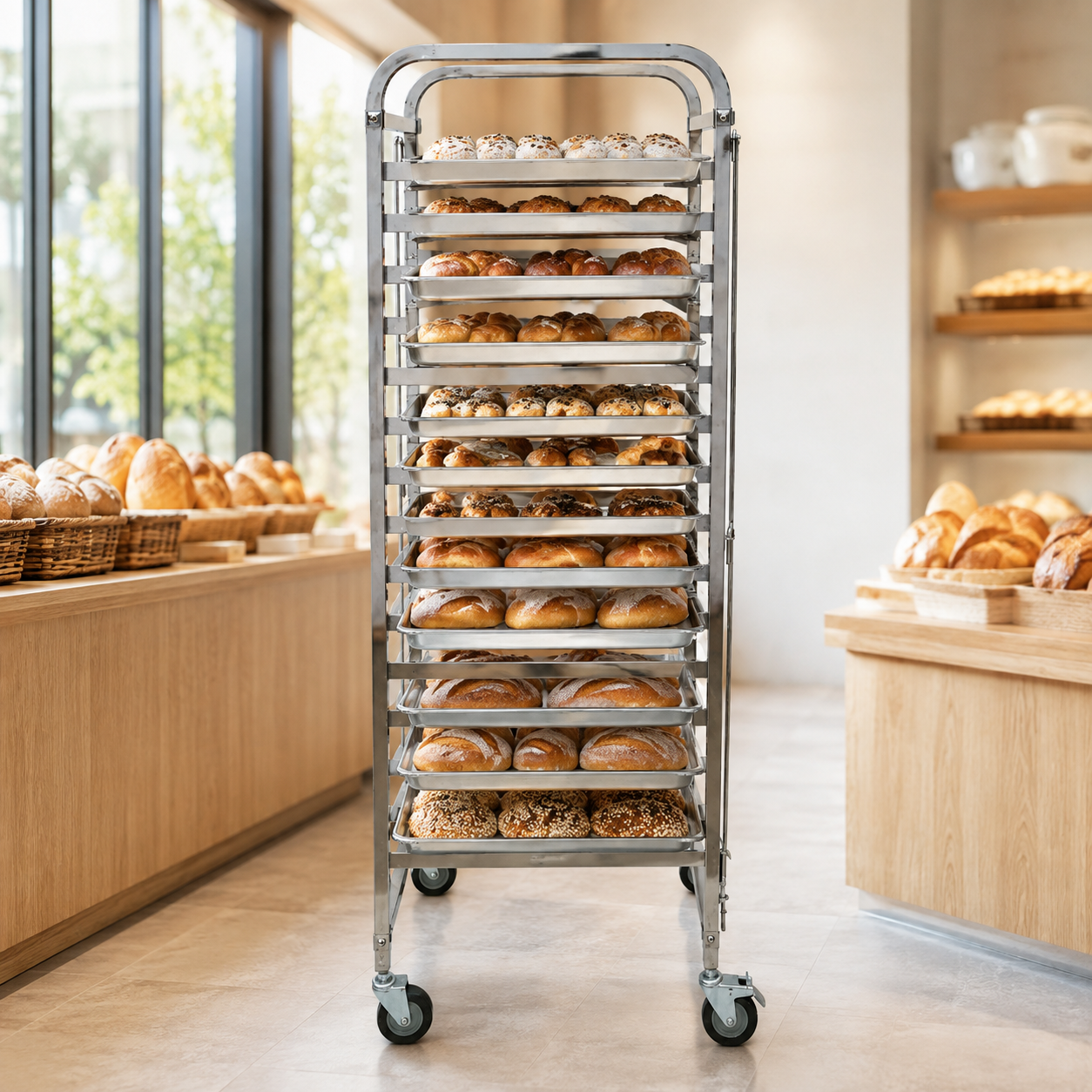
When sourcing equipment for a commercial bakery, the role of a specialized stainless steel bakery equipment manufacturer cannot be overstated. These manufacturers produce a wide array of essential items—from proofing racks and baking trays to cooling racks and transport trolleys—designed specifically to withstand the rigors of high-volume, continuous operation. Unlike general kitchen suppliers, a dedicated manufacturer focuses on the unique demands of the baking process, such as rapid temperature changes, heavy loads, and strict hygiene requirements. The primary purpose of this equipment is to provide a stable, sanitary, and efficient platform for moving dough, breads, and pastries through various stages of production. By partnering with a factory that understands industrial baking workflows, procurement managers can solve critical issues like product deformation during transport, premature equipment failure due to corrosion, and inefficient use of oven and cooler space.
Product Features: Engineered for Industrial Durability
The design philosophy behind professional bakery equipment prioritizes longevity and performance under stress. A key feature is the reinforced frame structure, which improves load stability during repeated transportation and industrial handling, preventing rack collapse when fully loaded with heavy dough or baked goods. Furthermore, the use of fully welded or riveted joints eliminates crevices where bacteria and mold can accumulate, meeting stringent food safety standards. The surface finish is another critical performance metric; equipment often undergoes electropolishing or passivation to enhance corrosion resistance and facilitate easy cleaning, reducing downtime for sanitation. For manufacturers, the ability to offer custom load ratings and stackability ensures that bakeries can maximize vertical space in ovens, proofers, and freezers. This level of engineering not only protects the product but also extends the equipment's service life, delivering a lower total cost of ownership.
Application Scenarios: From Proofing to Transport
The versatility of stainless steel equipment makes it indispensable across various stages of food production. In the bakery and pastry sector, specialized racks and trays are essential for proofing dough, baking artisan breads, and cooling delicate pastries. For food processing plants, these items are used for handling raw ingredients, freezing prepared meals, and transporting components between departments. In industrial manufacturing settings, stainless steel trays and racks may be used for drying parts or storing components in cleanroom environments. The cleaning and drying phases also rely heavily on stainless steel for its resistance to water, steam, and chemical sanitizers. Furthermore, in storage and transportation, robust stainless steel trolleys and shelves facilitate the safe movement of goods from production lines to cold storage or delivery trucks, ensuring that products remain uncontaminated and intact throughout the supply chain.
Material Specifications: Choosing the Right Grade
Selecting the appropriate material is a trade-off between corrosion resistance, cost, and application environment. 304 stainless steel is the industry standard for most bakery applications, offering excellent resistance to food acids and general corrosion. For highly corrosive environments or where strict chemical cleaning is frequent, 316 stainless steel provides superior resistance due to its molybdenum content, making it ideal for meat processing or coastal facilities. 201 stainless steel is a more economical option with lower nickel content, suitable for dry storage or light-duty applications where corrosion risk is minimal. Aluminum is often used for baking sheets due to its excellent heat conductivity, but it lacks the structural strength and corrosion resistance of stainless steel. A knowledgeable manufacturer will guide you on the best material based on your specific process, ensuring that your investment is neither over-specified nor under-protected.
Specification Parameters: What to Look For
When specifying equipment, procurement teams must consider a range of technical parameters to ensure compatibility with existing systems. Critical dimensions include the overall size (length x width x height) and the clearance between shelves, which must accommodate your standard product heights. The wire mesh diameter and aperture are crucial for airflow and drainage—larger apertures facilitate better air circulation in ovens, while smaller ones provide more support for small items. The load capacity per shelf or per rack is a vital metric, often expressed in kilograms or pounds, and must be verified to prevent deformation. Additionally, the surface treatment (e.g., #4 brushed finish, mirror polish) affects both aesthetics and cleanability. Buyers should also confirm compatibility with standard tray sizes (e.g., 18" x 26" or 600mm x 400mm) to ensure seamless integration into existing production lines.
Customization Services: Tailoring to Your Process
Off-the-shelf solutions rarely fit every unique production challenge. A capable stainless steel bakery equipment manufacturer offers extensive OEM and ODM services. This includes custom sizing to fit specific oven or proofer chambers, custom designs for specialized tasks like bagel boards or pretzel racks, and logo imprinting for brand visibility. Packaging can also be customized to protect equipment during long-distance shipping and to facilitate efficient warehouse storage. For bakeries with unique processes, manufacturers can develop specialty fittings, casters, or handles to improve ergonomics and safety. Engaging a factory early in the design phase can lead to cost-effective solutions that enhance workflow and reduce manual handling.
Procurement Guide: How to Select a Reliable Supplier
Choosing a supplier is as important as choosing the product. First, how do you select the right size? Map your existing oven, proofer, and cooler dimensions, and consider future expansion. Second, how do you choose the material? Assess your cleaning chemicals and environment; 304 is usually sufficient, but 316 is better for high-acid or high-humidity areas. Third, how do you confirm specifications? Ask for detailed CAD drawings and material certificates. Fourth, how do you judge supplier capability? Look for a factory with in-house laser cutting, bending, welding, and polishing capabilities, and request samples or video audits of their production line. A trustworthy manufacturer will provide transparent communication and after-sales support, ensuring a smooth procurement process. For custom requirements, please contact our team to discuss your project.
FAQ: Common Questions from B2B Buyers
1. What is the typical lead time for custom stainless steel bakery racks?
Lead times vary by complexity and order volume, but generally range from 4 to 8 weeks after drawing approval. Manufacturers with in-house production can better control schedules and expedite urgent orders.
2. Can you provide samples for quality evaluation?
Yes, many factories offer samples for a fee, which is often refundable upon a bulk order. This allows you to inspect material quality, weld strength, and finish before committing to a large purchase.
3. How do you ensure the equipment meets food safety standards?
We use food-grade stainless steel and employ welding and finishing processes that meet FDA and EU regulations. Certificates of material compliance can be provided upon request.
4. What is the minimum order quantity (MOQ)?
MOQ depends on the product and customization level. For standard items, MOQ may be as low as 50 units, while fully custom designs may require a higher MOQ to amortize tooling costs.
5. Do you offer installation and after-sales support?
We provide detailed installation manuals and video guidance. For complex systems, we can arrange for technical support. Warranties typically cover manufacturing defects for one year.
6. How do you handle shipping and packaging for international orders?
Equipment is typically packed in wooden crates or cartons with foam protection. We work with reliable freight forwarders to ensure safe and timely delivery, and can accommodate custom packaging requirements.
7. Can you replicate existing equipment from a sample or drawing?
Yes, our engineering team can reverse-engineer from a physical sample or produce from your technical drawings, ensuring a perfect fit for your existing systems.
Image ALT text suggestion: "Stainless steel bakery rack manufacturer factory production line"
SEO Title: Stainless Steel Bakery Equipment Manufacturer | Custom Industrial Racks
Meta Description: Leading stainless steel bakery equipment manufacturer. We provide custom racks, trays, and trolleys for industrial bakeries. Durable 304/316 stainless steel. Request a quote today.
SEO Keywords: stainless steel bakery equipment manufacturer, commercial bakery racks, industrial baking trays, custom stainless steel trolley, food grade stainless steel racks, bakery equipment supplier, OEM bakery equipment, stainless steel proofing racks, bakery transport racks, 304 stainless steel bakery equipment

