





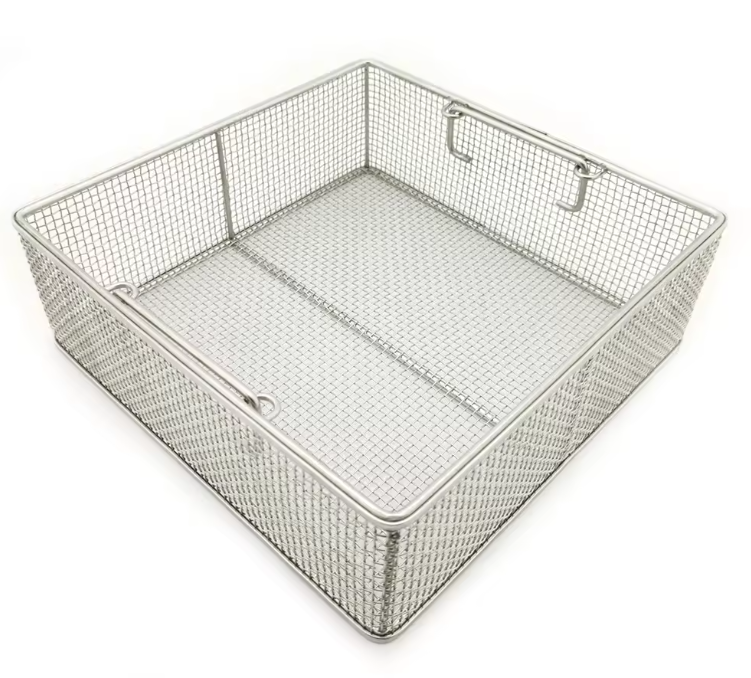
Stainless Steel Basket Maintenance Guide for Industrial Applications
Why Maintenance Matters for Industrial Stainless Steel Baskets
In industrial settings, stainless steel wire mesh baskets are exposed to harsh chemicals, high temperatures, and repetitive handling. Without a structured maintenance routine, even high-grade stainless steel can suffer from contamination, corrosion, or mechanical failure. A well-maintained basket not only lasts longer but also ensures consistent performance in cleaning, sterilization, and material handling processes.
For procurement professionals, understanding maintenance requirements is as critical as initial specifications. It affects total cost of ownership, compliance with industry standards, and operational efficiency. This guide outlines best practices for cleaning, inspecting, and prolonging the life of your custom stainless steel baskets.
Core Advantages of Stainless Steel Wire Mesh Baskets
The inherent properties of stainless steel make these baskets indispensable in industrial applications. Key benefits include:
- Corrosion resistance: Resists rust and chemical attack, ideal for ultrasonic cleaning and food processing.
- High-temperature tolerance: Withstands extreme heat in baking, drying, and sterilization cycles.
- Strong welded structure: Handles heavy loads without deformation.
- Excellent drainage and ventilation: Promotes efficient drying and contaminant removal.
- Easy to clean and maintain: Non-porous surface prevents bacterial growth.
- Long service life: Reduces replacement frequency and operational downtime.
Material Selection: Matching Stainless Steel Grade to Environment
Choosing the right material is the first step in effective maintenance. We offer baskets in three common stainless steel grades:
- SUS 201: Economical option for dry, moderate environments. Less corrosion-resistant than 304; suitable for light-duty material handling.
- SUS 304: The industry standard for food processing, cleaning, and general industrial use. Offers excellent corrosion resistance and formability.
- SUS 316: Enhanced resistance to chlorides and acids, ideal for medical sterilization, marine environments, and chemical exposure.
Select the grade based on your specific application conditions. If you are unsure, our engineering team can recommend the most cost-effective solution.
Construction and Manufacturing Process
Understanding how your basket is made helps you identify potential wear points. Our manufacturing process includes:
- Wire mesh construction: Precision-woven or welded mesh for uniform opening.
- Welding: TIG welding ensures strong joints without weak spots.
- Reinforced edges: Added wire rim to prevent distortion.
- Handle and lid design: Optional safety handles and tight-fitting lids for secure transport.
- Surface treatment: Passivation or electropolishing enhances corrosion resistance.
- Quality inspection: Each basket is checked for dimensional accuracy and weld integrity.
Mastering the Stainless Steel Basket Maintenance Guide
Effective maintenance involves three steps: regular cleaning, proper drying, and periodic inspection. Here is how to integrate this into your operations.
Recommended Cleaning Procedures
For routine use, wash the basket with warm water and a mild detergent. For stubborn residues, use a soft brush or non-abrasive pad. For ultrasonic cleaning baskets, avoid using bleach or hydrochloric acid which can pit the surface. Always rinse thoroughly with deionized water to prevent spotting.
For food applications, follow hygiene protocols using food-safe sanitizers. After cleaning, dry the basket immediately to prevent watermarks and to reduce the risk of corrosion in crevices.
Dealing with Stubborn Contaminants
If you encounter scale or oxidation, use a passivation paste or a solution of nitric acid. Allow it to dwell for a recommended time, then scrub gently and rinse. For oily residues, degreasers used in industrial dishwashers are effective. In critical industries like pharmaceuticals, consider electropolished baskets to minimize particle entrapment.
Inspection and Preventive Maintenance Schedule
Inspect baskets monthly for signs of wear, loose welds, or bent wires. Pay attention to contact points with other equipment. Replace any basket that shows cracks or sharp edges to avoid product contamination. Keep maintenance logs to track performance and schedule deep-cleaning cycles.
Common Mistakes in Basket Maintenance
Avoid using steel wool or chloride-based cleaners on stainless steel. They cause microscopic scratches that accelerate corrosion. Do not leave baskets soaked in saline or acidic solutions for extended periods. Also, mixing different metals can cause galvanic corrosion – store baskets away from other metals.
Customization Capabilities
Every application has unique requirements. We offer full OEM customization on:
- Dimensions: Diameter, length, and depth.
- Mesh opening: From 0.5 mm to 100 mm.
- Wire diameter: 0.5 mm to 10 mm.
- Basket height: Variable for load depth.
- Loading capacity: Reinforced options for heavy loads.
- Handle style: Swivel, fixed, or removable.
- Material grade: 201, 304, or 316.
- Packaging: Export-grade crating or shrink-wrapped.
Our engineering team works with your specs to provide drawings and samples before mass production.
Procurement Guide: Selecting the Right Basket
For engineers and buyers, choosing the right basket involves evaluating several factors.
How to Select the Right Stainless Steel Basket?
Define your load weight, part geometry, and process chemistry. For heavy parts, use a thicker wire and smaller mesh opening. For drying, opt for a larger opening to enhance airflow. Consider the basket’s geometry – round, rectangular, or custom-shaped – to fit your equipment.
Choosing the Correct Mesh Size
Mesh size determines what can pass through. For small components, use a fine mesh to prevent parts from falling through. For filtering large debris, a coarse mesh is sufficient. Always balance support with drainage.
Selecting the Right Stainless Steel Grade
As earlier, evaluate chemical exposure and temperature. For salt-prone environments, go with 316. For general washing, 304 is reliable. For cost-sensitive static applications, 201 may be acceptable.
Factors Affecting Service Life
The main factors are washing frequency, chemical concentration, and mechanical stress. Proper maintenance significantly extends lifespan. Another factor is the quality of the original weld. Our baskets undergo rigorous testing to ensure durability.
FAQs about Stainless Steel Basket Maintenance
Q: Can stainless steel mesh baskets be customized?A: Absolutely. We are an experienced manufacturer offering full customization. You can specify dimensions, mesh opening, wire diameter, material grade, and handle types. Send us your drawings or requirements for a quote.
Q: Which stainless steel grade is suitable for industrial cleaning?A: For most industrial cleaning applications, SUS 304 stainless steel is recommended due to its balanced corrosion resistance and strength. If cleaning involves strong chloride chemicals, SUS 316 offers better protection.
Q: What industries use stainless steel wire baskets?A: They are widely used in ultrasonic cleaning, pharmaceutical sterilization, food processing, bakery production, laboratory testing, and metal finishing. Their versatility makes them essential in many manufacturing lines.
Contact us for tailored solutions. As a factory-direct supplier, we offer OEM support, quality assurance, and global shipping. Let our expertise support your operation with reliable, long-lasting baskets.