





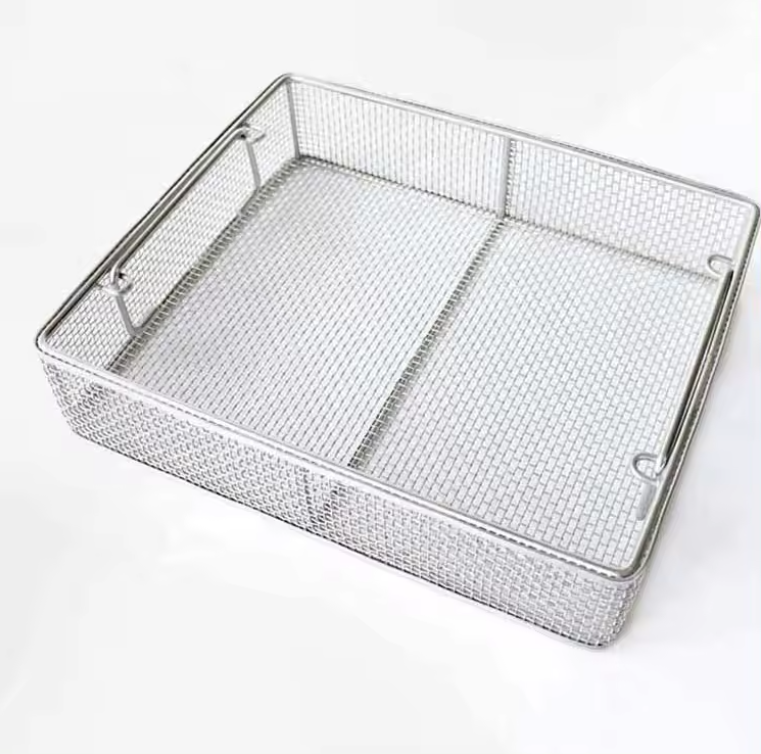
Stainless Steel Basket Wire Diameter: Key Factors for Strength, Weight, and Service Life
Product Overview
Custom stainless steel wire mesh baskets are essential tools in industrial cleaning, food processing, drying, sterilization, filtration, and material handling. These baskets are fabricated from woven or welded wire mesh, offering a robust and versatile solution for transporting, draining, and processing parts. As a professional manufacturer, we understand that every component of these baskets—especially the wire diameter—plays a pivotal role in performance and longevity. In this article, we focus on how wire diameter influences strength, weight, and service life, and provide practical guidance for procurement engineers and buyers.
Core Advantages of Stainless Steel Mesh Baskets
Stainless steel wire mesh baskets are favored across industries for several compelling reasons:
- Corrosion resistance: Stainless steel withstands harsh chemicals and moisture, ensuring durability in wet environments.
- High-temperature resistance: Suitable for autoclaving, baking, and hot washing processes.
- Strong welded structure: Properly welded intersections provide structural integrity even under heavy loads.
- Excellent drainage and ventilation: Mesh openings allow efficient fluid flow and air circulation.
- Easy cleaning and maintenance: Smooth surfaces resist buildup, simplifying sanitation.
- Long service life: High-quality materials and construction extend operational lifespan.
Wire diameter is a fundamental parameter that directly affects these advantages. Choosing the correct diameter ensures that the basket meets mechanical demands without compromising on weight or cost.
Material Grades
Selecting the appropriate stainless steel grade is as important as choosing wire diameter. Common grades include:
- SUS 201: Offers good corrosion resistance and is cost-effective for less demanding applications.
- SUS 304: The most widely used grade, providing excellent corrosion resistance, formability, and weldability—ideal for food processing and general industrial use.
- SUS 316: Contains molybdenum, enhancing resistance to chlorides and acids, making it suitable for marine and chemical environments.
Wire diameter interacts with grade selection: a thicker wire in 304 may be needed for high-load applications, while 316 can offer better corrosion resistance with a slightly thinner wire in some cases.
Structure and Manufacturing Process
The structural integrity of a stainless steel basket depends on wire diameter, mesh pattern, and welding technique. Our manufacturing process includes:
- Wire mesh structure: Woven or welded mesh with precise mesh openings.
- Welding process: Resistance welding ensures strong joints at intersections.
- Reinforced edges: Thicker wire or flat bar edges prevent deformation.
- Handle design: Ergonomically shaped handles, often reinforced to handle heavy loads.
- Lid design: Optional lids for containment and protection.
- Surface treatment: Passivation or electropolishing enhances corrosion resistance.
- Quality inspection: Dimensional checks, load testing, and visual inspection ensure compliance.
Wire diameter directly influences weldability: thinner wires require precise handling to avoid burn-through, while thicker wires demand higher welding currents. A skilled manufacturer balances these factors to deliver a robust product.
Application Areas
Stainless steel wire mesh baskets are used in:
- Ultrasonic cleaning: Baskets hold parts securely while allowing ultrasonic waves to penetrate.
- Industrial parts washing: For degreasing and rinsing components.
- Food processing: Blanching, cooling, and draining food products.
- Bakery production: Proofing, baking, and cooling baked goods.
- Medical sterilization: Autoclaving surgical instruments and devices.
- Laboratory cleaning: Washing glassware and tools.
- Drying process: Hot air drying of small parts.
- Material handling: Transporting components through production lines.
Wire diameter must match the application's load and environment. For example, ultrasonic cleaning baskets benefit from thinner wires for better acoustic transparency, while heavy industrial washing may require thicker wires for impact resistance.
Customization Services
Every industrial operation has unique requirements. As a manufacturer, we offer full customization to meet your specifications:
- Size: Custom dimensions to fit your equipment.
- Mesh opening: Varying apertures for specific part sizes and flow rates.
- Wire diameter: From 0.5 mm to 5.0 mm, depending on strength needs.
- Basket height: Adjustable depth for load capacity.
- Loading capacity: Engineered to handle defined weights.
- Handle type: Various styles: ergonomic, insulated, or removable.
- Material selection: Choose from 201, 304, or 316 stainless steel.
- Packaging requirements: Customized packaging for safe transit.
Consulting with our engineers helps determine the optimal wire diameter for your application, balancing strength, weight, and budget.
Procurement Guide
When selecting a stainless steel basket, consider these factors:
How to select the right stainless steel basket?
Evaluate the environment (temperature, chemicals), load requirements, and operational workflow. Wire diameter should be chosen to provide adequate strength without excessive weight. Consult with your supplier to review your application details.
How to choose mesh size?
Mesh opening size affects drainage, ventilation, and part containment. For small parts, use a smaller mesh to prevent falling through. For liquids and paste products, a coarser mesh may be adequate. Ensure that the mesh ensures good access for cleaning or processing.
How to choose stainless steel grade?
For general industrial and food applications, 304 is standard. If exposure to chlorides or acids is high, upgrade to 316. For cost-sensitive, non-critical uses, 201 may be acceptable. Our engineering team can recommend the best grade for your process.
What factors affect service life?
Wire diameter plays a crucial role: thicker wires resist fatigue and mechanical wear better, but they also increase weight. Proper design, quality welding, and surface treatment extend lifespan. Operating within the basket's load limits and avoiding impact loads will maximize durability.
Common Questions
Q: Can stainless steel mesh baskets be customized?
A: Absolutely. We offer full customization for size, mesh opening, wire diameter, handle style, and material grade. Just send your drawings or specifications for a tailored solution.
Q: Which stainless steel grade is suitable for industrial cleaning?
A: For most industrial cleaning applications, SUS 304 is ideal due to its corrosion resistance and affordability. If you work with aggressive chemicals or saltwater, choose SUS 316 for enhanced resistance.
Q: What industries use stainless steel wire baskets?
A: Industries include automotive parts washing, food processing, pharmaceuticals, medical device sterilization, electronics cleaning, and general manufacturing. Their versatility makes them indispensable in many production environments.
Q: How do I determine the right wire diameter for my basket?
A: Consider the maximum load, part size, required drain rate, and weight constraints. Thicker wire (e.g., 3 mm) provides strength for heavy loads, while thinner wire (e.g., 1 mm) is lighter and more economical for light tasks. Our technical team can assist in calculating the optimal wire diameter.
Conclusion
Wire diameter is a critical specification in stainless steel wire mesh baskets, directly impacting strength, weight, and service life. By understanding these effects and leveraging our manufacturing expertise, you can select or customize the optimal basket for your industrial processes. We are a professional manufacturer with ISO-certified production and a track record of international B2B supply. Contact us for custom stainless steel wire mesh basket solutions tailored to your requirements.