


Stainless Steel Cart Fabrication: A Strategic Guide for Industrial Buyers
Understanding Stainless Steel Cart Fabrication: A Procurement Perspective
When you're sourcing material handling equipment for food processing plants, pharmaceutical cleanrooms, or heavy manufacturing floors, the phrase stainless steel cart fabrication should immediately signal a set of engineering decisions that impact your total cost of ownership. Unlike generic catalog carts, custom-fabricated stainless steel carts are built to your exact specifications—dimensions, load capacity, surface finish, and even the type of stainless alloy—ensuring seamless integration into your existing workflow. The fabrication process itself involves a series of precise steps: cutting, forming, welding, polishing, and assembly. Each step directly influences the cart's structural integrity, corrosion resistance, and hygiene properties. As a manufacturer with over 15 years of experience serving B2B clients across North America and Europe, we've seen how poorly fabricated carts lead to premature failures, product contamination, and costly downtime. This guide aims to demystify the fabrication process and provide actionable insights for procurement professionals.
Product Introduction: What Exactly Is a Stainless Steel Cart?
At its core, a stainless steel cart is a mobile platform designed to transport, store, or process materials in environments where hygiene, corrosion resistance, and durability are paramount. Typical configurations include shelf carts, platform carts, bin carts, and specialty carts with integrated features like drainage, tilting mechanisms, or mesh sides. These carts solve a fundamental problem: moving heavy or sensitive items safely and efficiently without introducing contamination risks. For example, in a bakery, a stainless steel rack cart might hold baking sheets from the oven to the cooling area; in a pharmaceutical facility, a cart with solid shelves and caster wheels might transport raw materials through cleanrooms. The fabrication process determines whether the cart can withstand repeated washdowns, chemical exposure, and heavy loads without degrading.
Product Features: Design and Performance That Matter
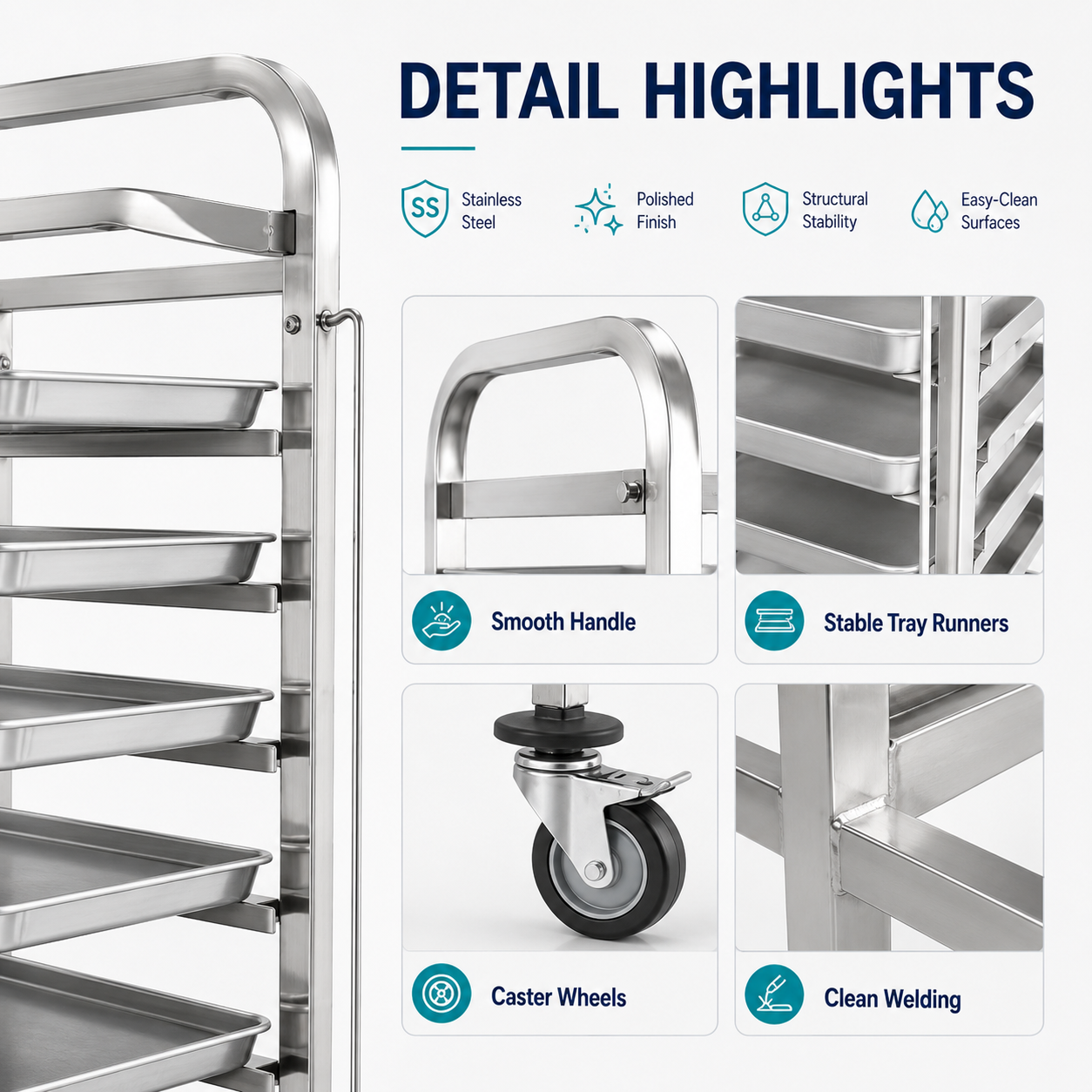
Industrial buyers should look beyond the shiny surface. A well-fabricated cart incorporates several design features that enhance its performance. First, the frame structure—often constructed from 304 stainless steel tubing or angle—must be reinforced at stress points. For instance, the junction where the legs meet the shelf should have gussets or brace plates to prevent wobbling under load. Second, the welding quality is critical. We use TIG welding for sanitary applications to produce smooth, crevice-free joints that resist bacterial growth. Third, the polishing step isn't just cosmetic; a #4 satin finish or mirror polish reduces surface porosity, making cleaning easier and improving corrosion resistance. Finally, the casters—often overlooked—should be selected based on floor type, load weight, and environmental conditions. For washdown areas, stainless steel or polyurethane wheels with sealed bearings are recommended. These features collectively determine the cart's lifespan and suitability for your specific operation.
Application Scenarios: Where Stainless Steel Carts Excel
Stainless steel carts are versatile workhorses across numerous industries. In food processing, they transport raw ingredients, finished products, and waste while meeting USDA and FDA sanitation standards. In bakeries, rack carts hold pans during proofing, baking, and cooling. Industrial manufacturing facilities use heavy-duty platform carts to move parts, tools, and assemblies between workstations. In cleaning and drying operations, carts with mesh shelves allow air circulation for drying parts or utensils. Storage and transportation applications benefit from carts with multiple shelves and locking casters for secure movement. Even in pharmaceutical and laboratory settings, stainless steel carts with solid shelves and cleanroom-compatible wheels are essential. Each scenario imposes unique requirements—for example, a cart used in a freezer must have low-temperature casters and lubricants, while a cart in a chemical plant may need 316 stainless steel for chloride resistance.
Material Selection: 304 vs. 316 vs. 201 Stainless Steel
Choosing the right material is a balancing act between cost and performance. 304 stainless steel is the most common choice for general industrial and food-grade applications. It offers excellent corrosion resistance, formability, and weldability. 316 stainless steel contains molybdenum, which significantly improves resistance to chlorides and acids—making it ideal for pharmaceutical, chemical, and coastal environments. 201 stainless steel is a lower-cost alternative with higher manganese content; while it offers decent corrosion resistance in mild environments, it is less suitable for wet or acidic conditions. Aluminum carts are lightweight and corrosion-resistant but cannot match stainless steel's strength and hygiene properties. For heavy loads or high-temperature applications, stainless steel remains the preferred choice. As a manufacturer, we often recommend 304 for most food and industrial uses, 316 for harsh chemical exposures, and 201 only for dry, non-corrosive environments where budget is the primary concern.
Specifications: Key Parameters for Your RFQ
When requesting a quote, providing detailed specifications ensures you receive an accurate and competitive price. Here are the critical parameters to define:
- Dimensions: Overall length, width, and height, as well as shelf spacing and clearance.
- Thickness: Material gauge for shelves and frame—typically 18-14 gauge for stainless steel.
- Capacity: Load capacity per shelf and total cart capacity in pounds or kilograms.
- Number of Shelves: One to five, with or without lips or dividers.
- Load Rating: Static and dynamic load ratings, considering caster size.
- Hole Size & Mesh: For mesh shelves, specify aperture size (e.g., 1/2" x 1/2").
- Tray Compatibility: If applicable, specify standard tray or pan sizes (e.g., 18" x 26" bakery pans).
- Surface Finish: #4 satin, #8 mirror, or bead blast.
- Caster Type: Swivel, rigid, with brakes, wheel material, and load capacity.
Providing these details upfront reduces back-and-forth and ensures the final product meets your operational needs.
Customization and OEM/ODM Capabilities
Every facility has unique needs, and off-the-shelf carts rarely fit perfectly. That's why we offer comprehensive OEM and ODM services. Our in-house engineering team can design carts from scratch based on your workflow, or modify existing designs to suit your space constraints. We handle custom sizes, custom designs (e.g., adding drawers, hooks, or electrical outlets), logo branding (laser-etched or embossed), and special packaging for export. For clients with existing drawings, we can fabricate to exact specifications. Our production capability includes laser cutting, CNC bending, robotic welding, and automated polishing, ensuring consistent quality across large orders. Whether you need a single prototype or a thousand units, our factory is equipped to deliver.
Procurement Guide: How to Choose and Vet Suppliers
Sourcing stainless steel carts from overseas or domestic suppliers requires due diligence. Start by defining your technical requirements clearly—use the specification list above as a checklist. Then, evaluate potential suppliers on these criteria:
- Material Certification: Ask for mill test reports to verify the stainless steel grade.
- Welding Quality: Request close-up photos of welds; look for smooth, consistent beads without burn-through.
- Surface Finish: Ensure the finish meets your hygiene or aesthetic standards.
- Load Testing: Ask if the supplier performs static load tests and provides documentation.
- Production Capacity: Confirm they can handle your order volume and lead time.
- Communications: Responsiveness and willingness to provide samples indicate a reliable partner.
As a manufacturer, we welcome factory audits and provide full traceability from raw material to finished cart. For custom requirements, please contact our team to discuss your project.
Frequently Asked Questions
Q1: What is the typical lead time for custom stainless steel carts?
A1: Lead time varies based on complexity and order quantity. For standard custom carts, we typically quote 4-6 weeks after drawing approval. For large orders or complex designs, it may extend to 8-10 weeks. We recommend planning your procurement accordingly.
Q2: Can you provide samples before mass production?
A2: Yes, we can produce a prototype for your evaluation. Sample costs and lead times depend on the design. For simple modifications to existing models, we may offer a sample at a reduced cost.
Q3: What is the difference between 304 and 316 stainless steel for carts?
A3: 304 offers excellent corrosion resistance for most food and industrial environments. 316 contains molybdenum, providing superior resistance to chlorides and chemicals, making it suitable for pharmaceutical, chemical, and coastal applications. The cost difference is typically 20-30%.
Q4: How do I determine the right load capacity for my cart?
A4: Consider the heaviest load you'll place on the cart, then add a safety factor of at least 25%. Also, account for dynamic loads during movement. Our engineers can help you calculate the appropriate capacity based on your usage.
Q5: What caster options are available for different floor types?
A5: For smooth concrete, polyurethane or rubber wheels are quiet and non-marking. For washdown areas, stainless steel or nylon wheels resist water and chemicals. For rough floors, larger casters with pneumatic tires provide better shock absorption. We can supply casters from leading brands like Blickle or Colson.
Q6: Do you offer custom branding on the carts?
A6: Yes, we can laser-etch or emboss your logo on the cart frame or shelves. We also offer custom packaging with your branding for shipments.
Q7: How do you ensure the quality of your stainless steel carts?
A7: We implement strict quality control at every stage: incoming material inspection, in-process checks during cutting, welding, and polishing, and final inspection before packing. We also perform load tests and dimensional checks. Certificates of compliance can be provided upon request.
Q8: Can you handle large volume orders with tight deadlines?
A8: Yes, our factory has a monthly capacity of 5,000+ carts. For large orders, we can allocate dedicated production lines and stagger shipments to meet your schedule. Please share your timeline, and we'll confirm feasibility.
Image ALT Text Suggestions
For any product images, we recommend the following ALT text to improve SEO and accessibility:
- "Stainless steel cart fabrication - TIG welding process"
- "Custom stainless steel cart with mesh shelves for bakery use"
- "304 stainless steel platform cart with heavy-duty casters"
- "Polished stainless steel cart for pharmaceutical cleanroom"
SEO Metadata
SEO Title: Stainless Steel Cart Fabrication: Industrial Buyer's Guide
Meta Description: Learn stainless steel cart fabrication from a manufacturer's perspective. Material selection, specifications, and procurement tips for B2B buyers. Contact us for custom quotes.
SEO Keywords: stainless steel cart fabrication, industrial carts manufacturer, custom stainless steel carts, 304 stainless steel cart, food grade cart supplier, OEM stainless steel cart, stainless steel cart specifications, material handling cart fabrication

