


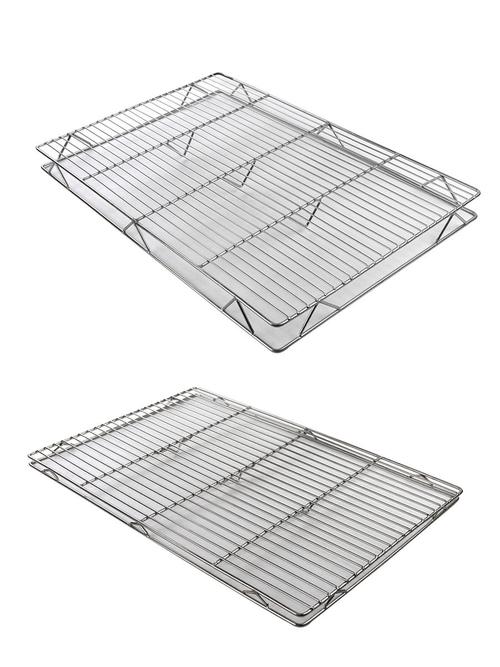
Stainless Steel Mesh Tray Manufacturer for Industrial Food Processing & Drying Applications
Product Introduction
An industrial mesh tray is a load-bearing platform constructed from stainless steel wire or expanded metal, designed specifically for continuous production environments where hygiene, load stability, and long-term operation reliability are critical. Unlike solid trays, the open-mesh structure allows rapid drainage, airflow, and heat transfer, making it a core component in food processing, baking, drying, and automated handling lines. From a manufacturer's perspective, this product is not a commodity accessory — it is a process-critical interface between raw material and finished output.
For importers, distributors, and industrial buyers, sourcing a reliable stainless steel mesh tray means solving several production problems at once: eliminating water pooling during washing, reducing drying cycle times, preventing product deformation under heat, and complying with food-contact and pharmaceutical cleanliness standards. When a line stops due to tray failure, the cost is measured in downtime, not in the unit price of the tray. That is why experienced procurement teams evaluate mesh trays as capital equipment components rather than disposable consumables. This article is written for buyers who need to specify, compare, and source mesh trays at volume, with real attention to material grades, tolerances, and OEM capability.
Product Features and Engineering Advantages
The performance of an industrial mesh tray comes from its structure and manufacturing process, not from marketing claims. Key engineering characteristics include:
- High corrosion resistance — achieved through correct grade selection and passivation treatment, essential for wet cleaning and food contact.
- Easy cleaning surface — electropolished or pickled wire surfaces reduce residue buildup and support CIP and manual washdown.
- Stable load capacity — reinforced frame design improves load stability during repeated transportation and high-frequency industrial handling.
- Custom manufacturing options — wire diameter, mesh opening, and frame geometry can be adjusted to match conveyor and rack systems.
- Thermal stability — mesh trays retain shape through baking, freezing, and steam sterilization cycles.
- Stacking and nesting compatibility — edge profiles can be designed for stable stacking, saving warehouse space.
The reinforced frame is not a cosmetic detail. In high-frequency handling, tray corners are the first failure point; a properly welded or crimped frame distributes point loads and prevents wire fatigue. Similarly, controlled mesh opening tolerance ensures consistent airflow and product support, which matters in drying and baking where uneven support causes rejects. Manufacturing methods — resistance welding, spot welding, or frame crimping — are chosen based on load requirements and cleaning frequency. A tray that is over-welded may trap contaminants; a tray that is under-welded will fail under dynamic load. The correct balance is a manufacturing decision, and buyers should expect suppliers to explain it.
Application Scenarios
Mesh trays are used across multiple industries, and in each case the reason for selection is specific.
Food processing: Trays carry vegetables, meat, seafood, and prepared foods through washing, blanching, cooling, and freezing. Open mesh allows water and steam to pass through, reducing processing time and preventing product sitting in liquid.
Bakery and commercial baking: Bakers use mesh trays for bread, pastries, and frozen dough because mesh provides even heat distribution and prevents moisture buildup on the product base.
Industrial drying: In chemical, textile, and material drying, mesh trays allow hot air to circulate through the product bed, improving drying uniformity and energy efficiency.
Pharmaceutical and laboratory: Sterilization, tablet drying, and sample handling require non-shedding, corrosion-resistant surfaces that can withstand autoclaving and chemical cleaning.
Manufacturing and parts handling: Small metal parts, fasteners, and components are washed, degreased, and dried in mesh trays that resist industrial cleaning agents.
Storage and transportation: Stackable mesh trays serve as returnable containers in warehouses and production lines, reducing packaging waste and improving inventory visibility.
Commercial production: Central kitchens, catering operations, and food service facilities use mesh trays for high-volume preparation and holding.
In every scenario, the underlying procurement logic is the same: the buyer is not purchasing a tray, but a repeatable, cleanable, and durable handling interface that fits existing equipment and processes.
Material Options and Manufacturing Details
Material selection is the single most important specification decision in mesh tray procurement. The most common options are:
304 stainless steel provides reliable corrosion resistance for food contact applications and daily industrial cleaning environments. It is the default choice for bakery, food processing, and general drying.
316 stainless steel offers higher resistance to chlorides and aggressive chemicals, making it suitable for seafood processing, pharmaceutical production, and coastal or high-humidity facilities. It costs more, but extends service life in corrosive environments.
201 stainless steel is a lower-cost option with reduced corrosion resistance, often used in dry storage or light-duty handling where moisture and chemicals are limited. Buyers should confirm intended cleaning methods before selecting 201.
Aluminum is lightweight and offers good thermal conductivity, but it is not suitable for highly alkaline or acidic cleaning. It is used in some baking and cooling applications where weight reduction matters.
Manufacturing details also affect performance: wire diameter influences load capacity and open area; mesh opening determines airflow and product support; surface treatment (pickling, passivation, electropolishing) affects hygiene and appearance. Buyers should request material certificates and, where relevant, food-contact compliance documentation. A supplier that cannot explain why 304 is specified over 201 for a given application is not a technical partner.
Specifications and Technical Parameters
Purchasing teams should confirm the following parameters before requesting a quotation:
- Size: length, width, and height, including frame profile. Available sizes can be customized according to equipment dimensions and production requirements.
- Wire diameter: commonly 1.0 mm to 5.0 mm depending on load.
- Mesh opening: typically 5 mm to 50 mm, selected for product size and airflow.
- Thickness / frame height: matched to rack and conveyor slots.
- Load capacity: static and dynamic load ratings should be stated by the supplier.
- Layers: single-layer or multi-layer stackable designs.
- Surface treatment: pickled, passivated, or electropolished.
- Tray compatibility: confirmation that trays fit existing racks, trolleys, and conveyor systems.
- Production tolerance: dimensional tolerance and flatness tolerance, which affect automation compatibility.
Where specific parameters are not fixed, buyers should provide the operating environment, product weight, and equipment interface. A reputable industrial mesh tray supplier will propose a specification rather than simply quoting a price.
Custom OEM Manufacturing Service
For buyers requiring non-standard trays, OEM manufacturing is often more cost-effective than adapting a standard product. Capabilities to look for include custom size and geometry, custom design and drawing review, logo marking, special packaging for export, material selection guidance, prototype development, and bulk production with consistent quality. A factory that supports prototyping can reduce the risk of a large order failing on fit or load performance.
Custom work typically starts with a drawing or sample. Suppliers should confirm tolerances, surface finish, and packaging requirements before production. For custom requirements, please contact our team with your drawings, target quantities, and application details.
Purchasing Guide for Industrial Buyers
Sourcing mesh trays at volume requires more than comparing unit prices. The following checklist helps procurement teams reduce risk:
- Confirm working environment — temperature, moisture, chemicals, and cleaning method.
- Check material requirements — food contact, pharmaceutical, or general industrial.
- Verify equipment compatibility — dimensions, stacking, and automation interfaces.
- Evaluate supplier production capacity — monthly output, welding equipment, and QC process.
- Review quality control — incoming material inspection, dimensional checks, load testing, and surface inspection.
- Assess export experience — packaging standards, documentation, and delivery reliability.
- Clarify packaging and delivery — carton strength, pallet configuration, and lead time.
Buyers should also ask for references or sample orders before committing to bulk production. A supplier's willingness to provide samples, certificates, and process documentation is a strong indicator of long-term reliability. In B2B procurement, the lowest quote often carries the highest total cost when downtime, rejects, and replacement cycles are included.
FAQ
What stainless steel grade is recommended for food processing applications?
304 stainless steel is the standard choice for most food processing because it offers reliable corrosion resistance and is suitable for daily cleaning. For high-chloride environments such as seafood processing or pharmaceutical production, 316 stainless steel is recommended. Buyers should confirm cleaning chemicals and operating conditions before finalizing the grade.
Can the tray size be customized?
Yes. Mesh trays can be manufactured to custom lengths, widths, heights, and frame profiles based on equipment dimensions. Providing a drawing or sample ensures accurate fit. Custom sizes typically require a minimum order quantity, and suppliers should confirm tolerance and lead time before production.
Do you provide OEM manufacturing service?
OEM service includes custom design, material selection, logo marking, special packaging, prototyping, and bulk production. Buyers should provide application details, target quantities, and any compliance requirements. A capable OEM supplier will review drawings and propose a manufacturable specification rather than accepting every request without feedback.
What information should buyers provide before quotation?
Buyers should provide dimensions, wire diameter or mesh opening, material grade, load requirements, operating environment, quantity, and packaging needs. If the tray must fit existing equipment, include the interface dimensions. The more complete the specification, the more accurate the quotation and the lower the risk of rework.
How do you control product quality?
Quality control typically covers incoming material certificates, dimensional inspection, weld strength checks, load testing, surface finish inspection, and final packaging review. Buyers should request inspection reports and, for large orders, consider third-party inspection. A documented QC process is a key differentiator between trading companies and real factories.
What is the typical lead time for bulk orders?
Lead time depends on quantity, customization, and material availability. Standard trays may ship within a few weeks, while custom OEM orders require additional time for prototyping and production. Buyers should confirm lead time in writing and plan around production schedules to avoid line interruptions.
How should mesh trays be packaged for export?
Export packaging should protect wire surfaces and prevent deformation during transit. Common methods include cartons with edge protection, pallets, and shrink wrapping. For large orders, suppliers should confirm stacking strength and container loading plan to reduce shipping damage and freight cost.

