


Stainless Steel Mesh Tray Sourcing Guide for Industrial Buyers
Product Introduction
In industrial procurement, a stainless steel mesh tray is not a commodity item purchased on price alone. It is a production tool that must withstand continuous loading, repeated cleaning, and aggressive operating environments. From food processing plants to pharmaceutical manufacturing lines, these trays are specified by engineers and sourcing managers who understand that a failed tray can halt an entire production batch.
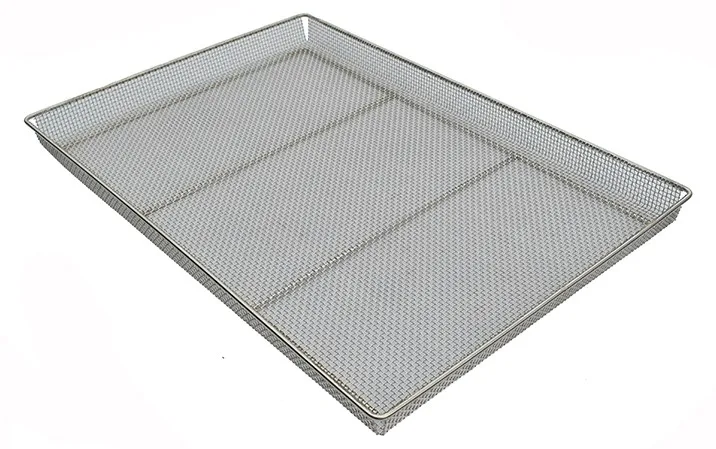
This industrial tray is designed for continuous production environments where hygiene, load stability, and long-term operational reliability are critical. Unlike solid sheet trays, the mesh construction allows for rapid drainage, uniform airflow, and efficient steam or heat penetration during drying, cooling, and sterilization processes. For buyers, the key question is not whether the tray looks acceptable on a sample photo, but whether the supplier can deliver consistent specifications across thousands of units and multiple production runs.
Companies purchase these trays because they directly impact throughput, product quality, and maintenance costs. A poorly manufactured mesh tray can cause product damage, create cleaning bottlenecks, or fail under load, leading to unplanned downtime. This guide is written for procurement professionals who need to evaluate suppliers, specify materials correctly, and build a reliable supply chain for industrial mesh trays.
Product Features and Engineering Advantages
The difference between a functional mesh tray and a problematic one often comes down to engineering details that are invisible in a catalog. In industrial settings, trays are subjected to vibrational forces, forklift handling, stacking pressure, and high-temperature washdowns. The construction method determines whether the tray retains its shape after months of use or becomes a safety hazard.
The reinforced frame design improves load stability during repeated transportation and high-frequency industrial handling. When buyers evaluate samples, they should examine the welding quality at frame-to-mesh junctions, the uniformity of wire spacing, and whether the edges are ground smooth to prevent injury and product snagging. A well-built tray will show consistent weld penetration and no sharp protrusions.
For industrial applications, the following features are critical:
- High corrosion resistance — suitable for humid, chemical, and food-contact environments
- Easy cleaning surface — mesh pattern minimizes particle retention and supports CIP/SIP processes
- Stable load capacity — engineered to resist deflection under distributed and point loads
- Custom manufacturing options — dimensions, mesh openings, and frame profiles tailored to equipment
- Stackability and nesting design — improves storage density and transportation efficiency
Manufacturing processes also matter. Automated mesh welding and controlled rim forming produce more consistent trays than manual spot welding. Buyers should ask suppliers about their welding equipment, tolerance standards, and post-weld treatment. For example, pickling and passivation after welding remove heat tint and restore corrosion resistance, a step that cheaper suppliers often skip.
Application Scenarios
Mesh trays appear across many industries, but the performance requirements vary significantly. Understanding the application helps buyers select the right material grade, mesh configuration, and load rating.
In food processing, trays are used for washing, blanching, cooling, freezing, and drying. The open mesh design allows water and air to pass through, reducing drying time and preventing product from sitting in pooled liquid. Stainless steel is preferred because it does not react with food acids or cleaning chemicals, and it meets food-contact hygiene standards.
In bakery and commercial baking, mesh trays support bread, pastries, and other baked goods during proofing and baking. The mesh allows heat to circulate evenly, producing consistent color and texture. These trays must withstand repeated thermal cycling without warping.
In industrial manufacturing, mesh trays carry components through degreasing, phosphating, painting, and curing lines. They must resist chemical attack and maintain dimensional stability under conveyor vibration. Similarly, in drying processes, trays are used in oven and air-drying systems for parts, powders, and agricultural products.
In pharmaceutical and laboratory environments, mesh trays are used for sterilizing glassware, drying samples, and organizing components in cleanrooms. Here, surface finish and particle shedding are major concerns. In storage and transportation, stackable mesh trays improve handling efficiency and protect parts during movement between production stages.
Each application demands a different balance of corrosion resistance, load capacity, and mesh openness. A tray that performs well in a bakery may fail in a chemical degreasing line. Buyers should specify the operating environment clearly before requesting quotations.
Material Options and Manufacturing Details
Material selection is one of the most common sources of confusion in mesh tray procurement. The grade of stainless steel directly affects corrosion resistance, cost, and service life.
304 stainless steel provides reliable corrosion resistance for food-contact applications and daily industrial cleaning environments. It is suitable for most food processing, bakery, and general drying applications. It offers a good balance of performance and cost. 316 stainless steel contains molybdenum, which improves resistance to chlorides and aggressive chemicals. It is recommended for pharmaceutical, chemical processing, and marine environments where 304 would corrode. 201 stainless steel is a lower-cost option with reduced corrosion resistance. It may be suitable for dry storage or light-duty applications, but buyers should be cautious about using it in wet or chemical environments. Aluminum trays are lightweight and offer good thermal conductivity, but they are not suitable for highly corrosive or food-contact applications where stainless steel is required.
Manufacturing details also influence performance. Mesh opening size, wire diameter, and frame thickness must be specified together. A larger mesh opening improves drainage but reduces load capacity. A thicker wire increases strength but may reduce airflow. Buyers should work with suppliers who can provide technical guidance rather than simply quoting the lowest price.
Specifications and Technical Parameters
When requesting quotations, buyers should provide as much technical detail as possible. Suppliers who receive vague inquiries often quote generic products that may not fit the intended equipment or process.
Key specifications include:
- Size — length, width, and height, including tolerance range
- Thickness — wire diameter and frame material thickness
- Capacity — maximum distributed load and point load
- Weight loading — static and dynamic load ratings
- Layers — single or multi-tier configurations
- Mesh opening — distance between wires, often measured in millimeters
- Wire diameter — affects strength, weight, and airflow
- Tray compatibility — fit with existing racks, ovens, and conveyors
- Surface treatment — pickled, passivated, polished, or coated
- Production tolerance — acceptable dimensional variation
Available sizes can be customized according to equipment dimensions and production requirements. Buyers should confirm whether the supplier has existing tooling for standard sizes, as custom tooling may add cost and lead time. For critical applications, requesting a pre-production sample is strongly recommended.
Custom OEM Manufacturing Service
Many industrial buyers require customized trays rather than standard catalog items. A capable OEM supplier should offer:
- Custom size and design — based on drawings or physical samples
- Logo marking — laser etching or stamping for brand identification
- Special packaging — customized cartons, pallets, or protective wraps
- Material selection — technical advice on grade and finish
- Prototype development — sample production before mass manufacturing
- Bulk production — consistent quality across large order quantities
For custom requirements, please contact our team. Experienced manufacturers will ask detailed questions about the application, load conditions, and cleaning methods before recommending a design. Buyers should be wary of suppliers who offer custom manufacturing without requesting technical specifications.
Purchasing Guide for Industrial Buyers
Successful procurement of stainless steel mesh trays depends on preparation and supplier evaluation. The following checklist helps buyers avoid common mistakes:
- Confirm working environment — temperature, humidity, chemicals, and cleaning methods
- Check material requirements — food-contact, pharmaceutical, or industrial grade
- Verify equipment compatibility — dimensions, loading method, and conveyor interface
- Evaluate supplier production capacity — monthly output and lead times
- Review quality control procedures — incoming material inspection, weld checks, and final inspection
- Assess export experience — packaging standards, documentation, and shipping reliability
- Request references or past project details — especially for similar applications
When comparing quotations, buyers should look beyond unit price. A lower-priced tray that fails prematurely creates replacement costs, production downtime, and safety risks. Suppliers with strong engineering support and consistent quality control typically offer better long-term value. For bulk orders, discussing inspection terms, packaging requirements, and delivery schedules upfront prevents costly misunderstandings.
FAQ
What stainless steel grade is recommended for food processing applications?
304 stainless steel is the standard choice for most food processing applications because it offers reliable corrosion resistance and meets food-contact requirements. For environments with high chloride exposure or aggressive cleaning chemicals, 316 stainless steel is recommended. Buyers should confirm that the supplier uses certified material and provides mill test certificates when required.
Can the tray size be customized?
Yes, most industrial mesh tray manufacturers offer custom sizes based on drawings or samples. Buyers should provide accurate dimensions, tolerance requirements, and details about how the tray will be used. Custom sizes may require new tooling, which can affect lead time and minimum order quantity. It is advisable to confirm these details before placing a bulk order.
Do you provide OEM manufacturing service?
OEM manufacturing is available for buyers who need customized trays, branding, or special packaging. The process typically includes design review, prototype development, sample approval, and bulk production. Buyers should discuss intellectual property protection and quality standards before sharing proprietary designs. A reliable OEM supplier will document specifications and maintain consistency across production runs.
What information should buyers provide before quotation?
Buyers should provide dimensions, material grade, wire diameter, mesh opening, load requirements, surface finish, quantity, and delivery destination. If the tray must fit existing equipment, providing drawings or photos is helpful. The more technical detail provided, the more accurate the quotation and the lower the risk of receiving an unsuitable product.
How do you control product quality?
Quality control should include incoming material inspection, in-process welding checks, dimensional verification, load testing, and final visual inspection. Suppliers should maintain inspection records and be able to provide certificates of conformity. For critical applications, third-party inspection before shipment is a reasonable requirement that many experienced suppliers can accommodate.
What is the typical lead time for bulk orders?
Lead time depends on order quantity, customization requirements, and production capacity. Standard sizes may ship within a few weeks, while custom designs with new tooling can take longer. Buyers should confirm production schedules and shipping timelines in writing. For urgent projects, discussing expedited production options early in the negotiation process is advisable.
How should mesh trays be packaged for export?
Export packaging should protect trays from deformation, moisture, and surface damage. Common methods include individual wrapping, edge protection, and reinforced cartons or pallets. Buyers should specify packaging requirements in the purchase order and request photos before shipment. Proper packaging reduces the risk of receiving damaged goods and simplifies customs clearance.

