


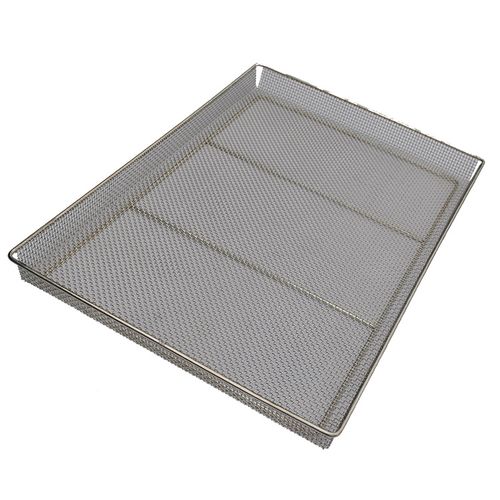
Stainless Steel Mesh Tray Supplier: A Strategic Sourcing Guide for Industrial Buyers
Product Introduction
In industrial production environments, the humble tray often becomes a critical point of failure. A stainless steel mesh tray is not simply a container—it is a productivity tool that must withstand continuous operation, aggressive cleaning cycles, and heavy loads while maintaining hygiene standards. As a stainless steel mesh tray supplier serving European and North American industrial buyers, we understand that procurement decisions are driven by total cost of ownership, not unit price alone. This industrial tray is designed for continuous production environments where hygiene, load stability, and long-term operational reliability are critical. Unlike solid trays, mesh construction allows for rapid drainage, air circulation, and uniform heat transfer—making it indispensable in drying, cooling, coating, and washing processes. When production managers specify mesh trays, they are solving specific problems: reducing drying times, preventing water pooling during cleaning, ensuring even airflow in ovens, or facilitating the transport of small components that would otherwise fall through standard racks. For importers and distributors, understanding these end-use requirements is essential to selecting a supplier who can deliver consistent quality across repeat orders.
Product Features and Engineering Advantages
A well-engineered stainless steel mesh tray differs from commodity offerings in several structural details that directly impact service life. The reinforced frame design improves load stability during repeated transportation and high-frequency industrial handling. We use spot welding or argon arc welding at frame-to-mesh junctions, depending on the application's vibration profile. The mesh itself is woven from wire that has been mechanically straightened and cut to precise lengths, ensuring uniform openings that prevent small parts from snagging or falling through. Surface treatment options include passivation and electropolishing, which remove surface contaminants and improve corrosion resistance in food contact and cleanroom environments. Key engineering advantages include:
- High corrosion resistance through appropriate grade selection and surface passivation
- Easy cleaning surface with smooth welds and no crevices that trap residue
- Stable load capacity with reinforced perimeter frames and cross-bracing where required
- Custom manufacturing options to match existing rack systems and conveyor dimensions
- Stackable designs for space-efficient storage and transport
These features matter most in industries where trays are handled hundreds of times per shift. A tray that deforms after three months forces unplanned replacements and disrupts production schedules. Buyers should ask suppliers about wire diameter tolerance, weld integrity testing, and load testing procedures.
Application Scenarios
Stainless steel mesh trays appear across a surprisingly wide range of industrial processes. In food processing, they are used for washing produce, draining fried products, cooling baked goods, and freezing applications where airflow is critical. Bakeries rely on mesh trays for proofing and baking because the open structure allows heat to circulate evenly around dough pieces. In industrial manufacturing, mesh trays hold components during degreasing, phosphating, and powder coating operations—the mesh allows liquids to drain freely and air to reach all surfaces. Drying processes benefit from mesh trays in tunnel dryers and batch ovens, where uniform air circulation reduces drying time and prevents moisture pockets. Cleaning processes such as ultrasonic cleaning and parts washing use mesh trays because they allow cleaning fluids to reach every surface of the parts being cleaned. In storage and transportation, stackable mesh trays organize small parts, fasteners, and components in warehouses and between production stages. The pharmaceutical and laboratory sectors use mesh trays for glassware drying, sample preparation, and sterilization processes where cleanliness and chemical resistance are paramount. Commercial production environments, including commercial kitchens and central processing facilities, use larger mesh trays for bulk food handling. Each application imposes specific requirements on material grade, mesh size, and frame construction, which is why a one-size-fits-all approach rarely works.
Material Options and Manufacturing Details
Material selection is one of the most consequential decisions in specifying a stainless steel mesh tray. 304 stainless steel provides reliable corrosion resistance for food contact applications and daily industrial cleaning environments. It handles most detergents, mild acids, and temperature variations up to approximately 500°C. 316 stainless steel adds molybdenum for enhanced resistance to chlorides and aggressive chemicals, making it suitable for pharmaceutical cleanrooms, marine environments, and processes involving salt solutions or strong cleaning agents. 201 stainless steel offers a cost-effective alternative for dry or low-corrosion applications, though it is not recommended for wet environments or food contact. Aluminum mesh trays are lighter and offer good thermal conductivity, but they lack the corrosion resistance and durability of stainless steel, making them suitable only for specific drying applications where weight is a primary concern. Manufacturing details also matter: wire diameter typically ranges from 1.0mm to 3.0mm depending on load requirements, mesh openings from 2mm to 25mm, and frame thickness from 1.5mm to 5mm. Surface treatments such as passivation improve corrosion resistance by removing free iron from the surface, while electropolishing creates a mirror-like finish that reduces adhesion of residues and improves cleanability.
Specifications and Technical Parameters
Industrial buyers should confirm the following parameters before placing an order. Available sizes can be customized according to equipment dimensions and production requirements, but standard ranges help establish expectations. Typical external dimensions range from 300mm x 400mm to 800mm x 1200mm. Wire diameter is commonly 1.5mm to 3.0mm for load-bearing applications, with 1.0mm to 1.5mm for lightweight drying. Mesh opening ranges from 5mm to 20mm depending on the smallest part that must be retained. Load capacity varies with design—standard trays handle 15kg to 50kg uniformly distributed loads, while reinforced designs can support up to 100kg. Layer configurations include single-layer, stackable with removable posts, and multi-tier rack systems. Surface treatments include pickling, passivation, and electropolishing. Production tolerances for external dimensions are typically ±2mm, with mesh alignment tolerances of ±1mm. Buyers should request a technical drawing for approval before production begins.
Custom OEM Manufacturing Service
For industrial buyers with specific equipment interfaces or branding requirements, custom OEM manufacturing is often necessary. Our factory supports custom sizes, custom designs including handle placement and stacking features, logo marking through laser etching or stamping, special packaging for container shipments, material selection based on application requirements, prototype development for new production lines, and bulk production with consistent quality control. For custom requirements, please contact our team to discuss your specifications. We recommend providing detailed drawings or samples for accurate quotation.
Purchasing Guide for Industrial Buyers
Selecting the right stainless steel mesh tray supplier requires more than comparing quotes. Consider the following procurement checklist:
- Confirm working environment—identify chemicals, temperature range, and cleaning methods
- Check material requirements—304 vs. 316 vs. 201 based on corrosion exposure
- Verify equipment compatibility—confirm dimensions, load capacity, and interface with existing racks or conveyors
- Evaluate supplier production capacity—ask about monthly output, welding equipment, and quality control processes
- Request samples or prototypes—test in actual production conditions before bulk orders
- Review quality control documentation—material certificates, dimensional inspection reports, and weld inspection records
- Assess export experience—packaging standards, shipping terms, and documentation for international orders
- Confirm delivery reliability—lead times, production scheduling, and communication processes
Bulk purchasing decisions should also account for packaging quality—poorly packed trays arrive deformed and unusable. Ask for photos of previous export packaging and confirm pallet configurations for container loading.
FAQ
Q1: What stainless steel grade is recommended for food processing applications?
A1: 304 stainless steel is the standard choice for most food processing applications due to its balance of corrosion resistance and cost. For applications involving chlorinated cleaning agents, salt solutions, or acidic foods, 316 stainless steel is recommended. Both grades meet FDA and EU food contact requirements when properly passivated.
Q2: Can the tray size be customized?
A2: Yes, custom sizes are our standard offering. We manufacture trays to match your equipment dimensions, rack systems, or conveyor specifications. Provide drawings or dimensions and we will confirm feasibility and provide a technical drawing for approval before production.
Q3: Do you provide OEM manufacturing service?
A3: Yes, we offer OEM services including custom dimensions, logo marking, special packaging, and material selection. Our engineering team can assist with design modifications to improve performance or reduce costs. Contact us with your requirements for a detailed proposal.
Q4: What information should buyers provide before quotation?
A4: Please provide: tray dimensions, material grade preference, wire diameter and mesh opening requirements, load capacity, surface treatment needs, order quantity, and delivery destination. Samples or drawings help ensure accurate quoting and reduce back-and-forth communication.
Q5: How do you control product quality?
A5: We conduct incoming material inspection, in-process dimensional checks, weld strength testing, and final inspection before packing. Material certificates and inspection reports are available upon request. We also welcome third-party inspection during production or before shipment.

