





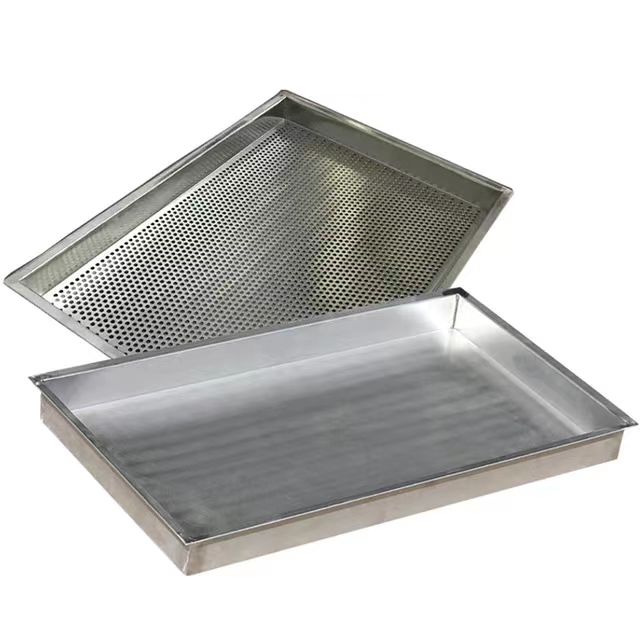
Stainless Steel Oven Trolley Trays: A Buyer’s Guide to Durability, Fit, and Performance
Why Stainless Steel Oven Trolley Trays Are Non-Negotiable in Commercial Baking
In busy bakery and food production environments, oven trolley trays endure extreme thermal cycling, frequent handling, and aggressive washing. Ordinary trays warp, dent, and lose dimensional stability, causing jams on rails and uneven baking. Stainless steel oven trolley trays — especially the common stainless steel tray 600x400 — are engineered to maintain flatness, edge sharpness, and consistent fit across thousands of bake cycles. Unlike aluminum or coated steel, stainless survives caustic cleaners and high heat without peeling or corroding, making it the cost-effective long-term choice for commercial ovens and bakery rack systems.
What Makes a Trolley Tray Reliable Under Heat, Turnover, and Washdown
The three enemies of any tray are heat distortion, mechanical stress, and chemical attack. A proper trolley tray uses 304 or 316 stainless steel (316 for high-salt or high-acid environments). The fabrication process matters too: deep-drawn corners instead of welded seams reduce weak points. And the surface finish must be smooth enough to release baked goods but textured enough to avoid sticking. When you choose commercial oven tray options, always specify the exact alloy, gauge, and edge profile to match your oven rack spacing and cleaning routine.
Dimensional Consistency: The Hidden Key to Smooth Rack Flow
If you’ve ever watched a tray hitch on the oven rails or jam in the proofer, you know how costly even a 2 mm deviation can be. Dimensionally consistent trays slide freely because their length, width, and lip height are within a tolerance of ±1 mm. The stainless steel tray 600x400 is popular in Europe and Asia; in North America, 18x26 inches is standard. But regardless of size, insist on a supplier that checks every batch with a fixture gauge. Mishandling in transport or poor stacking after washing can bend corners, so always measure a few sample trays periodically to ensure they still fit your trolley.
Edge Strength and Weld Quality: Where Failures Begin
Trays fail most often at the edges — where they hit the rack, slide against adjacent trays, or get repeatedly gripped during hot loading. Edge strength comes from either a reinforced rolled-edge or a solid wire rim welded around the perimeter. A reinforced edge resists bending when carrying heavy dough loads and prevents the tray from flexing in the center, which can cause uneven baking. For welded trays, inspect the weld seam: it should be continuous, smooth, and free of cracks. Even a tiny crevice can harbor bacteria and start corrosion during daily washdowns. Ask your supplier for a weld sample and bend-test it before committing.
Anti-Deformation at High Temperatures: Material and Design Matters
When the oven hits 250°C, thermal expansion causes trays to distort. A flat tray after cooling is the goal. Anti-deformation depends on the alloy’s thermal stability and the tray’s structural rigidity. Avoid over-thinning: while a 0.6 mm sheet saves cost, it will buckle in larger sizes. For 600x400 trays, 0.8 mm is a sensible minimum for heavy use. Also, trays with a slight peripheral lip (15–20 mm) redistribute stress and reduce warping. Some commercial ovens need a tray that fits a specific rack lobe — always match the tray's curl or flange to your existing guides to avoid pressure points.
Rack Contact and Guide Interaction: Avoid Friction and Jams
The interface between the tray and the trolley's guides is often overlooked. Too much friction and the tray sticks; too little and it rattles. The tray’s outer edges must be perfectly parallel and free of burrs. When sliding a tray into a proofing rack or oven, the corner radius should match the guide curve. Rack contact points are where corrosion often starts — after electroplating or passivation, a tray should be dry before stacking. Lubricating the guides occasionally with food-grade silicone helps, but the best solution is to order trays with a slick, non-porous finish that allows clean sliding without added lubricants.
Stacking and Identification: Safe Storage and Traceability in Production
Stacking trays flat when loaded can deform the bottom ones if batches are heavy and the lips are weak. Ensure your trays have a stacking dimple or a flat rim that inter-locks with the one below, preventing sideways slip and reducing crushing. For inventory and hygiene audits, tray identification matters. Laser-etched or embossed batch numbers and expiry dates on the lip help trace products and manage rotation. Whether you code them with your brand or with date stamps, clear marking on the tray itself avoids mix-ups in high-volume bakeries. Stainless trays resist abrasion, so the markings stay legible through hundreds of wash cycles.
Material and Finish Options for Your Bakery Rack Trays
For most bakery rack trays, 304 stainless steel is the right call — it is food-safe, corrosion-resistant, and easy to clean. If your operation uses chlorinated detergents or processes acidic doughs (e.g., sourdough), choose 316 for extra pitting resistance. The surface finish matters too: a No. 2B mill finish is standard, but you can request a Brushed finish to hide scratches — however, that may trap food particles. Electropolishing gives the smoothest surface, reducing cleaning time and bacterial adhesion. Remember, aluminum trays are lighter but they pass heat faster and dent easily; stainless is the durable choice for high-volume rack ovens.
Custom Sizes and Perforations: Dialing in Your Workflow Efficiency
Many commercial oven trays are available in custom sizes, ensuring in each application they fit perfectly. Common sizes include 400×300 mm, 600×400 mm, and 800×600 mm. Tray thickness can range from 0.5 mm to 2.0 mm — thin for light loads, thick for heavy duty. Perforations (round holes of 1 mm to 10 mm) allow airflow for rapid baking and even browning. For baking, you need a hole pattern that maximizes heat circulation while still supporting the product. Customization of dimensions, hole size, hole spacing, and arrangement can boost output in your specific oven. Whether you need a 600×400 mm tray for a rack oven or a full-sheet pan for a deck oven, standard sizes work, but custom ensures safety.
Procurement Checklist: What to Inspect Before Buying Commercial Oven Trays
Use this checklist when evaluating a supplier. First, verify alloy certificates (304 or 316) and gauge thickness with a micrometer. Measure dimensional accuracy — length, width, height — across a sample of 5 trays. Check edge strength by pressing a weight on the rim; it should not bend more than 1 mm. For anti-deformation, place a tray on a flat surface and look for gaps after heating to 250°C. Test the rack fit in your own oven rack. Inspect for burrs and weld quality. Ask for a stacking test: load 20 trays full of dough for 2 hours and inspect the bottom ones. Finally, confirm the tray code or serial mark is permanent. A solid supplier will provide a written quality control sheet with each batch.
Common Failure Modes and How to Avoid Them
Most failures stem from edge damage during handling or washing — trays dropped onto concrete or bent when slid against each other. Distortion happens when you overheat an empty tray, so always heat a loaded oven. Corrosion in the form of pitting occurs when you use high chloride detergents without rinsing properly. Weld cracking appears after thermal fatigue when the tray design has sharp corners and thick material. To avoid these, pick reinforced edges, use a thickness that matches your load, dry trays after washing, and avoid overloading racks. Regular inspection every six months can catch small issues before they cause downtime.
Frequently Asked Questions
Q: Are stainless steel oven trolley trays dishwasher-safe?
Yes, they are dishwasher-safe, but always use non-chlorinated detergents and rinse thoroughly to prevent pitting.
Q: Can I get trays with a specific size for my old oven?
Absolutely. Top manufacturers offer custom sizes, including 600x400 or other dimensions, to fit any rack.
Q: Do you recommend 201 or 304 stainless steel?
For most food applications, 304 is best. 201 is cost-saving but less corrosion-resistant, so use it only for dry goods.
Q: What does “bakery rack trays” mean exactly?
It refers to trays designed to fit into mobile racks used in proofers, ovens, and freezers — usually 460x720 mm or 600x400 mm.
Q: How long should a stainless tray last?
With proper care, a commercial oven tray lasts 10 years or more. The key is to avoid bending and heating empty.
Strengthen Your Supply Chain with the Right Tray Partner
Your oven trolley trays are not a commodity — they are a production asset. Choose a partner who understands bakery dynamics. Call us today for a free fitting test sample. Mention code BAKE600 to get a special quote on 600x400 stainless steel trays. Visit our contact page to download the full procurement checklist. Let us help you eliminate warping, reduce cleaning time, and keep your racks sliding freely for years.