


Stainless Steel Rack Tray Sourcing Guide for Industrial Buyers
Product Introduction
In industrial procurement, a stainless steel rack tray is not a commodity item purchased on price alone. It is a load-bearing component that interacts with conveyor systems, racking structures, washing lines, and drying ovens every day. For importers, distributors, and industrial buyers serving food processing plants, bakeries, pharmaceutical factories, and manufacturing facilities, the tray must perform reliably under continuous operation, frequent cleaning, and variable temperature conditions.
From a manufacturer's perspective, this industrial tray is designed for production environments where hygiene, load stability, and long-term operation reliability are critical. It solves several common production problems: unstable loads during transport, corrosion caused by repeated washing, contamination risks from unsuitable materials, and inconsistent dimensions that cause jams in automated equipment. When buyers source from an experienced industrial mesh tray supplier, they are not just purchasing a metal product; they are securing a component that keeps production lines running.
Typical buyers include food processing companies, commercial bakeries, engineering firms, laboratory equipment distributors, and industrial wholesalers. Each has different priorities, but all need documented specifications, consistent quality, and a supplier capable of handling repeat orders.
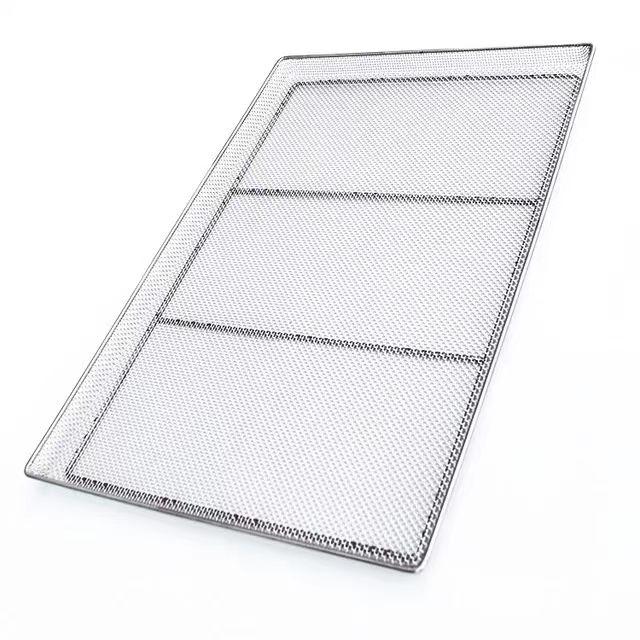
Image ALT Text: Stainless steel rack tray for industrial food processing applications by manufacturer
Product Features and Engineering Advantages
Industrial buyers should evaluate features based on how they affect production uptime and maintenance costs. The following characteristics are commonly specified for stainless steel rack trays used in demanding environments:
- High corrosion resistance — suitable for wash-down areas and humid processing rooms
- Easy cleaning surface — reduces labor and supports hygiene compliance
- Stable load capacity — maintains shape under repeated loading and transport
- Custom manufacturing options — dimensions, mesh, and frame configured to equipment
- Reinforced frame construction — improves rigidity during high-frequency handling
- Consistent mesh opening — supports airflow and drainage in drying processes
The structural design matters. A reinforced frame with properly welded cross supports improves load stability during repeated transportation and high-frequency industrial handling. This is especially important when trays are stacked, pushed into racks, or lifted by automated systems. The manufacturing process also affects performance: wire mesh should be securely joined to the frame, and surface treatment should eliminate sharp edges and weld spatter that could damage products or injure workers.
In industrial environments, trays are exposed to steam, detergents, and temperature changes. A well-engineered stainless steel drying tray maintains its shape and surface condition longer, reducing replacement frequency and downtime. For buyers, this translates into lower total cost of ownership, not just a lower unit price.
Application Scenarios
Stainless steel rack trays are used across multiple industries, and each application places different demands on the product.
Food processing: Trays carry raw materials, semi-finished products, and packaged goods through washing, blanching, freezing, and drying stages. Stainless steel is preferred because it resists corrosion from food acids and cleaning chemicals, and it does not harbor bacteria when properly maintained.
Bakery and commercial baking: Oven racks and proofing trays require stable dimensions and heat resistance. A stainless steel rack tray that maintains its shape at high temperatures helps ensure consistent baking results and safe handling.
Industrial manufacturing: Parts washing, coating, and drying lines use trays to hold components during automated processes. The tray must withstand repeated immersion and mechanical handling without deformation.
Drying processes: In food dehydration, chemical drying, and textile processing, mesh trays allow hot air to circulate evenly. The mesh opening and wire diameter directly affect drying efficiency.
Cleaning and sanitation: Trays used in cleaning systems must drain quickly and resist detergent corrosion. A smooth surface and proper mesh design prevent water pooling and residue buildup.
Storage and transportation: Stackable trays improve warehouse efficiency and protect products during internal transport. Consistent dimensions are essential when trays are used with automated storage systems.
Pharmaceutical and laboratory: These environments require documented materials, clean surfaces, and sometimes passivation. 316 stainless steel is often specified for enhanced corrosion resistance.
For each scenario, the common requirement is reliability. Buyers should match the tray specification to the actual working environment rather than selecting a general-purpose product.
Image ALT Text: Stainless steel drying tray for industrial food processing manufacturer
Material Options and Manufacturing Details
Material selection is one of the most important decisions in the procurement process. The most common options are 304 stainless steel, 316 stainless steel, 201 stainless steel, and sometimes aluminum for lightweight applications.
304 stainless steel provides reliable corrosion resistance for food contact applications and daily industrial cleaning environments. It is suitable for most food processing, bakery, and general manufacturing applications. It offers a good balance of cost and performance.
316 stainless steel contains molybdenum, which improves resistance to chlorides and aggressive chemicals. It is recommended for pharmaceutical, laboratory, coastal, and high-corrosion environments. The cost is higher, but it extends service life in harsh conditions.
201 stainless steel is a lower-cost option with lower nickel content. It offers moderate corrosion resistance and is suitable for dry storage or light-duty applications. It is not recommended for frequent wash-down or chemical exposure.
Aluminum is lightweight and corrosion resistant in some environments, but it is softer and less suitable for heavy loads or high-temperature applications. It is sometimes used in baking trays where weight reduction is important.
Manufacturing details also matter. Buyers should ask about welding method, surface treatment, and tolerance control. Common surface treatments include polished, passivated, and electropolished finishes. Production tolerance should be confirmed before ordering, especially when trays must fit existing racks or conveyor systems.
Specifications and Technical Parameters
Industrial buyers should confirm the following parameters before requesting a quotation:
- Size: Length, width, and height. Custom sizes can be manufactured according to equipment dimensions.
- Thickness: Frame and wire thickness affect load capacity and durability.
- Capacity: Maximum load per tray and per layer.
- Weight loading: Static and dynamic load ratings.
- Layers: Single-layer or multi-layer rack configurations.
- Mesh opening: Determines airflow, drainage, and product retention.
- Wire diameter: Affects strength and open area.
- Tray compatibility: Must match existing racks, ovens, or conveyor systems.
- Surface treatment: Polished, passivated, or electropolished.
- Production tolerance: Usually ±1–2 mm depending on size and process.
Available sizes can be customized according to equipment dimensions and production requirements. If specific parameters are not provided, buyers should request a technical drawing for approval before mass production. This step prevents costly mismatches and delays.
Custom OEM Manufacturing Service
Many industrial buyers require custom stainless steel trays rather than standard products. A capable OEM stainless steel tray manufacturer should offer:
- Custom size and geometry
- Custom design and drawing support
- Logo marking and branding
- Special packaging for export
- Material selection assistance
- Prototype development and sampling
- Bulk production with consistent quality
For custom requirements, please contact our team. Experienced manufacturers can review your application, recommend suitable materials, and provide drawings for confirmation. This reduces the risk of ordering non-compatible trays and helps buyers meet project deadlines.
When evaluating a supplier, ask about their engineering support, sample lead time, and production capacity. A supplier who communicates clearly during the sampling stage is more likely to handle bulk orders reliably.
Purchasing Guide for Industrial Buyers
This purchasing checklist helps buyers make better decisions:
- Confirm working environment — temperature, humidity, chemicals, and wash-down frequency
- Check material requirements — 304, 316, or 201 based on corrosion exposure
- Verify equipment compatibility — dimensions, rack type, and load capacity
- Evaluate supplier production capacity — monthly output and lead times
- Review quality control process — incoming material inspection, welding checks, and final inspection
- Confirm packaging — export-grade packing to prevent damage during shipping
- Assess export experience — documentation, shipping terms, and communication
Buyers should also consider delivery reliability. Delays in tray delivery can stop production lines. A supplier with stable production scheduling and export experience reduces supply chain risk. Price is important, but total cost of ownership, including replacement frequency and downtime, should guide the final decision.
Common Questions from Industrial Buyers
What stainless steel grade is recommended for food processing applications?
304 stainless steel is the standard choice for most food processing applications because it offers reliable corrosion resistance and is suitable for food contact. If the environment includes chlorides, heavy cleaning chemicals, or high humidity, 316 stainless steel is recommended. 201 stainless steel is generally not recommended for frequent wash-down or food contact applications.
Can the tray size be customized?
Yes. Most industrial tray manufacturers offer custom sizes based on equipment dimensions and production requirements. Buyers should provide drawings or measurements, including length, width, height, and any rack interface details. A technical drawing for approval is recommended before mass production to avoid compatibility issues.
Do you provide OEM manufacturing service?
Yes. OEM service typically includes custom design, material selection, logo marking, special packaging, and bulk production. Buyers should discuss their application and order volume with the manufacturer. Prototype development is often available to confirm fit and performance before full production.
What information should buyers provide before quotation?
Buyers should provide dimensions, material grade, load capacity, surface treatment, quantity, and application details. If trays must fit existing equipment, drawings or photos are helpful. The more detailed the requirements, the more accurate the quotation and the lower the risk of production errors.
How do you control product quality?
Quality control usually includes incoming material inspection, dimensional checks during production, weld strength testing, surface inspection, and final inspection before packing. Buyers should request inspection reports or arrange third-party inspection for large orders. A documented QC process is a sign of a reliable supplier.
What is the typical lead time for bulk orders?
Lead time depends on order quantity, customization, and production schedule. Standard products may ship in 2–4 weeks, while custom trays may require 4–8 weeks including sampling and approval. Buyers should confirm lead time before placing orders and plan for transportation time.
How should stainless steel trays be packaged for export?
Export packaging should protect trays from scratches, deformation, and moisture. Common methods include cartons with corner protection, wooden pallets, and stretch wrapping. Buyers should specify packaging requirements in the purchase order to reduce damage during shipping.
FAQ
Q1: What stainless steel grade is recommended for food processing applications?
A1: 304 stainless steel is suitable for most food processing applications. For high-corrosion environments or pharmaceutical use, 316 stainless steel is recommended. 201 stainless steel is not ideal for frequent washing or food contact. Buyers should match the grade to the working environment and cleaning chemicals.
Q2: Can the tray size be customized?
A2: Yes. Custom sizes are common in industrial procurement. Buyers should provide equipment dimensions, load requirements, and rack interface details. A drawing approval process helps ensure the final product fits correctly and performs as expected.
Q3: Do you provide OEM manufacturing service?
A3: Yes. OEM service includes custom design, material selection, logo marking, special packaging, and bulk production. Buyers can request samples or prototypes before placing large orders to confirm quality and compatibility.
Q4: What information should buyers provide before quotation?
A4: Buyers should provide dimensions, material grade, load capacity, surface treatment, quantity, and application details. Drawings or photos of existing equipment are helpful. Clear requirements lead to accurate quotations and reduce production risks.
Q5: How do you control product quality?
A5: Quality control includes material inspection, dimensional checks, weld testing, surface inspection, and final inspection before packing. Buyers can request inspection reports or third-party inspection for large orders to ensure compliance with specifications.
Image ALT Text: Custom stainless steel rack tray for industrial drying and food processing manufacturer
SEO Information
SEO Title: Stainless Steel Rack Tray for Industrial Food Processing
Meta Description: Source stainless steel rack trays for food processing, drying, and industrial manufacturing. Custom sizes, 304/316 options, OEM service, and export-ready quality control.
SEO Keywords: stainless steel rack tray, industrial mesh tray supplier, stainless steel drying tray, food processing tray, commercial drying rack, custom stainless steel tray, OEM stainless steel tray manufacturer, stainless steel mesh tray

