


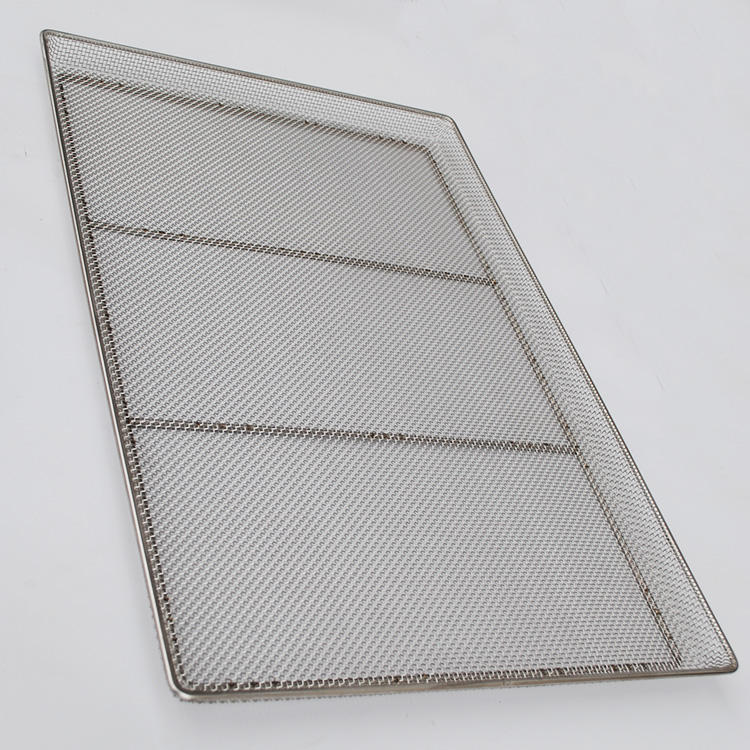
Stainless Steel Screen Tray Procurement Guide for Industrial Food Processing and Manufacturing
Product Introduction: What Industrial Buyers Need to Know About Stainless Steel Screen Trays
A stainless steel screen tray is not a generic kitchen accessory. In industrial procurement terms, it is a load-bearing, airflow-optimized component designed for continuous production environments where hygiene, load stability, and long-term operational reliability are critical. These trays are constructed with a welded stainless steel frame and a woven or welded mesh screen surface, allowing air, steam, water, or heat to pass through while supporting products during processing, drying, cooling, or transportation.
From a manufacturer's perspective, the stainless steel screen tray solves several production-floor problems simultaneously. It eliminates moisture buildup that causes spoilage in food processing, reduces drying time by maximizing airflow, withstands repeated washdown and sanitization cycles, and maintains structural integrity under heavy or high-temperature loads. For importers, distributors, and industrial buyers, sourcing the right tray means fewer replacements, lower downtime, and consistent product quality across batches.
The demand for industrial mesh tray suppliers has grown as food safety regulations tighten and manufacturers seek durable, reusable alternatives to plastic or coated wire trays. Whether you are equipping a bakery line, a pharmaceutical drying room, or a parts-cleaning operation, the tray specification directly affects throughput and operating cost.
Product Features and Engineering Advantages
Understanding why a stainless steel screen tray outperforms alternative designs requires looking at the engineering behind it. The reinforced frame design improves load stability during repeated transportation and high-frequency industrial handling. Unlike stamped or folded trays, a properly manufactured screen tray uses a continuous welded frame that resists twisting and deformation under uneven loads.
Key engineering features include:
- High corrosion resistance — suitable for wet, humid, and chemical-exposure environments
- Easy-cleaning surface — open mesh design prevents debris accumulation and supports CIP protocols
- Stable load capacity — reinforced edges and cross-bracing maintain shape under heavy loads
- Custom manufacturing options — mesh opening, wire diameter, frame profile, and dimensions tailored to equipment
- Stackability and nesting — designed for space-efficient storage and automated handling systems
The mesh surface is typically woven or welded. Woven mesh offers flexibility and finer filtration, while welded mesh provides greater rigidity and uniform openings for heavier products. The choice depends on the application: a commercial drying rack for delicate baked goods may use finer woven mesh, while a tray for heavy metal parts would use a coarser welded mesh with thicker wire.
Surface treatment also matters. Passivation removes free iron from the surface after welding, improving corrosion resistance. Electro-polishing creates a smoother surface that reduces product adhesion and makes cleaning more effective in pharmaceutical and food-contact applications. Buyers should confirm whether these processes are included or available as options.
Application Scenarios Across Industries
Stainless steel screen trays are used across a wide range of industries, and each application imposes different requirements on the product.
Food processing is the largest application segment. Trays are used for drying, cooling, freezing, blanching, and transporting products such as vegetables, fruits, meat, and seafood. The open mesh allows rapid drainage and airflow, which reduces processing time and improves product consistency. Stainless steel construction meets food-contact regulations and withstands repeated sanitation.
Bakery and confectionery operations use screen trays for proofing, baking, and cooling. The mesh surface prevents dough from sticking and allows even heat distribution. A food processing tray designed for bakery use often requires specific mesh openings that balance product support with airflow.
Industrial manufacturing relies on these trays for parts washing, drying, coating, and heat treatment. They must resist chemicals, oils, and high temperatures while maintaining dimensional stability. In these environments, a heavier-gauge stainless steel mesh tray is often necessary.
Pharmaceutical and laboratory applications demand high cleanliness standards. Trays used in drying ovens, sterilizers, and cleanrooms require electro-polished surfaces and documented material certifications. Contamination control is critical, and trays must be compatible with autoclaving and chemical sterilization.
Storage and transportation within factories and warehouses benefit from stackable screen trays that protect products while allowing ventilation. This reduces condensation damage and improves inventory turnover.
In each scenario, the decision to use a stainless steel screen tray over a solid tray or plastic alternative comes down to airflow, drainage, durability, and hygiene. Buyers should map the tray to the specific process conditions rather than selecting a general-purpose product.
Material Options and Manufacturing Details
Material selection is one of the most important decisions in stainless steel screen tray procurement. The grade affects corrosion resistance, cost, and suitability for different environments.
304 stainless steel provides reliable corrosion resistance for food contact applications and daily industrial cleaning environments. It is the standard choice for most food processing, bakery, and general manufacturing applications. It handles moderate exposure to moisture, cleaning agents, and organic acids.
316 stainless steel offers superior corrosion resistance, particularly against chlorides, salt, and harsh chemicals. It is recommended for seafood processing, pharmaceutical manufacturing, chemical exposure, and coastal environments. The higher molybdenum content makes it more expensive, so buyers should specify 316 only when the application demands it.
201 stainless steel is a lower-cost alternative with lower nickel content. It offers adequate corrosion resistance for dry environments, indoor storage, and light-duty applications. It is not recommended for frequent wet cleaning or food-contact surfaces where long-term corrosion resistance is required.
Aluminum trays are lightweight and cheaper but lack the corrosion resistance and durability of stainless steel. They are sometimes used for dry baking or lightweight transportation, but they deform more easily and are not suitable for wet or chemical environments.
Manufacturing details also influence performance. Wire diameter typically ranges from 1.0 mm to 5.0 mm depending on load requirements. Mesh opening can vary from 2 mm to 50 mm or more. Frame profiles may be flat, angled, or tubular, and corner construction may be welded, riveted, or mechanically joined. Buyers should request drawings and samples before committing to bulk orders.
Specifications and Technical Parameters
Industrial buyers should confirm the following parameters before placing an order. Available sizes can be customized according to equipment dimensions and production requirements.
- Size — length, width, and height must match existing racks, ovens, or conveyor systems
- Thickness — frame thickness and mesh wire diameter affect load capacity and durability
- Capacity — maximum distributed load per tray, typically expressed in kilograms
- Weight loading — static and dynamic load ratings for manual or automated handling
- Layers — single-layer or multi-tier configurations for space optimization
- Mesh opening — determined by product size and airflow requirements
- Wire diameter — selected based on load and rigidity needs
- Tray compatibility — must fit existing trolleys, racks, and automated systems
- Surface treatment — passivation, electro-polishing, or pickling as required
- Production tolerance — typically ±1 mm to ±3 mm depending on dimensions and process
Buyers should also request material certificates, dimensional inspection reports, and load test data where applicable. For food-contact applications, documentation confirming compliance with relevant regulations (such as FDA or EU food-contact standards) is essential.
Custom OEM Manufacturing Service
Many industrial applications require trays that are not available as standard products. A qualified OEM stainless steel tray manufacturer can develop custom solutions based on drawings, samples, or application requirements.
Custom capabilities typically include:
- Custom size — built to fit specific equipment dimensions
- Custom design — frame profile, mesh pattern, and reinforcement tailored to the application
- Logo marking — laser etching or stamping for brand identification
- Special packaging — export-ready packaging with rust protection and custom labeling
- Material selection — 304, 316, 201, or alternative materials based on environment
- Prototype development — samples for testing before mass production
- Bulk production — scalable capacity with consistent quality control
For custom requirements, please contact our team with your drawings, specifications, and estimated order quantity. Early engagement helps identify potential manufacturing constraints and ensures the final product meets both functional and budgetary requirements.
Purchasing Guide for Industrial Buyers
Effective procurement of stainless steel screen trays requires more than comparing prices. Buyers should evaluate suppliers on quality control, production capability, export experience, packaging, and delivery reliability.
Consider the following procurement checklist:
- Confirm working environment — temperature, moisture, chemicals, and cleaning methods
- Check material requirements — grade, surface finish, and certifications
- Verify equipment compatibility — dimensions, load points, and handling systems
- Evaluate supplier production capacity — monthly output, equipment, and lead times
- Review quality control processes — incoming material inspection, in-process checks, and final inspection
- Request samples and test reports — verify dimensions, finish, and load capacity
- Clarify packaging and shipping terms — protection against moisture and damage during transit
- Confirm after-sales support — replacement policy and technical assistance
How to choose the right size? Start with the equipment or rack the tray will be used in. Measure the internal dimensions and account for clearance. If the tray will be handled manually, consider weight and ergonomics. For automated systems, confirm tolerance requirements.
How to select the right material? Match the grade to the environment. 304 for general food and industrial use, 316 for corrosive or high-hygiene applications, and 201 only for dry, light-duty use.
How to judge supplier capability? Request factory photos or video audits, review export documentation, ask for references, and place a trial order before committing to a long-term contract. A supplier with experience in your industry will understand your requirements faster and reduce the risk of costly errors.
Frequently Asked Questions
Q1: What stainless steel grade is recommended for food processing applications?
304 stainless steel is the standard recommendation for most food processing applications. It offers reliable corrosion resistance, meets food-contact requirements, and withstands daily cleaning. For seafood, brine, or highly acidic products, 316 stainless steel provides better protection against chloride corrosion and extends service life.
Q2: Can the tray size be customized?
Yes. Most manufacturers offer custom sizes based on your equipment dimensions. Provide drawings or measurements, and confirm tolerance requirements. Custom sizes typically require a minimum order quantity and may extend lead time. Always request a sample or first-article inspection before full production.
Q3: Do you provide OEM manufacturing service?
Yes. OEM service includes custom design, material selection, logo marking, special packaging, and private labeling. Provide your specifications or samples, and the manufacturer will develop a solution accordingly. Early communication helps avoid design issues and ensures the final product meets your market requirements.
Q4: What information should buyers provide before quotation?
Provide tray dimensions, material grade, mesh opening, wire diameter, load requirements, surface treatment, quantity, and delivery destination. If available, include drawings or samples. This information allows the manufacturer to provide an accurate quotation and identify any technical considerations.
Q5: How do you control product quality?
Quality control includes incoming material inspection, dimensional checks during production, weld strength testing, surface finish verification, and final inspection before packing. Request inspection reports and material certificates. For critical applications, third-party inspection can be arranged before shipment.
Q6: What is the typical lead time for bulk orders?
Lead time depends on order quantity, customization requirements, and production schedule. Standard trays may ship within 2–4 weeks. Custom or large orders may require 4–8 weeks. Confirm lead time before ordering and plan for shipping time separately.
Q7: How should trays be packaged for export?
Export packaging should protect against moisture, impact, and deformation. Common methods include wooden crates, pallets with stretch film, and rust-preventive paper or VCI film. Confirm packaging specifications with the supplier and request photos before shipment.
Q8: Can trays be used in high-temperature ovens?
Yes, stainless steel screen trays can be used in high-temperature applications, but the maximum temperature depends on the grade and design. 304 and 316 stainless steels generally handle temperatures up to 800°C in continuous service, though load capacity decreases at high temperatures. Confirm operating conditions with the manufacturer.

