





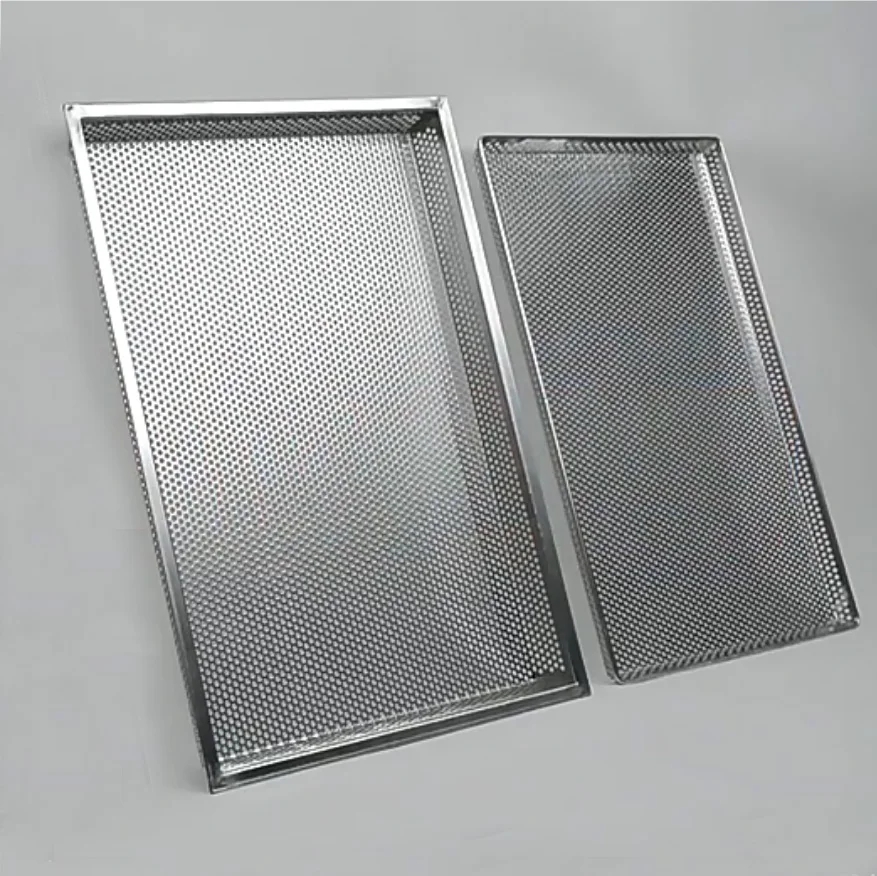
Stainless Steel Tray 600x400: The Industry Standard for European Baking & Gastronomy Applications
What Is a Stainless Steel Tray 600x400 and Why Is It the European Standard?
The stainless steel tray 600x400 (often called a baking tray 600 x 400) is the go-to size for European baking and food processing. Its dimensions—600 mm in length and 400 mm in width—perfectly fit standard stainless steel sheet pan 600mm rack ovens and rolling racks. In the industry, it's also referred to as a 40×60 cm tray (since 600×400 mm equals 40×60 cm). This compatibility ensures seamless integration with existing equipment like plate 400x600 oven systems and metal oven tray 40x60 racks.
Key Specifications and Tolerances for Rack & Rotating Oven Compatibility
When ordering a stainless steel sheet tray 400x600, precise dimensions are crucial. The nominal size is 600×400 mm, but actual tray dimensions must account for manufacturing tolerances—typically ±1 mm for length and width. Edge height varies from 20 mm to 40 mm, affecting stackability and capacity. Material thickness options include 0.5, 0.6, 0.7, 0.8, 1.0, 1.1, 1.2, 1.3, 1.4, 1.5, and 2.0 mm. Thinner gauges suit light loads (e.g., pastries), while thicker gauges support heavier items like large roasts or multiple sheet pans stacked.
Customization: Round Corners, Rolled Edges, Perforations & Load Capacity
Beyond basic dimensions, details matter. Round corners (e.g., R5, R10, R15) improve cleaning and reduce stress points. Rolled edges add rigidity and prevent injury during handling. Perforation patterns (circular holes of 1–10 mm diameter) can be customized for airflow, drainage, or weight reduction. Common open areas range from 20% to 50%. Load capacity depends on material, thickness, and design: a 1.0 mm 304 stainless steel tray typically supports 15–25 kg uniformly distributed, while a 2.0 mm tray can handle 40–60 kg. Always verify with the manufacturer for your specific application.
Material Selection: Stainless Steel vs. Aluminum
Stainless steel (grades 201, 304, 316) offers durability, corrosion resistance, and hygienic properties—ideal for baking tray 600 x 400 in food environments. Grade 304 is most common for bakeries; 316 is for high‑salt or acidic conditions. Aluminum (1060, 3003, 5052) is lighter (approx. 1/3 the weight of stainless) and heats faster, but is less durable and can react with acidic foods. Choose based on your cleaning process, load, and budget.
Parameters Table
| Parameter | Typical Value | Notes |
|---|---|---|
| Nominal Size | 600 × 400 mm | Also called 40×60 cm |
| Length Tolerance | ±1 mm | Critical for rack fit |
| Width Tolerance | ±1 mm | Critical for rack fit |
| Edge Height | 20–40 mm | Standard: 20 or 30 mm |
| Material Thickness | 0.5–2.0 mm | Common: 0.8, 1.0, 1.2 mm |
| Corner Radius | R5–R20 mm | R10 is typical |
| Edge Finish | Rolled, hemmed, or flat | Rolled for strength |
| Hole Diameter | 1–10 mm | Round holes, custom pattern |
| Open Area | 20%–50% | Depends on hole & spacing |
| Material Grade | 304 SS (most common) | Also 201, 316, aluminum |
| Max Load (1.0 mm 304) | ~20 kg (uniform) | Varies with design |
Information Required Before Quotation
- Exact dimensions (length, width, edge height, corner radius)
- Material grade (e.g., 304 stainless steel, 5052 aluminum)
- Thickness in mm (e.g., 1.0 mm)
- Perforation details (hole diameter, pitch, pattern, open area)
- Edge type (rolled, hemmed, straight)
- Surface finish (brushed, mirror, matte)
- Quantity (unit price varies with volume)
- Intended use (oven type, load, food contact)
Frequently Asked Questions
None—they are the same size. 600×400 mm is the metric notation; 40×60 cm is the centimeter notation. Both refer to the same European standard for gastronorm and bakery trays.
Measure the rack's internal width and depth. Add about 2–5 mm clearance for easy loading/unloading. Also check the support rails—some racks have offset lips. Always request a drawing or sample before bulk order.
Yes, most manufacturers offer custom perforation. You can specify hole diameter, row spacing, staggered or straight pattern, and total open area. For a stainless steel sheet pan 600mm, common hole sizes are 2 mm, 3 mm, or 5 mm with 50% open area for airflow.
For loads over 15 kg, use at least 1.2 mm stainless steel. For very heavy items (e.g., stacked trays), consider 1.5 mm or 2.0 mm. Lighter loads (e.g., pastries) can use 0.8 mm.
Aluminum is lighter and heats faster, but is less durable and prone to dents. It's suitable for low‑volume or mobile applications. For high‑volume commercial baking, stainless steel is preferred for longevity.
Call to Action
Ready to source the perfect stainless steel tray 600x400 for your bakery or kitchen? Send us your specifications—length, width, edge height, thickness, material, and perforation needs—and we'll provide a competitive quote with fast lead times. Contact us today to ensure your trays are optimized for your rack oven, rolling rack, or rotating oven.What is the difference between 600×400 mm and 40×60 cm trays?How do I ensure my tray fits my rack or oven?Can I get a custom hole pattern?What thickness should I choose for heavy loads?Is aluminum a good alternative?