


Stainless Steel Tray Sourcing for Industrial Buyers: A Practical OEM Guide
Product Introduction
A stainless steel tray is not a generic kitchen item in industrial procurement. It is a production tool that moves, holds, dries, cleans, or protects parts and food products across shifts, conveyor lines, and washing systems. For importers, distributors, and OEM buyers, the real question is not whether the tray looks good in a catalog photo. It is whether the tray maintains dimensional stability after repeated handling, whether it meets hygiene standards, and whether the supplier can repeat the same specification across thousands of units without deviation.
From a manufacturer’s perspective, industrial trays are designed for continuous production environments where hygiene, load stability, and long-term operation reliability are critical. A tray that warps after three weeks in a bakery or fails a food safety audit creates downtime, rejected shipments, and warranty claims. That is why serious buyers evaluate stainless steel trays as engineered components, not as commodity hardware. The right supplier should understand mesh opening tolerances, frame welding, surface finish, and how the tray interacts with existing racks, trolleys, and conveyor systems.
This article is written for B2B sourcing teams that need practical, factory-level information. It covers how trays are built, which materials fit which environments, what specifications to confirm before quotation, and how to evaluate an OEM stainless steel tray manufacturer beyond price per piece.
Product Features and Engineering Advantages
Industrial stainless steel trays are built around a simple principle: repeatability under load. A reinforced frame design improves load stability during repeated transportation and high-frequency industrial handling. When a tray is loaded with wet parts or dough, the frame carries the stress. If the frame is too thin or the welding is inconsistent, the tray will twist, causing jams in automated lines and uneven drying.
Manufacturing details matter more than marketing claims. Key engineering features include:
- High corrosion resistance for food contact and wash-down environments
- Easy cleaning surface with non-porous welds that resist bacterial traps
- Stable load capacity through reinforced edge frames and cross supports
- Custom manufacturing options for mesh size, wire diameter, and overall dimensions
- Stacking and nesting compatibility with existing trolleys and racks
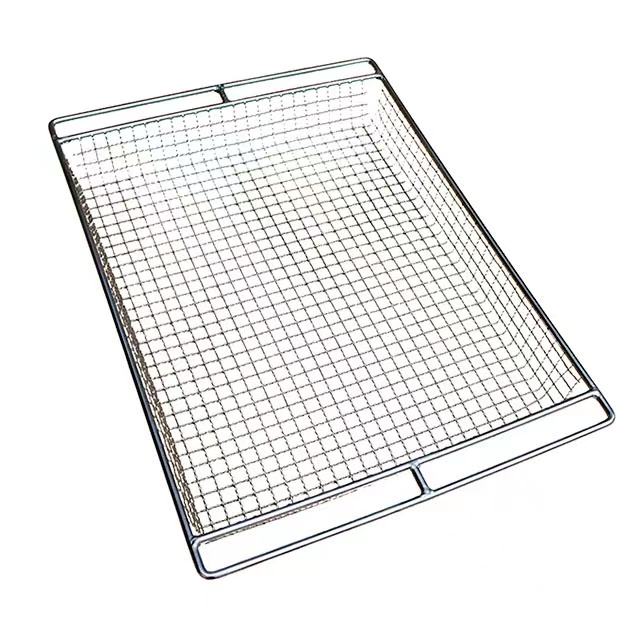
In drying applications, airflow is a performance requirement. A stainless steel drying tray with an open mesh pattern allows uniform air circulation, which reduces drying time and energy cost. In cleaning processes, the tray must drain quickly and withstand chemical exposure. In transportation, the tray must resist vibration and repeated impact without loosening at the joints.
Another engineering advantage is surface treatment consistency. Electropolishing, passivation, or mirror polishing can be specified depending on the application. For pharmaceutical and laboratory use, a smoother surface reduces particle retention. For heavy manufacturing, a brushed or pickled finish may be sufficient and more cost-effective. The manufacturer should be able to explain the trade-offs, not just quote a grade.
Application Scenarios
Different industries buy stainless steel trays for different reasons. A food processing plant may prioritize hygiene and corrosion resistance. A bakery may focus on heat distribution and stackability. An industrial manufacturer may need load capacity and resistance to cutting fluids. Understanding the application prevents over-specifying and reduces total cost.
Food processing: Trays are used for freezing, blanching, cooling, and transporting raw or cooked products. 304 stainless steel is common because it handles daily wash-down and food contact. 316 stainless steel is specified when products contain salt, brine, or acidic marinades.
Bakery and commercial baking: Stainless steel mesh trays allow heat and air to circulate around bread, pastries, and dough. The tray must resist repeated thermal cycling without warping. A commercial drying rack compatibility check is essential before ordering.
Industrial manufacturing: Trays carry small parts through degreasing, coating, and drying lines. The mesh opening must match part size to prevent fall-through. Load capacity is calculated based on the heaviest batch, not the average.
Pharmaceutical and laboratory: Trays are used for sterilizing, drying, and organizing instruments or samples. Surface finish and cleanability are critical. Documentation for material traceability may be required.
Storage and transportation: Stackable stainless steel trays protect components during internal logistics and export packing. Nesting design reduces return freight costs.
Cleaning processes: Trays used in parts washers must drain fast and resist detergents. Frame rigidity prevents deformation during high-pressure spraying.
In each case, the tray is part of a larger system. Buyers should confirm that the tray fits existing equipment before placing a bulk order. A small dimensional error can stop a production line.
Material Options and Manufacturing Details
Material selection is a commercial and technical decision. The lowest price per kilogram is rarely the lowest cost in use. 201 stainless steel offers lower corrosion resistance and is suitable for dry storage or light-duty applications where moisture exposure is limited. It is not recommended for frequent wash-down or food contact.
304 stainless steel provides reliable corrosion resistance for food contact applications and daily industrial cleaning environments. It is the default choice for food processing trays, bakery trays, and commercial drying racks. It handles most detergents and sanitizers used in food plants.
316 stainless steel adds molybdenum for improved resistance to chlorides and aggressive chemicals. It is specified for pharmaceutical, marine, and high-salt food applications. The cost is higher, but it reduces replacement frequency in harsh environments.
Aluminum trays are lightweight and offer good thermal conductivity, but they are softer and less corrosion-resistant than stainless steel. They may be suitable for baking where weight is a concern, but they are not ideal for caustic cleaning or heavy industrial handling.
Manufacturing details also affect performance. Wire diameter determines load capacity and mesh rigidity. Welding method affects joint strength and cleanability. Spot welding, seam welding, and argon arc welding each have appropriate applications. The supplier should match the welding process to the load and hygiene requirements. Surface treatment options include pickling, passivation, electropolishing, and mirror polishing. Each adds cost but solves a specific problem.
Specifications and Technical Parameters
Industrial buyers should confirm the following specifications before requesting a quotation. Without this information, suppliers will quote different products, and price comparisons become meaningless.
- Size: Length, width, and height. Available sizes can be customized according to equipment dimensions and production requirements.
- Thickness: Frame and wire thickness. Common ranges are 1.0 mm to 3.0 mm for frames, depending on load.
- Capacity: Maximum load per tray in kilograms. This should be stated for static and dynamic conditions.
- Weight loading: Uniform load versus point load. Point loads require additional reinforcement.
- Layers: Single-layer or multi-layer rack configurations.
- Mesh opening: The distance between wires. This determines airflow and part retention.
- Wire diameter: Thicker wire increases strength but reduces open area.
- Tray compatibility: Confirm fit with existing trolleys, racks, and conveyor systems.
- Surface treatment: Pickled, passivated, electropolished, or mirror polished.
- Production tolerance: Dimensional tolerance should be agreed in writing, typically ±1 mm to ±3 mm depending on size.
If a buyer cannot provide all specifications, the supplier should offer a specification worksheet. A professional industrial mesh tray supplier will ask about the working environment, cleaning method, load type, and equipment interface before quoting.
Custom OEM Manufacturing Service
Many buyers need more than a standard tray. They need a tray that fits a specific machine, carries a branded identity, or meets a unique hygiene standard. Custom OEM manufacturing covers:
- Custom size based on drawings or physical samples
- Custom design including frame reinforcement, mesh pattern, and stacking features
- Logo marking through laser etching or stamping
- Special packaging for retail, export, or automated unpacking
- Material selection with documented grade and traceability
- Prototype development before mass production
- Bulk production with consistent quality control
A capable OEM stainless steel tray manufacturer should provide a sample or prototype before full production. This reduces risk for both sides. The sample should be tested in the actual working environment, not just inspected visually. For custom requirements, please contact our team to discuss drawings, target quantities, and delivery schedules.
Purchasing Guide for Industrial Buyers
This section answers the practical questions that procurement teams face when sourcing stainless steel trays. The goal is to avoid costly mistakes and select a supplier that can deliver consistently.
How to choose the right size? Start with the equipment interface. Measure the rack, trolley, or conveyor opening. Add clearance for thermal expansion and handling. Confirm the maximum load and the load distribution. If the tray will be stacked, check the stacking height and nesting depth.
How to choose the material? Match the material to the environment. For dry storage, 201 may be acceptable. For food contact and daily washing, 304 is the standard. For salt, brine, or pharmaceutical cleaning, 316 is safer. Ask the supplier for a material recommendation based on your cleaning chemicals and operating temperature.
How to confirm specifications? Put everything in writing: dimensions, tolerances, wire diameter, mesh opening, surface finish, load capacity, and packaging. Request a sample or first-article inspection report. Do not rely on verbal agreements.
How to judge supplier capability? Look beyond the price list. Evaluate:
- Quality control procedures and inspection records
- Production capability including welding, forming, and surface treatment
- Export experience with your region and packaging requirements
- Packaging methods that prevent damage during ocean freight
- Delivery reliability with realistic lead times and communication
What to watch in bulk purchasing? Confirm the production tolerance for each batch. Ask how the supplier handles raw material variation. Review the packaging specification to avoid scratched or bent trays. Agree on a pre-shipment inspection process. For large orders, consider a third-party inspection. A supplier that welcomes inspection is usually more reliable than one that avoids it.
Another common issue is communication during tooling or prototype development. Buyers should provide clear drawings, photos, or samples. If a drawing is ambiguous, the supplier should ask questions before production, not after. This is a sign of a professional manufacturer.
FAQ
Q1: What stainless steel grade is recommended for food processing applications?
For most food processing applications, 304 stainless steel is the recommended grade. It offers reliable corrosion resistance for food contact and daily cleaning with common detergents and sanitizers. If the product contains salt, brine, or acidic marinades, or if the cleaning chemicals are aggressive, 316 stainless steel is a better choice. The final decision should be based on the specific food product, cleaning protocol, and operating temperature. Always confirm the grade with your supplier and request material certificates for traceability.
Q2: Can the tray size be customized?
Yes. Most industrial tray manufacturers offer custom sizes based on drawings, samples, or equipment dimensions. Customization includes length, width, height, frame thickness, mesh opening, and wire diameter. Buyers should provide accurate measurements and confirm the interface with existing racks or conveyors. A prototype or sample is recommended before bulk production to verify fit and performance. Custom sizes usually require a minimum order quantity and may affect lead time. Discuss your target dimensions and annual volume with the supplier early in the process.
Q3: Do you provide OEM manufacturing service?
Yes. OEM manufacturing includes custom design, logo marking, special packaging, material selection, and private labeling. The process typically starts with a drawing or sample, followed by a prototype, buyer approval, and bulk production. OEM service is suitable for importers, distributors, and industrial buyers who need a consistent product under their own brand or specification. A professional manufacturer will document the approved specification and maintain it across repeat orders. For custom requirements, contact the supplier with your drawings and target quantity.
Q4: What information should buyers provide before quotation?
Buyers should provide dimensions, material grade, surface finish, load capacity, mesh opening, wire diameter, quantity, and packaging requirements. If the tray must fit existing equipment, include a drawing or photo of the interface. Also state the working environment, cleaning method, and operating temperature. The more information provided, the more accurate the quotation. If some details are unknown, the supplier can offer recommendations. A specification worksheet helps standardize the inquiry and reduces back-and-forth communication.
Q5: How do you control product quality?
Quality control should cover incoming material inspection, dimensional checks during production, weld strength testing, surface finish inspection, and final pre-shipment inspection. Material certificates should be available for stainless steel grades. Production tolerance should be measured against the approved specification. Packaging should be inspected to prevent damage during transport. For bulk orders, a pre-shipment inspection report with photos or video is recommended. Buyers should ask about the supplier’s inspection equipment and record-keeping process before placing an order.
Q6: What is the typical lead time for bulk orders?
Lead time depends on the complexity of the tray, the material grade, the surface treatment, and the order quantity. Standard trays may ship in 15 to 30 days after deposit. Custom trays with new tooling or prototypes may require 30 to 45 days. Surface treatments such as electropolishing can add time. Buyers should confirm the lead time in writing and plan for ocean freight and customs clearance. For urgent projects, ask whether the supplier can prioritize production without compromising quality.
Q7: How should trays be packaged for export?
Export packaging should prevent scratching, bending, and moisture damage. Common methods include individual wrapping, foam or cardboard separators, edge protection, and sturdy wooden or plywood crates. For stacked trays, a rigid pallet or crate prevents deformation during transit. Buyers should specify whether retail packaging or bulk packaging is required. If the trays will be stored in a humid environment, add moisture barrier bags or desiccant. Confirm the packaging specification before production to avoid last-minute changes and additional costs.

