


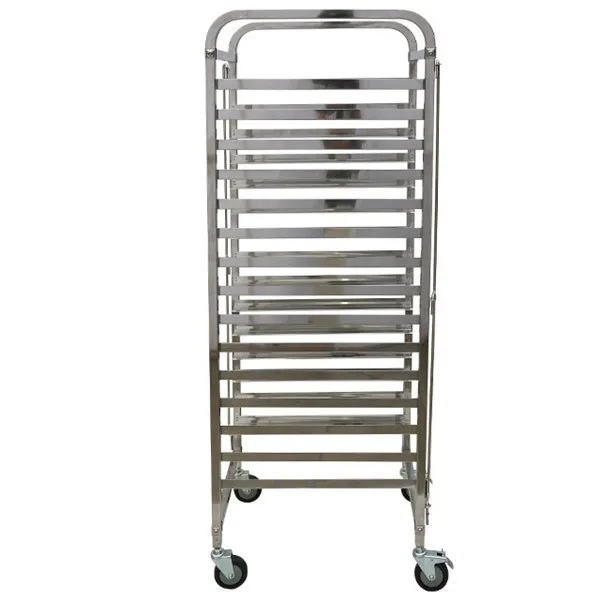
Stainless Steel Tray Trolley 600x400: The Complete B2B Procurement Guide for Industrial Buyers
Product Introduction: What Is a 600x400 Stainless Steel Tray Trolley?
A stainless steel tray trolley 600x400 is a mobile racking solution specifically engineered to hold standard 600mm x 400mm trays, commonly known as Euro norm trays or bakery trays. Unlike generic carts, these trolleys are designed with precise channel spacing and frame dimensions to ensure seamless loading and unloading of trays in high-demand industrial settings. The primary purpose is to facilitate the storage, transportation, drying, and cooling of products on trays, solving the problem of manual handling and reducing product damage. For procurement managers, investing in a dedicated tray trolley means optimizing workflow, minimizing labor costs, and ensuring compliance with hygiene standards. Whether you are in food processing, bakery, or pharmaceutical manufacturing, the right trolley design directly impacts operational efficiency.
Product Features: Structural Design and Material Advantages
Industrial tray trolleys are not simply frames with wheels. The design incorporates reinforced tubular frames and precision-formed tray slides to withstand repeated loading and dynamic forces during transport. Key features include:
- Reinforced frame structure: Typically constructed from 25mm or 30mm square tubes, the frame provides superior load stability, especially when moving over uneven floors or ramps.
- Adjustable tray slides: Welded or removable slides with precise pitch (e.g., 75mm, 100mm, or 150mm) allow for flexible tray configurations and easy cleaning.
- High-quality casters: Heavy-duty swivel casters with brakes, available in stainless steel or nylon, ensure smooth mobility and secure positioning.
- Corrosion resistance: The use of 304 or 316 stainless steel ensures resistance to moisture, cleaning agents, and food acids, extending service life in washdown environments.
These features are not merely conveniences; they are engineering responses to the rigors of industrial handling. For instance, the reinforced frame improves load stability during repeated transportation, reducing the risk of tray displacement and product spillage. The slide design minimizes friction, allowing operators to load and unload trays quickly without snagging.
Application Scenarios: Where 600x400 Tray Trolleys Excel
The 600x400 tray size is a global standard in many industries, and the trolley adapts to diverse applications:
- Food Processing: Transporting raw ingredients, intermediate products, or finished goods through processing lines. Stainless steel construction meets HACCP and FDA requirements.
- Bakery: Holding bread, pastry, or bun trays during proofing, baking, cooling, and display. The trolley's heat resistance and easy-clean design are critical.
- Industrial Manufacturing: Carrying components, small parts, or tools in assembly lines. Trolleys can be customized with dividers or lids for parts protection.
- Cleaning and Drying: Used in washrooms or drying rooms where trays need to be dried after washing. The open design promotes airflow and drainage.
- Storage and Transportation: As a mobile storage unit, the trolley maximizes floor space and can be rolled into trucks or containers for shipping.
In each scenario, the trolley must withstand specific challenges: chemical exposure, high temperatures, or heavy loads. Therefore, selecting the correct material and configuration is vital for long-term performance.
Material Specifications: Choosing the Right Stainless Steel
The material of construction significantly affects durability, cost, and compliance. Here is a comparison of common options:
- 304 Stainless Steel: The most common choice for food and general industrial applications. It offers excellent corrosion resistance, formability, and weldability. Suitable for most environments except high-chloride or highly acidic conditions.
- 316 Stainless Steel: Contains molybdenum, providing superior resistance to chlorides and acids. Ideal for pharmaceutical, chemical, and marine environments. Higher cost but longer life in harsh conditions.
- 201 Stainless Steel: A lower-cost alternative with lower nickel content. It offers moderate corrosion resistance and is suitable for dry or less demanding environments. Not recommended for frequent washdowns.
- Aluminum: Lightweight and corrosion-resistant (when coated), but less durable than stainless steel. Often used for light-duty or specialized applications where weight is a concern.
For B2B buyers, the choice hinges on the operating environment. If your facility uses aggressive cleaning chemicals or processes salty products, 316 is worth the investment. For general bakery or dry storage, 304 provides the best balance of cost and performance.
Specification Parameters: What to Look for in a Tray Trolley
When specifying a 600x400 tray trolley, consider these technical parameters:
- Dimensions: Overall length, width, and height. Standard trolleys accommodate 600x400 trays with internal width of at least 620mm to allow easy loading.
- Tube Thickness: Typically 1.2mm to 2.0mm. Thicker tubes increase load capacity but also weight.
- Capacity: Number of tray slides (e.g., 10, 15, 20, or custom). Slide pitch determines tray spacing.
- Load Capacity: Static and dynamic load ratings. A typical trolley can hold 100-300 kg, depending on design.
- Tray Slide Pitch: Distance between slides. Common pitches: 75mm, 100mm, 150mm. Choose based on product height and airflow needs.
- Surface Finish: Polished or brushed. Polished surfaces are easier to clean and more resistant to buildup.
- Caster Type: Swivel, fixed, with or without brakes. Material: stainless steel, nylon, or polyurethane.
These parameters should be clearly specified in purchase orders to avoid misalignment with existing trays.
Customization Services: OEM and ODM Capabilities
As a manufacturer with extensive OEM experience, we understand that standard products rarely fit every application. Our factory offers full customization:
- Custom Size: Adjust trolley dimensions to fit non-standard trays or space constraints.
- Custom Design: Modify frame structure, add handles, shelves, or drainage systems.
- Logo and Branding: Laser-etch or attach brand plates for corporate identity.
- Packing: Custom packaging for safe shipping, including palletizing and crating.
- Special Requirements: Explosion-proof casters, high-temperature wheels, or anti-static features.
For custom requirements, please contact our team to discuss your specifications. We provide rapid prototyping and production scalability.
Procurement Guide: How to Select the Right Trolley
Buying a tray trolley involves more than comparing prices. Consider these factors:
- How to choose size? Measure your existing trays and ensure the trolley's internal width allows 5-10mm clearance. Consider aisle widths and doorways for maneuverability.
- How to choose material? Assess the environment: humidity, chemicals, temperature. For washdown, choose 304 or 316. For dry storage, 201 may suffice.
- How to confirm specifications? Request a detailed drawing or sample. Check tube thickness, weld quality, and caster ratings. Ask for load test certificates.
- How to judge supplier capability? Evaluate their manufacturing experience, certifications (ISO, CE), and willingness to provide references. A factory audit can verify production standards.
We recommend ordering a sample or pilot batch to test performance before full-scale procurement.
Image ALT Text Suggestions
For product images, use descriptive ALT text such as: "Stainless steel tray trolley 600x400 with 15 slides for bakery use" or "304 stainless steel trolley for 600x400 trays in food processing." This improves SEO and accessibility.
Frequently Asked Questions (FAQ)
Q: What is the typical lead time for a custom stainless steel tray trolley?
A: Lead time varies based on complexity and order quantity. Standard models can ship in 2-3 weeks; custom designs may take 4-6 weeks after drawing approval.
Q: Can I mix tray sizes on one trolley?
A: Generally, no. The trolley is designed for a specific tray size. However, we can design adjustable slides or multi-size trolleys upon request.
Q: Are casters replaceable?
A: Yes, our casters are bolted or welded in a way that allows replacement. We also supply spare casters.
Q: What is the maximum load capacity?
A: It depends on the design. Standard trolleys handle 150-250 kg. Heavy-duty models can reach 500 kg with reinforced frames and casters.
Q: Do you provide samples?
A: Yes, we can provide samples for evaluation, though a sample fee and shipping cost may apply. The fee is often refundable upon bulk order.
Q: How do I clean and maintain the trolley?
A: Use mild detergent and water. Avoid abrasive cleaners that can scratch the surface. Regularly inspect casters and slides for wear.
Q: What certifications do you have?
A: Our factory is ISO 9001 certified, and products can be CE marked. We also provide material certificates for stainless steel.
Q: Can you produce trolleys for 600x400 trays with specific slide pitch?
A: Absolutely. We manufacture to your exact pitch requirements, whether 75mm, 100mm, or custom.
SEO Title
Stainless Steel Tray Trolley 600x400 | Industrial B2B Guide
Meta Description
Discover the best stainless steel tray trolley for 600x400 trays. B2B guide covers specifications, materials, customization, and procurement tips. Request a quote today.
SEO Keywords
stainless steel tray trolley 600x400, industrial tray trolley, 600x400 tray rack, stainless steel trolley manufacturer, bakery tray trolley, food processing trolley, custom tray trolley, OEM tray trolley, 304 stainless steel trolley, tray trolley supplier

