





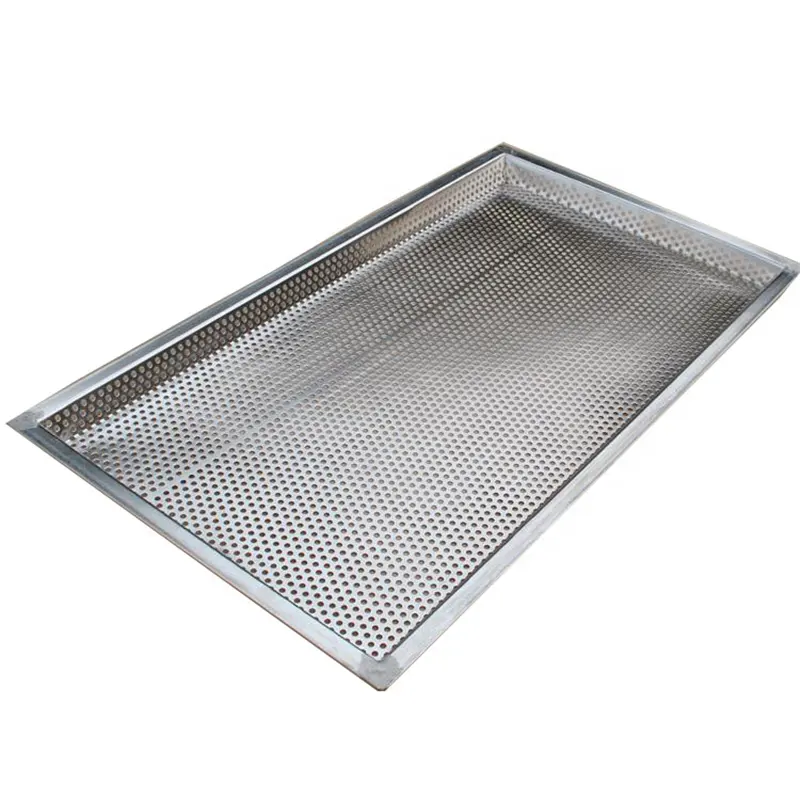
Stainless Steel Tray with Rolled Edges: Safety, Rigidity, and Performance Compared
Why Rolled Edges Matter on Stainless Steel Trays
In commercial kitchens, bakeries, and industrial food processing, the stainless steel tray with rolled edges is more than a simple container. The rolled edge—a continuous fold at the tray perimeter—transforms flat sheet metal into a safer, stiffer, and more ergonomic tool. Whether you are using a rolled edge baking tray for pastry production or a commercial stainless steel tray for sterilization, edge geometry directly affects daily operations.
The primary benefit of a rolled edge is edge safety. A sharp, unrolled edge can cut gloves, hands, or food packaging. By folding the metal back on itself, the tray eliminates razor-like contact points, reducing accidents in fast-paced environments. Additionally, the rolled rim acts as a structural rib, increasing the tray’s rigidity without adding extra material thickness. This is especially important for large-format trays that must resist bending under heavy loads.
Handling experience also improves: a rolled edge provides a smooth, rounded gripping surface that is comfortable to hold even with wet or greasy hands. It also prevents food debris from lodging in crevices, simplifying cleaning routines. Below, we break down the four main edge types and their trade-offs.
Edge Types Compared: Closed Roll, Open Roll, Reinforced, and Welded
Not all edges are created equal. The choice between a closed rolled edge, an open rolled edge, a reinforced (wire or rod) edge, and a welded edge impacts cleaning ease, liquid retention, manufacturing cost, and application suitability. Here is a technical comparison.
| Edge Type | Cleaning | Water Trapping | Manufacturing | Best For |
|---|---|---|---|---|
| Closed rolled edge | Excellent—seam is fully enclosed, no crevices | None—liquid cannot enter the sealed fold | Requires precision roll forming; moderate cost | Sanitary environments, food contact, medical use |
| Open rolled edge | Good—external surface smooth, but inner seam may collect residue | Possible if the gap is exposed; must be oriented downward | Simpler than closed, slightly lower cost | General bakery, light industrial, where frequent sanitation is not critical |
| Reinforced (wire) edge | Moderate—wire may have gaps at corners | Low—wire displaces water, but seams may trap moisture | Adds a stainless wire or rod for extra rigidity | Heavy loads, large pans, commercial ovens |
| Welded edge | Variable—depends on weld finish; can have pits | Low if fully fused, but weld spatter can create traps | Labor-intensive, requires polishing to restore corrosion resistance | Custom sizes, high-strength needs, permanent installations |
For sanitary applications, closed rolled edges are the gold standard. They prevent moisture and bacteria from hiding in tiny gaps. Open rolled edges are more economical, but you must ensure the tray is positioned so the open seam faces downward during draining. Reinforced edges, commonly seen on reinforced sheet pan, add durability for heavy-duty use, yet they may require more careful hand washing to avoid residue buildup around the wire. Welded edges offer the highest strength but demand skilled fabrication to avoid corrosion at the weld joint.
Closed Roll vs. Open Roll: What You Need to Know
The closed rolled edge is formed by folding the metal edge completely back until it touches the tray body, creating a hollow, sealed tube-like rim. This design leaves no exposed seam, making it exceptionally hygienic. In contrast, an open rolled edge has a small gap where the folded metal does not fully touch the tray surface. This gap can trap food particles and water, increasing the risk of bacterial growth if not thoroughly dried.
From a manufacturing perspective, closed edges require a more complex rolling process and tighter tolerances, which slightly raises the price. However, for businesses that prioritize food safety and easy cleaning, the extra cost is justified. Open rolled edges are faster to produce and can be a budget-friendly option for non-critical tasks like transporting dry goods.
When selecting between the two, consider your cleaning method. Commercial dishwashers with high-pressure spray can force water into an open seam. Over time, this may lead to rust or delamination of the metal layers. A closed edge, on the other hand, withstands repeated wash cycles without issue.
Reinforced and Welded Edges for Heavy-Duty Use
For heavy loads or oversized trays, a reinforced sheet pan with a wire or rod inserted into the fold provides extra stiffness. The added metal increases the moment of inertia, reducing flex when the tray is fully loaded. This is beneficial in ovens where trays must slide in and out of racks without warping. Similarly, welded edges—where an additional flat bar is welded onto the perimeter—offer maximum rigidity, but they are more expensive and require careful finishing to avoid crevice corrosion.
In commercial settings, such as a commercial stainless steel tray used for curing meats or storing heavy components, a reinforced edge is often the best compromise. It prolongs the tray’s life and maintains flatness, which improves heat distribution in ovens and prevents uneven baking.
Practical Buying Insights for Commercial Trays
When purchasing a stainless steel tray with rolled edges, consider the following:
•Material grade: 304 stainless steel is standard for food contact; 316 offers higher corrosion resistance for saline or acidic environments.
•Edge type: Choose closed roll for hygiene; reinforced for heavy loads.
•Size and thickness: Thicker metal (1.0 mm or more) adds rigidity but increases weight. Standard sizes like 600×400 mm fit most ovens and racks.
•Finish: A #4 brushed finish hides scratches, while a mirror finish is easier to clean but shows fingerprints.
Always ask suppliers for samples and test the edge smoothness with a gloved hand. Confirm that the rolling process does not leave any sharp burrs at the corners. For custom dimensions, verify that the manufacturer can maintain the rolled edge’s integrity across the entire perimeter.
FAQ
A plain edge is a straight cut with sharp corners, whereas a rolled edge is folded back to create a rounded, smooth rim. Rolled edges are safer and more rigid, while plain edges are cheaper but pose a higher injury risk.
Minor dents can be hammered out, but a severely deformed rolled edge may require professional re-rolling. For commercial use, it is often more cost-effective to replace the tray.
Yes, especially closed rolled edges. Open rolled edges can trap water, so ensure they are thoroughly dried or choose closed edges for dishwasher-safe operation.
No, the rolled edge itself does not significantly alter heat conduction. However, a reinforced edge may add slight weight but does not impact baking performance.
Most manufacturers offer standard sizes in stock. Custom orders usually take 2-4 weeks depending on quantity and edge type.What is the difference between a rolled edge and a plain edge on a stainless steel tray?Can rolled edges be repaired if damaged?Are rolled edge trays safe for use in dishwashers?Do rolled edges affect heat transfer in baking?What is the typical lead time for custom rolled edge trays?