


Stainless Steel Trolley Corrosion Resistance: A B2B Buyer’s Guide for Industrial Applications
Product Introduction: What Is a Stainless Steel Trolley and Why Corrosion Resistance Matters
In industrial material handling, a stainless steel trolley is a wheeled platform or cage cart engineered to transport parts, ingredients, or finished goods across production, storage, and cleaning zones. Unlike standard painted steel carts, stainless steel trolleys are specified for corrosion resistance because they frequently encounter moisture, steam, chemicals, and frequent washdowns. For B2B buyers, the key question is not simply “is it stainless?” but “which grade and construction will survive our specific environment without contaminating products or failing prematurely?”
As a manufacturer with over 15 years of experience supplying OEM stainless steel trolleys to food, pharmaceutical, and heavy industry clients, we’ve seen that corrosion resistance directly impacts hygiene compliance, maintenance intervals, and replacement costs. A trolley that rusts at weld points or under fasteners can introduce contamination risks and unplanned downtime. This article provides a procurement-focused framework covering materials, design features, specifications, customization, and supplier evaluation.
Product Features: Design and Material Advantages That Enhance Corrosion Resistance
Corrosion resistance in a stainless steel trolley is not solely about the metal grade—it’s a system of design decisions. The following features are critical for industrial buyers to verify:
- Reinforced frame structure improves load stability during repeated transportation and reduces flexing that can crack passive oxide layers.
- Fully welded or sealed tube ends prevent moisture ingress into hollow sections, which is a common hidden corrosion site.
- Polished or passivated surfaces minimize crevices where chlorides and organic soils accumulate.
- Stainless steel fasteners and casters avoid galvanic corrosion between dissimilar metals.
- Open or perforated deck designs allow drainage and airflow, reducing standing water and chemical retention.
From a manufacturing perspective, we use laser-cut components and jig-welded frames to ensure consistent fit-up. This reduces weld porosity and heat-affected zones that are prone to rust. For high-corrosion environments, we also offer electropolishing as a post-weld treatment, which removes surface iron contamination and enhances the chromium oxide layer.
Application Scenarios: Where Corrosion-Resistant Trolleys Are Essential
Different industries impose different corrosion challenges. Understanding your application is the first step in selecting the right trolley specification.
Food Processing and Bakery
In food processing, trolleys face high-pressure washdown, acidic food residues, and caustic cleaning agents. A standard 201 stainless steel may show rust within months. We recommend 304 or 316 stainless steel with smooth, crevice-free surfaces. For bakery applications, trolleys often move through proofers, ovens, and freezers—temperature cycling can cause condensation inside tubes, so sealed or vented designs must be chosen carefully. Our bakery clients typically specify perforated trays or wire mesh decks for airflow and crumb drainage.
Industrial Manufacturing and Cleaning
In metalworking or chemical plants, trolleys may be exposed to coolants, cutting fluids, and solvents. 316 stainless steel is often required when chlorides are present. For cleaning departments, trolleys are frequently steam-cleaned or immersed in alkaline baths. Here, fully welded tubular frames with no open ends are essential to prevent internal corrosion. We also offer polyurethane or nylon wheels that resist water and chemicals better than rubber.
Drying, Storage, and Transportation
In drying rooms, trolleys hold parts or products at elevated temperatures and humidity. 201 stainless steel may suffice for low-humidity storage, but for condensation-prone drying, 304 is the minimum. For transportation between buildings, reinforced casters and a load-rated frame prevent deformation that can lead to coating damage. In cold storage, we recommend stainless steel bearings to avoid grease washout.
Material Selection: 304 vs. 316 vs. 201 vs. Aluminum
Choosing the wrong material is the most common and costly procurement mistake. Here is a practical comparison based on our production data and field returns:
- 304 stainless steel: The industry standard for food, dairy, and general wet environments. Good resistance to organic acids and moderate chlorides. Not recommended for high-chloride or high-salt exposure.
- 316 stainless steel: Contains molybdenum for superior pitting resistance. Specified for pharmaceutical, chemical, and coastal applications. Typically 20–30% more expensive than 304, but often pays back through longer service life.
- 201 stainless steel: Lower nickel and higher manganese. Acceptable for dry storage or light-duty indoor use. Not recommended for washdown or chemical exposure—we have seen rust bleeding within 6–12 months in food plants.
- Aluminum: Lightweight and naturally corrosion-resistant via oxide layer, but not suitable for caustic cleaning (aluminum dissolves in strong alkaline solutions). Also lower load capacity than stainless steel.
For B2B buyers, always request mill test certificates for the stainless steel grade. Some suppliers substitute 201 for 304 without disclosure. We provide full traceability from steel mill to finished trolley.
Specification Parameters: What to Confirm Before Ordering
Industrial buyers should verify the following parameters in a quotation. Vague specs lead to disputes and downtime.
- Dimensions: Overall length, width, height, and deck height. Also confirm wheel diameter and swivel radius for aisle clearance.
- Thickness: Tube wall thickness (e.g., 1.2 mm, 1.5 mm, 2.0 mm) and sheet metal gauge (e.g., 18 gauge, 16 gauge). Thinner material may meet load rating but dent easily.
- Capacity: Static and dynamic load ratings. Dynamic should be at least 25% of static for repeated movement.
- Number of shelves: 1 to 5 tiers. Confirm spacing and adjustability.
- Load capacity per shelf: Uniformly distributed load. Point loading reduces capacity.
- Hole size and mesh: For perforated decks, specify hole diameter and pitch. For wire mesh, specify wire diameter and opening.
- Tray compatibility: If used with standard bakery trays or Euro containers, confirm external dimensions match.
- Surface treatment: Polished (mirror or satin), electropolished, or passivated. Specify Ra value for hygienic applications.
We recommend requesting a dimensional drawing and load test report before production. Our engineering team provides these as standard for OEM orders.
Customization Services: OEM and ODM Capabilities
As a manufacturer, we support full customization for B2B clients. Our in-house capabilities include:
- Custom size and design: From 500 mm to 2000 mm length, with adjustable shelves or fixed tiers.
- Logo and branding: Laser-etched or stamped logos on frames or nameplates.
- Packing: Custom crates, pallets, or carton marking for container loading.
- Special requirements: Static-dissipative casters, high-temperature wheels, locking brakes, and anti-microbial coatings.
We handle small trial orders and scale to full container loads. For custom requirements, please contact our team with your drawings or application details. We respond within 24 hours with a technical proposal.
Procurement Guide: How to Choose the Right Trolley and Supplier
Based on our experience with hundreds of industrial buyers, here are the critical questions to ask:
- How to choose size? Map your aisle widths, door openings, and turning radius. Add 100 mm clearance. Consider future product sizes.
- How to choose material? Match to cleaning chemicals and environment. If you use chlorinated foaming cleaners, specify 316. If dry storage, 201 may suffice.
- How to confirm specifications? Request a detailed drawing with tolerances, material certs, and load test data. Do not accept “standard” without numbers.
- How to judge supplier capability? Ask for factory audit reports, photos of production lines, and references from similar industries. Check if they weld in-house or outsource.
We also recommend a pilot order before full commitment. A single trolley tested in your worst-case environment reveals more than a catalog.
Frequently Asked Questions (FAQ)
Q1: What is the difference between 304 and 316 stainless steel for trolley corrosion resistance?
316 contains 2–3% molybdenum, which significantly improves resistance to chlorides and pitting. For food plants using salty products or chemical cleaners, 316 is worth the premium. For general wet areas, 304 is sufficient.
Q2: Can 201 stainless steel be used in a food processing plant?
We do not recommend it. 201 has lower nickel and higher manganese, making it prone to rust in washdown and acidic environments. It may pass initial inspection but often fails within a year, leading to contamination risks.
Q3: How do I prevent rust at weld joints on a stainless steel trolley?
Specify fully welded and passivated joints. Passivation removes free iron from the weld zone and restores the chromium oxide layer. Also avoid crevices by using continuous welds rather than spot welds.
Q4: What surface finish is best for corrosion resistance?
A satin or electropolished finish is ideal. Mirror polish looks nice but can have micro-scratches that trap contaminants. Electropolishing improves the chromium-to-iron ratio and is common in pharmaceutical applications.
Q5: Are stainless steel casters necessary?
Yes, for wet or chemical environments. Carbon steel casters will rust and seize. We recommend stainless steel brackets with polyurethane or nylon wheels for most industrial washdown areas.
Q6: What is the typical lead time for custom stainless steel trolleys?
For OEM orders, lead time is 20–35 days after drawing approval, depending on quantity and material availability. We keep 304 and 316 sheet and tube in stock for fast turnaround.
Q7: Can you provide load test certificates?
Yes. Every custom order includes a load test report with static and dynamic testing. We also provide material certificates and dimensional inspection reports.
Q8: How do I clean a stainless steel trolley without damaging it?
Use passivated-safe alkaline or neutral cleaners. Avoid hydrochloric acid or bleach-based products on 304. Rinse with clean water and dry. For 316, occasional nitric acid passivation can extend life.
Image ALT Text Suggestions
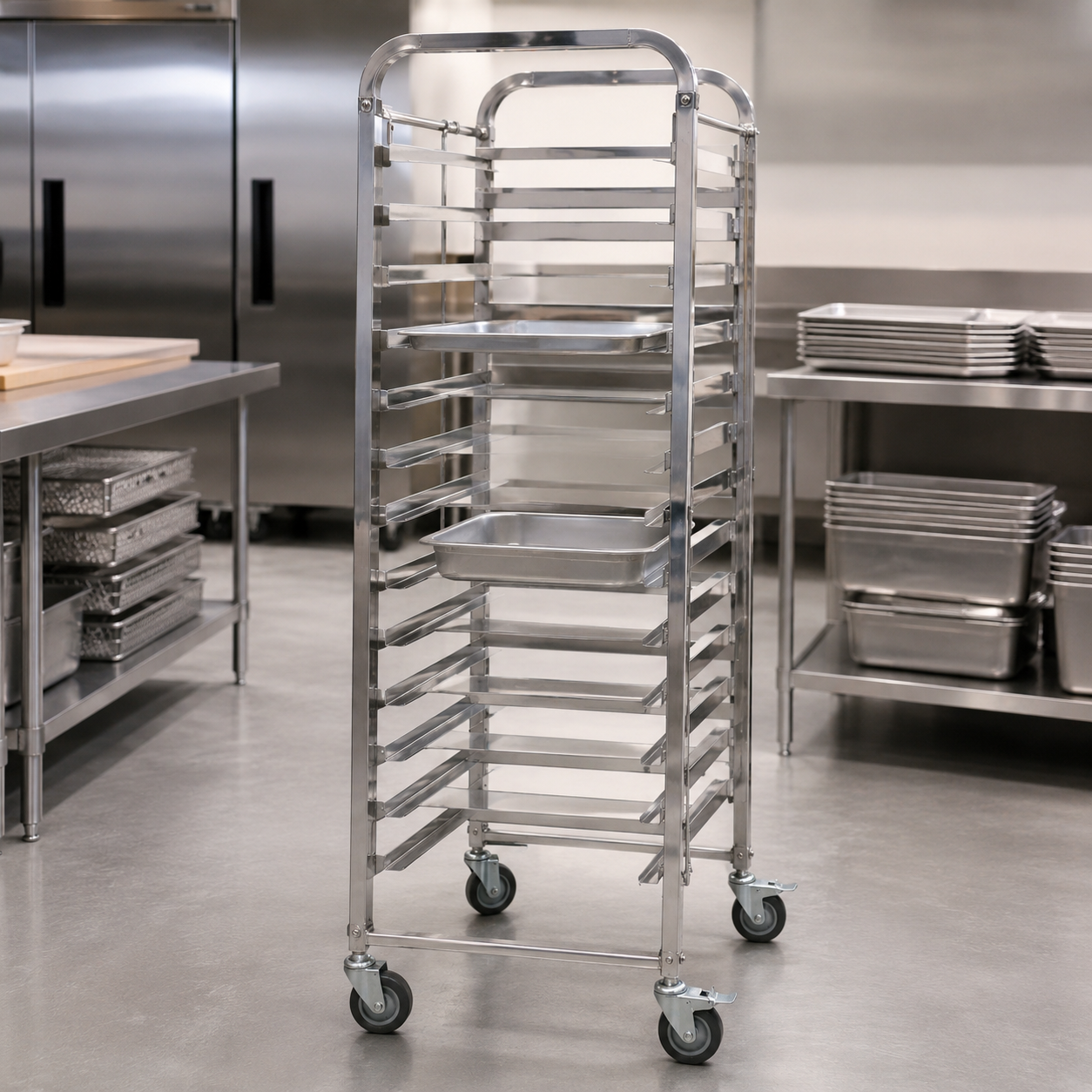
Image 1: “Stainless steel trolley with reinforced frame and perforated shelves for food processing corrosion resistance”
Image 2: “316 stainless steel trolley with electropolished surface in pharmaceutical washdown area”
Image 3: “OEM stainless steel trolley manufacturer welding tubular frame for industrial use”
SEO Meta Information
SEO Title: Stainless Steel Trolley Corrosion Resistance | B2B Industrial Guide
Meta Description: Learn how to choose corrosion-resistant stainless steel trolleys for food, pharma, and industrial use. Compare 304 vs 316, specs, and supplier tips.
SEO Keywords: stainless steel trolley corrosion resistance, industrial stainless steel trolley, 304 vs 316 stainless steel cart, corrosion resistant trolley manufacturer, food grade stainless steel trolley, stainless steel trolley supplier, custom stainless steel trolley OEM, stainless steel trolley specifications, stainless steel trolley for washdown, stainless steel trolley load capacity

