


Stainless Steel Trolley for Food Industry: A Comprehensive Sourcing Guide for B2B Buyers
Product Introduction: What Is a Stainless Steel Trolley for the Food Industry?
A stainless steel trolley for food industry is a wheeled platform or cart designed to transport food products, ingredients, or equipment within processing plants, bakeries, and other food-related facilities. Unlike generic carts, these trolleys are engineered to meet strict hygiene standards, resist corrosion from frequent cleaning, and withstand heavy loads in demanding environments. They solve critical problems such as cross-contamination, inefficient manual handling, and premature equipment failure due to moisture and chemicals. Whether you're moving raw ingredients, baked goods, or packaged products, a properly specified trolley enhances workflow and compliance.
Product Features: Design and Performance for Industrial Use
Industrial food trolleys are built with features that directly address operational challenges. The reinforced frame structure improves load stability during repeated transportation, reducing the risk of tipping or deformation under heavy loads. 304 stainless steel construction offers excellent corrosion resistance, essential for washdown environments. Welded joints are ground smooth to eliminate crevices where bacteria can harbor, meeting FDA and EU hygiene regulations. Swivel casters with brakes provide maneuverability and safety on wet floors. Optional features like removable shelves or mesh panels facilitate easy cleaning and air circulation for drying. These design choices are not arbitrary; they are validated through years of field experience in food plants where downtime is costly.
Application Scenarios: Where Stainless Steel Trolleys Excel
Stainless steel trolleys are indispensable across various food industry segments:
- Food Processing: Transporting raw materials, work-in-progress, and finished products between processing stations. Trolleys with solid shelves prevent spillage, while mesh versions allow airflow for cooling.
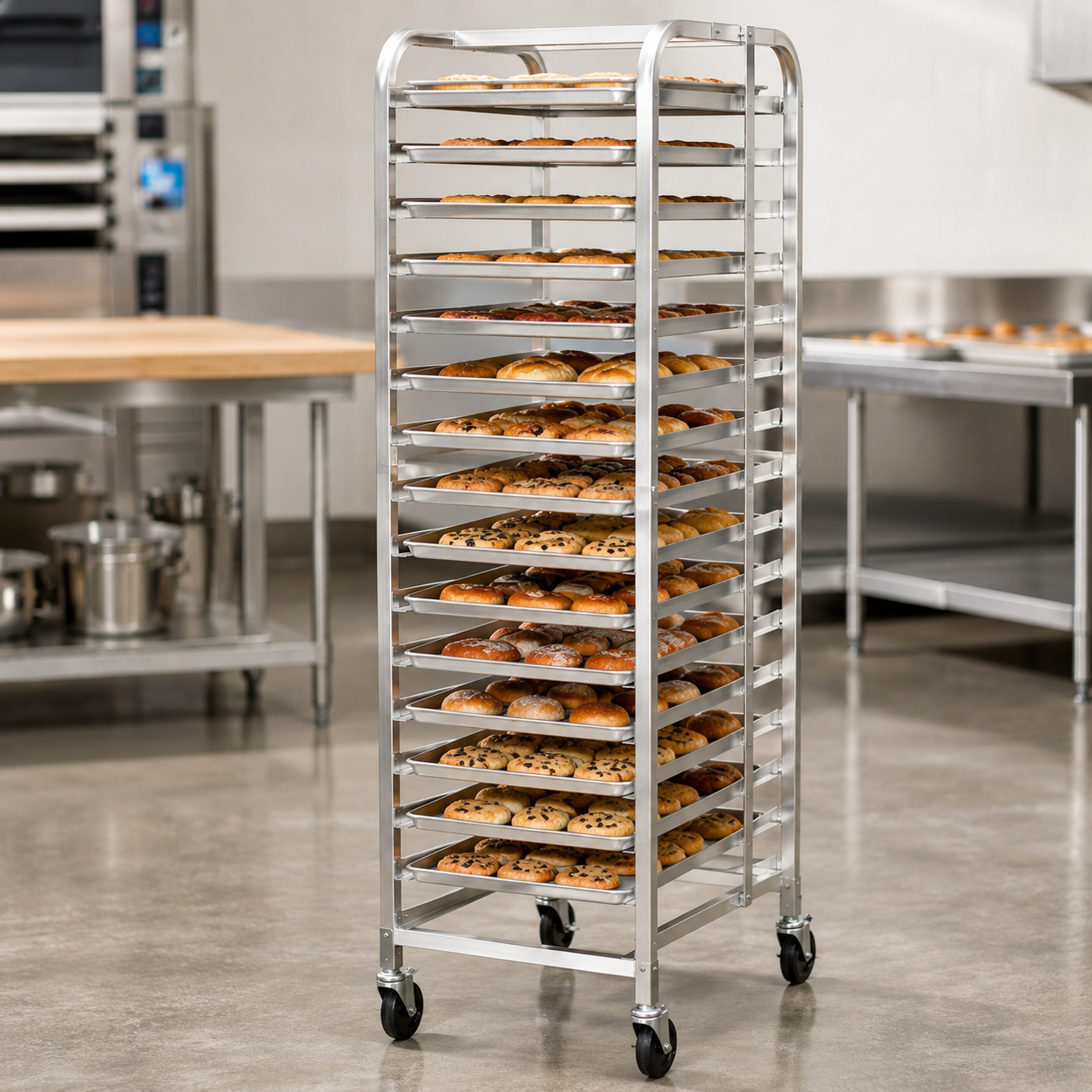
- Bakery: Moving dough, baked goods, and proofing trays. Trolleys compatible with standard bakery rack sizes streamline operations.
- Industrial Manufacturing: In facilities producing packaged foods, trolleys move ingredients and packaging materials. Heavy-duty models handle loads up to 500 kg.
- Cleaning and Drying: Trolleys with perforated shelves or mesh are ideal for draining and drying utensils, containers, or parts after washing.
- Storage and Transportation: Mobile storage solutions reduce double-handling and improve space utilization in cold rooms and warehouses.
In each scenario, the trolley's design must align with specific needs: for example, a bakery may require tray compatibility with 18" x 26" sheet pans, while a meat processor might need stainless steel 316 for chloride resistance.
Material Selection: 304, 316, 201 Stainless Steel, and Aluminum
The choice of material significantly impacts durability, cost, and compliance. Here's a breakdown:
- 304 Stainless Steel: The industry standard for food contact. Offers good corrosion resistance against most acids and alkalis. Suitable for general food processing and washdown areas.
- 316 Stainless Steel: Contains molybdenum, providing superior resistance to chlorides and harsh chemicals. Recommended for meat and seafood processing, where salt and cleaning agents are prevalent.
- 201 Stainless Steel: A lower-cost alternative with lower nickel content. It offers moderate corrosion resistance and is suitable for dry or less corrosive environments, but may rust in frequent wet conditions.
- Aluminum: Lightweight and economical but prone to oxidation and not as durable under heavy loads or aggressive cleaning. Generally not recommended for direct food contact unless coated.
From a procurement perspective, specifying the right material prevents premature failure. For example, a 201 trolley in a seafood plant may rust within months, leading to replacement costs and contamination risks. Always verify material certificates from the supplier.
Specifications: Key Parameters for Procurement
When sourcing stainless steel trolleys, these specifications matter:
- Dimensions: Length, width, and height must fit through doorways, aisles, and around equipment. Custom sizes are often required.
- Thickness: Typically 1.0mm to 2.0mm for shelves and frames. Thicker gauges (e.g., 1.5mm) offer better load capacity and durability.
- Capacity/Load Rating: Static and dynamic load capacities. Industrial trolleys range from 100 kg to 500 kg or more.
- Number of Shelves: Single, double, or multi-tier. Consider workflow and storage needs.
- Mesh/Perforation: Aperture size (e.g., 10mm x 10mm) affects airflow and small-item retention.
- Tray Compatibility: For bakeries, ensure shelf spacing matches standard tray heights.
- Surface Finish: Polished or brushed. Polished surfaces are easier to clean but may show scratches; brushed hides wear better.
- Caster Type: Swivel, rigid, with brakes. Wheel material (e.g., polyurethane) impacts floor protection and noise.
Provide these specs to suppliers for accurate quotes. A reputable manufacturer will offer a detailed spec sheet and may suggest optimizations based on your application.
Customization Services: OEM/ODM Capabilities
Off-the-shelf trolleys may not fit unique workflows. A capable manufacturer offers OEM and ODM services, including:
- Custom Size: Tailored dimensions to fit specific spaces or equipment.
- Custom Design: Modifications like additional shelves, hooks, or special casters.
- Logo and Branding: Laser-etched or printed logos for asset tracking.
- Packing: Custom packaging for safe transport and storage.
- Special Requirements: E.g., static-dissipative casters for explosive environments, or extra reinforcement for heavy loads.
When evaluating a supplier's customization capability, ask for past project examples and lead times. A factory with in-house design and production ensures consistent quality and faster turnaround. For custom requirements, please contact our team to discuss your project.
Procurement Guide: How to Choose and Vet Suppliers
Buying stainless steel trolleys for the food industry involves several considerations:
- How to choose the right size? Map your transport routes and door widths. Consider future needs—slightly larger may offer flexibility.
- How to select material? Match to your cleaning chemicals and environment. 304 for general use, 316 for corrosive, 201 for dry areas.
- How to confirm specifications? Request a detailed drawing and material certificate. Third-party inspection is advisable for large orders.
- How to judge supplier capability? Look for ISO 9001 certification, years in business, and client references. A factory audit can verify production capacity and quality control.
Also, consider total cost of ownership: a cheaper trolley that fails early costs more in downtime and replacement. Trustworthy suppliers provide warranties and responsive after-sales support.
Image ALT Text Suggestions
For product images, use descriptive ALT text like: "Stainless steel trolley with mesh shelves for food processing" or "Heavy-duty 304 stainless steel cart with swivel casters for bakery use." This improves SEO and accessibility.
SEO Meta Information
SEO Title: Stainless Steel Trolley for Food Industry | B2B Sourcing Guide
Meta Description: Discover stainless steel trolley solutions for food industry. Learn about materials, specs, customization, and supplier selection. Optimize your procurement.
SEO Keywords: stainless steel trolley for food industry, food grade trolley, stainless steel cart manufacturer, industrial food trolley, hygienic transport cart, 304 stainless steel trolley, custom food trolley, bakery trolley, food processing trolley, stainless steel trolley supplier.
Frequently Asked Questions (FAQ)
Q1: What is the difference between 304 and 316 stainless steel for food trolleys?
A1: 304 offers good corrosion resistance for general food environments, while 316 contains molybdenum for superior resistance to chlorides and harsh chemicals, making it ideal for meat and seafood processing.
Q2: Can I customize the size and shelf configuration?
A2: Yes, most manufacturers offer OEM/ODM services. Provide your required dimensions, number of shelves, and load capacity for a tailored solution.
Q3: What load capacity can stainless steel trolleys handle?
A3: Capacities range from 100 kg to over 500 kg, depending on design and caster quality. Always specify dynamic load requirements.
Q4: Are these trolleys suitable for washdown areas?
A4: Yes, 304 and 316 stainless steel trolleys with welded, smooth joints are designed for washdown. Avoid 201 or aluminum in frequent wet conditions.
Q5: How do I ensure the trolley meets food safety standards?
A5: Look for FDA-compliant materials, smooth surfaces without crevices, and certifications like NSF. Request material certificates and hygiene test reports.
Q6: What is the typical lead time for custom orders?
A6: Lead times vary by complexity and order volume. For custom designs, expect 4-8 weeks after sample approval. Confirm with your supplier.
Q7: Do you provide samples for evaluation?
A7: Many manufacturers offer samples for a fee, which is often credited toward bulk orders. Evaluate sample quality and craftsmanship before committing.
Q8: How should I maintain stainless steel trolleys?
A8: Regular cleaning with mild detergent and warm water, followed by drying, prevents corrosion. Avoid abrasive cleaners that can scratch the surface.

