


Stainless Steel Trolley Maintenance: A B2B Procurement Guide for Food Equipment Carts
Product Introduction: What Is a Stainless Steel Trolley for Food Equipment?
A stainless steel trolley for food equipment is a wheeled platform designed to transport, store, and handle food products, ingredients, or processing tools in hygienic environments. It solves critical problems in food processing plants, bakeries, and industrial kitchens: cross-contamination, manual handling injuries, and inefficient workflow. Typically constructed from 304 or 316 stainless steel, these trolleys withstand frequent washdowns, chemical sanitizers, and heavy loads. Unlike generic carts, food-grade trolleys feature smooth, crevice-free surfaces and optional drainage systems. For procurement managers, investing in the right trolley means fewer replacements, lower downtime, and easier compliance with FDA and EU food safety regulations. Proper stainless steel trolley maintenance extends service life by 5–10 years, making it a cost-effective asset for any B2B operation.
Product Features: Structural Design, Material Advantages, and Performance
Industrial food trolleys are engineered for repeated high-pressure cleaning and heavy-duty cycles. Key features include:
- Reinforced frame structure with cross-bracing or gusseted corners improves load stability during repeated transportation and industrial handling, preventing racking or twisting under uneven loads.
- Full-welded or riveted construction eliminates crevices where bacteria can harbor, meeting NSF/ANSI 2 standards for food equipment.
- Optional perforated or mesh shelves allow airflow for drying or drainage, reducing moisture buildup that accelerates corrosion.
- Heavy-duty casters (polyurethane, nylon, or stainless steel) with sealed bearings resist water, grease, and chemicals, ensuring smooth rolling on wet or uneven floors.
- Ergonomic push handles with non-slip grips reduce operator fatigue during long shifts.
Material selection directly impacts performance. 304 stainless steel offers excellent corrosion resistance for most food environments. 316 stainless steel includes molybdenum for superior resistance to chlorides and acids—ideal for seafood processing or brine applications. 201 stainless steel is a lower-cost alternative with moderate corrosion resistance, suitable for dry storage or light-duty use. Aluminum trolleys are lightweight and rust-resistant but cannot withstand aggressive sanitizers like chlorine. For B2B buyers, specifying 304 or 316 ensures compliance and longevity; 201 or aluminum may reduce upfront cost but increase replacement frequency in wet or chemical-heavy settings.
Application Scenarios: Where Stainless Steel Trolleys Deliver Value
Different industries demand tailored trolley configurations. Below are common applications and their procurement considerations:
- Food Processing: Transporting raw meat, poultry, or vegetables between prep and packaging lines. Trolleys must withstand daily high-pressure washdowns with caustic foams. 316 stainless steel with perforated shelves and drainage channels is preferred. Case: A poultry plant reduced bacterial swab failures by 40% after switching to fully welded 316 trolleys with removable shelves for deep cleaning.
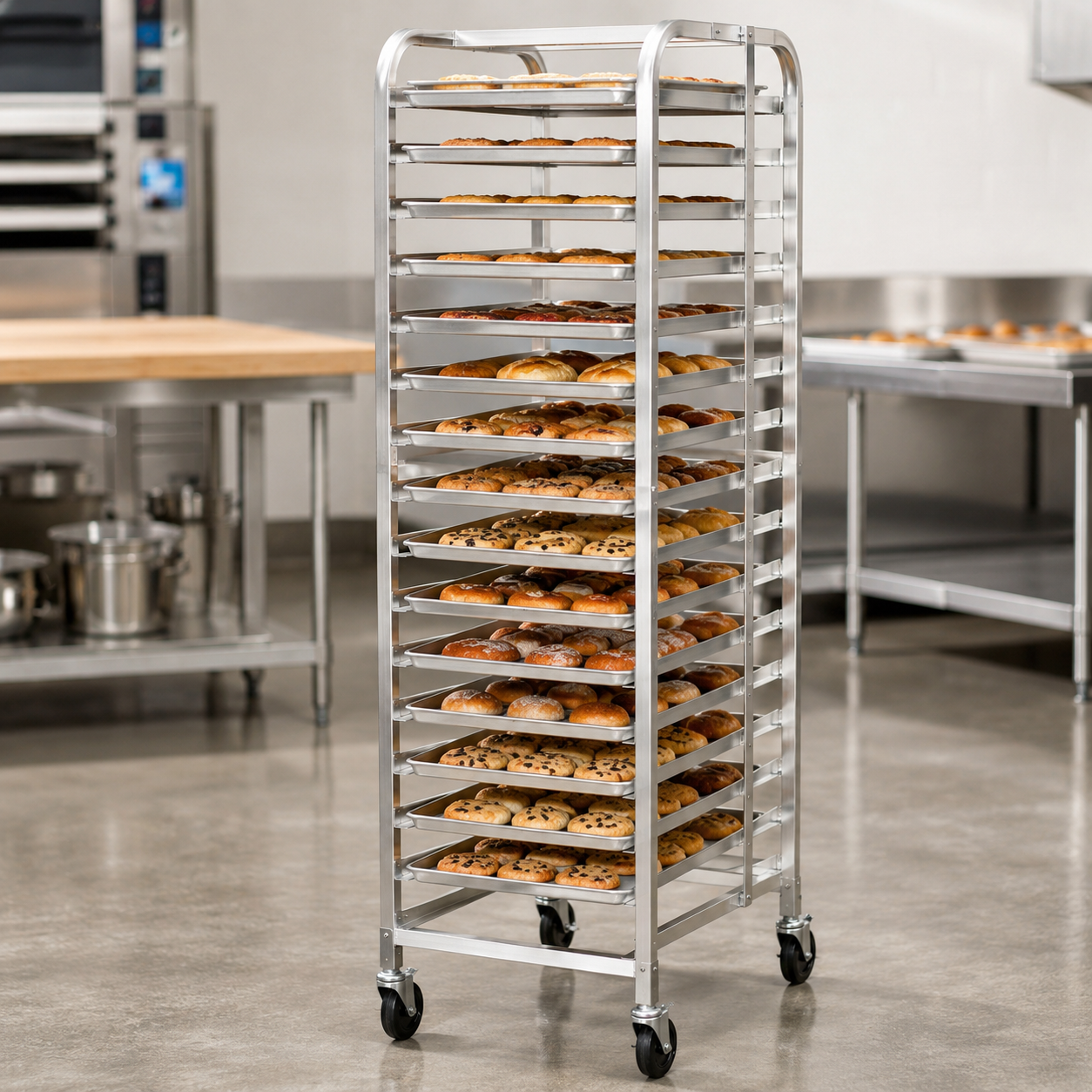
- Bakery: Moving dough troughs, baked goods, or cooling racks. Trolleys often face flour dust and sugar syrups that can clog casters. Choose models with sealed bearings and easy-to-remove wheels for cleaning. Mesh shelves prevent crumb accumulation.
- Industrial Manufacturing: Hauling heavy molds, tools, or components in food-grade environments (e.g., pharmaceutical or nutraceutical). Reinforced frames with load capacities up to 1,200 lbs are essential. Static-dissipative casters may be required in explosive atmospheres.
- Cleaning and Sanitation: Dedicated trolleys for mops, buckets, and chemicals. Use 304 stainless steel with solid shelves and a lower drainage spout. Avoid aluminum due to caustic corrosion.
- Drying and Storage: Air-drying racks for trays, utensils, or parts. Perforated or wire mesh shelves with 1/2-inch openings maximize airflow. Stackable or nesting designs save floor space.
- Transportation: Moving goods between buildings or loading docks. Trolleys need large-diameter casters (6–8 inches) for threshold negotiation, plus brakes for safety on ramps.
Each scenario dictates specific features. For B2B procurement, always request test reports for load capacity and corrosion resistance under your actual operating conditions.
Material Specifications: 304 vs. 316 vs. 201 vs. Aluminum
Choosing the right material is a critical procurement decision. The table below summarizes key differences for food equipment trolleys:
- 304 Stainless Steel: 18% chromium, 8% nickel. Excellent general corrosion resistance, easy to weld and form. Food-grade standard. Best for most wet, acidic, or alkaline environments. Cost: moderate.
- 316 Stainless Steel: Adds 2–3% molybdenum. Superior resistance to chlorides, seawater, and high-salt foods. Required for seafood, dairy with brine, and chemical sanitizers. Cost: 20–30% higher than 304.
- 201 Stainless Steel: Lower nickel and higher manganese. Moderate corrosion resistance. Suitable for dry storage or occasional moisture. Not recommended for daily washdown or acidic foods. Cost: 15–20% lower than 304.
- Aluminum: Lightweight, naturally corrosion-resistant but not stainless. Reacts with alkaline cleaners. Best for dry storage or light-duty transport. Not NSF-approved for direct food contact. Cost: lowest.
For B2B buyers, always request mill test certificates (MTCs) to verify material composition. A reputable manufacturer will provide traceability from steel mill to finished trolley.
Specification Parameters: What to Specify in a Purchase Order
When sourcing stainless steel trolleys, these parameters ensure you receive the right product:
- Dimensions: Overall length, width, height (custom from 24” x 36” to 48” x 96”). Shelf size and spacing.
- Thickness: Shelf and frame material gauge (e.g., 14 ga, 16 ga, 18 ga). Heavier gauges resist denting under heavy loads.
- Capacity: Uniform load capacity per shelf and total trolley capacity (e.g., 500 lbs per shelf, 1,500 lbs total).
- Number of Shelves: 2, 3, 4, or custom. Adjustable or fixed heights.
- Load Capacity: Critical for safety. Always specify a safety factor (e.g., 2:1 or 3:1).
- Hole Diameter and Mesh Opening: For perforated shelves, specify hole size (e.g., 1/4”, 1/2”) and open area percentage. For wire mesh, specify mesh count and wire diameter.
- Tray Compatibility: If trolleys carry standard baking trays or Euro containers, specify tray dimensions (e.g., 18” x 26”, 600 x 400 mm) and required ledge depth.
- Surface Finish: #4 brushed, #8 mirror, or 2B mill finish. Brushed is standard for food equipment; mirror for aesthetic or easy-clean applications. Passivation after welding is mandatory for corrosion resistance.
- Caster Type: Wheel diameter, material (polyurethane, nylon, stainless steel), bearing type (sealed precision ball), brake options, and mounting plate pattern.
Provide these specifications to your supplier to receive accurate quotes and avoid costly rework.
Customization Services: OEM/ODM Capabilities for B2B Buyers
As a manufacturer with over 15 years of experience, we offer full OEM and ODM services for stainless steel trolleys. Our factory supports:
- Custom Size: Any dimension to fit your existing workflow or storage racks.
- Custom Design: From simple shelf trolleys to complex multi-tier drying racks with integrated drainage or heating elements.
- Logo and Branding: Laser-etched or embossed logos on frames or shelves. Custom packaging with your branding.
- Packing: Individual carton, palletized, or custom crates for export. Moisture barrier and edge protection.
- Special Requirements: ESD-safe casters, high-temperature wheels (up to 500°F), stainless steel brakes, or food-grade lubricants.
Our engineering team provides 3D drawings and samples before mass production. For custom requirements, please contact our team to discuss your application.
Procurement Guide: How to Select the Right Trolley and Supplier
B2B buyers should evaluate trolleys based on total cost of ownership, not just unit price. Follow this checklist:
- How to choose size? Map your workflow: measure doorways, aisles, and turning radii. Add 6 inches to the largest load for clearance. For multi-tier trolleys, ensure shelf spacing accommodates your tallest items.
- How to choose material? Use 304 for general wet areas, 316 for chloride-rich or high-acid foods, 201 for dry storage only, and aluminum for light-duty dry transport. Always request material certificates.
- How to confirm specifications? Ask for a detailed drawing with tolerances. Verify load capacity with a third-party test or witness testing at the factory. Check weld quality (no porosity, uniform penetration) and surface finish (no scratches, pits, or discoloration).
- How to judge supplier capability? Audit the factory: look for in-house laser cutting, bending, welding, and polishing. Check quality control (calibrated torque wrenches, load testing, passivation tanks). Request references from similar food industry clients. A capable supplier will provide a clear production schedule and warranty (typically 1–3 years).
Common pitfalls: buying 201 steel for wet environments (leads to rust within months), ignoring caster quality (cheap wheels fail under loads), and not specifying passivation (heat tint from welding becomes corrosion initiation sites). Avoid these by working with an experienced manufacturer.
Maintenance Best Practices: Cleaning and Care for Long Service Life
Proper stainless steel trolley maintenance is straightforward but essential. Follow these steps:
- Daily Cleaning: Remove food debris with a soft brush or squeegee. Wash with warm water and a mild detergent. Rinse thoroughly. For sanitizing, use a 200 ppm chlorine solution or a quaternary ammonium compound. Avoid steel wool or abrasive pads that scratch the passive layer.
- Weekly Deep Clean: Remove shelves and casters if possible. Soak in detergent, scrub welds and crevices with a nylon brush. Rinse and dry with a microfiber cloth. Inspect for rust spots or pitting.
- Monthly Inspection: Check casters for wear, hair, or debris wrapping around axles. Lubricate bearings with food-grade grease. Tighten all bolts and fasteners. Verify brakes function correctly.
- Annual Passivation: If the trolley shows signs of corrosion, apply a citric acid or nitric acid passivation gel to restore the chromium oxide layer. Follow with thorough rinsing.
What to avoid: chlorine bleach left to dry (causes pitting), hydrochloric acid cleaners, and carbon steel brushes (contaminate the surface with free iron). For high-temperature or chemical environments, consider electropolishing for maximum corrosion resistance.
Frequently Asked Questions (FAQ)
Q1: How often should I clean a stainless steel trolley in a food plant?
A1: Clean after every shift or between product changeovers to prevent cross-contamination. In raw meat or poultry areas, clean and sanitize at least every 4 hours. Dry storage trolleys can be cleaned weekly.
Q2: Can I use bleach on my stainless steel trolley?
A2: Yes, but only diluted (200 ppm) and never leave it to dry. Rinse thoroughly with clean water and dry immediately. Prolonged exposure to chlorine causes pitting, especially in 304 steel. For frequent bleach use, upgrade to 316.
Q3: What is the best way to remove rust spots from a stainless steel trolley?
A3: Use a citric acid-based passivation gel or a non-abrasive stainless steel cleaner. Apply with a soft cloth, let sit for 5–10 minutes, then rinse and dry. Do not use steel wool or sandpaper.
Q4: How do I choose between 304 and 316 stainless steel for my trolley?
A4: Choose 316 if your environment contains chlorides (seafood, brine, dairy with salt), high-acid foods (tomato, citrus), or aggressive sanitizers. For general food processing with mild cleaners, 304 is sufficient and more economical.
Q5: What load capacity should I specify for a food trolley?
A5: Calculate your heaviest load and add a 50% safety margin. For example, if you transport 400 lbs of product, specify a trolley rated for 600 lbs. Always check per-shelf and total capacity.
Q6: Can I get custom sizes and logos on my trolleys?
A6: Yes. As a direct manufacturer, we offer custom dimensions, shelf configurations, caster types, and branding. Provide drawings or samples; we will produce a prototype for approval. For custom requirements, please contact our team.
Q7: How do I maintain casters on a stainless steel trolley?
A7: Remove hair and debris weekly. Lubricate sealed bearings with food-grade grease every 3–6 months. Replace wheels if flat spots or cracks appear. For wet areas, choose stainless steel or polyurethane casters with sealed bearings.
Q8: What is the typical lead time for a custom stainless steel trolley order?
A8: For standard sizes, 15–20 days. For custom designs, 25–35 days after drawing approval. Large orders (500+ units) may require 45–60 days. Always confirm with your supplier.
Meta Information
SEO Title: Stainless Steel Trolley Maintenance & Procurement Guide
Meta Description: Expert B2B guide to stainless steel trolley maintenance, cleaning, material selection (304/316), specs, and custom OEM food equipment carts. Request a quote today.
SEO Keywords: stainless steel trolley maintenance, food equipment cart cleaning, 304 stainless steel trolley, 316 stainless steel cart, industrial food trolley supplier, custom stainless steel trolley, food processing trolley, bakery trolley maintenance, stainless steel cart cleaning, OEM food trolley manufacturer
Image ALT Text Suggestions: "Stainless steel trolley with perforated shelves in food processing plant", "Worker cleaning 304 stainless steel food trolley with detergent", "Custom 316 stainless steel trolley with heavy-duty casters for bakery", "Close-up of stainless steel trolley caster maintenance", "OEM stainless steel trolley with logo for B2B food equipment".

